
Reviewed by Josh N · Updated August 29, 2026 · How we verify
Reported Phenomena
- Spectral figures
Reported by visitors & local legend. Stories, not verified claims.
Anyone arriving at Castle Ward expecting a single coherent country house is in for a surprise, because the building cannot agree with itself. Walk round from the entrance front to the garden side and the architecture changes nationality, century and mood. Searches for the haunted Castle Ward turn up a great deal of atmosphere and very little documented phenomena, so this account sticks to what the record of this County Down estate in Northern Ireland actually holds: a family that bought a rock of the foxes, a viscount declared insane, a house emptied of everything valuable, and a bomb in the grounds within living memory.
Quick Facts Before You Set Off for Strangford
Where: near the village of Strangford, County Down, overlooking Strangford Lough, 7 miles from Downpatrick and 1.5 miles from Strangford.Owner: the National Trust, since 1952.Scale: 332 hectares (820 acres) of landscaped grounds with a shore on the lough.On site: a fortified tower house, a Victorian laundry, a theatre, a restaurant, a shop, a saw mill and a working corn mill.Screen credit: Winterfell in HBO’s Game of Thrones.
Carrick na Sheannagh: How the Wards Took the Rock of the Foxes
The north end of Strangford Manor was originally called Carrick na Sheannagh, from the Irish carraig na sionnach, meaning rock of the foxes, and it belonged to the Earls of Kildare. In 1570 it was bought by Bernard Ward, father of Sir Robert Ward, Surveyor-General of Ireland, and renamed Castle Ward. The 850 acre walled demesne dates from the same century.
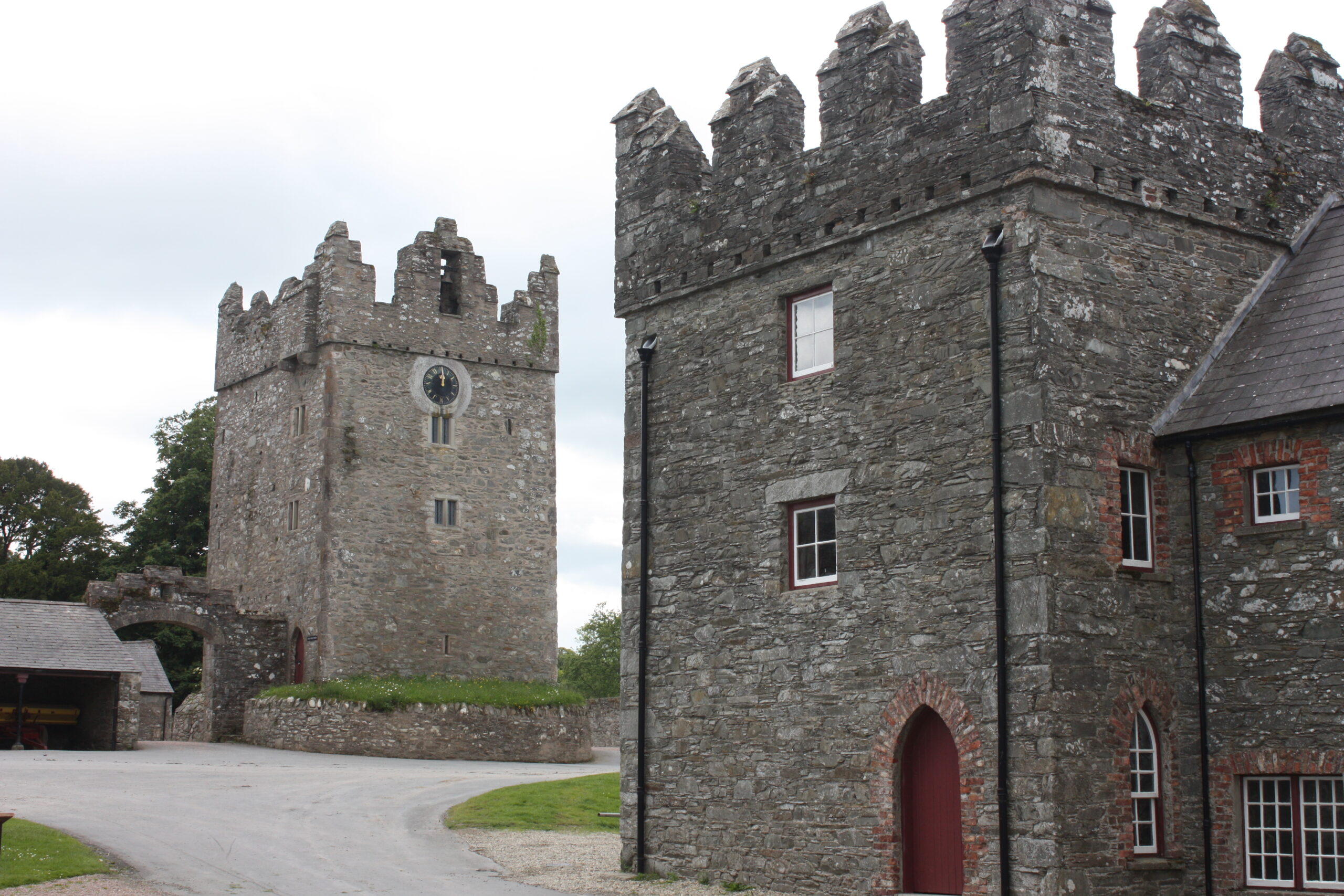
The Wards then built and rebuilt. Old Castle Ward, put up about 1590 near the lough, still stands. A mansion raised about 1720 by Judge Michael Ward was demolished about 1850, though some of its landscaping survives. In the estate’s farmyard there is a tower house built as a defensive structure in 1610 by Nicholas Ward, which is the oldest thing on the property a visitor is likely to walk into.
Palladian at the Front, Gothic at the Back: A Marriage in Stone
The house that dominates the estate today went up in the early 1760s for Judge Michael Ward’s son, Bernard. Its architect is unknown. He may have come from the Bristol area, with which the family had associations, and one candidate is James Bridges, who practised in Bristol between 1757 and 1763 and whose work there bears some similarity to Castle Ward.
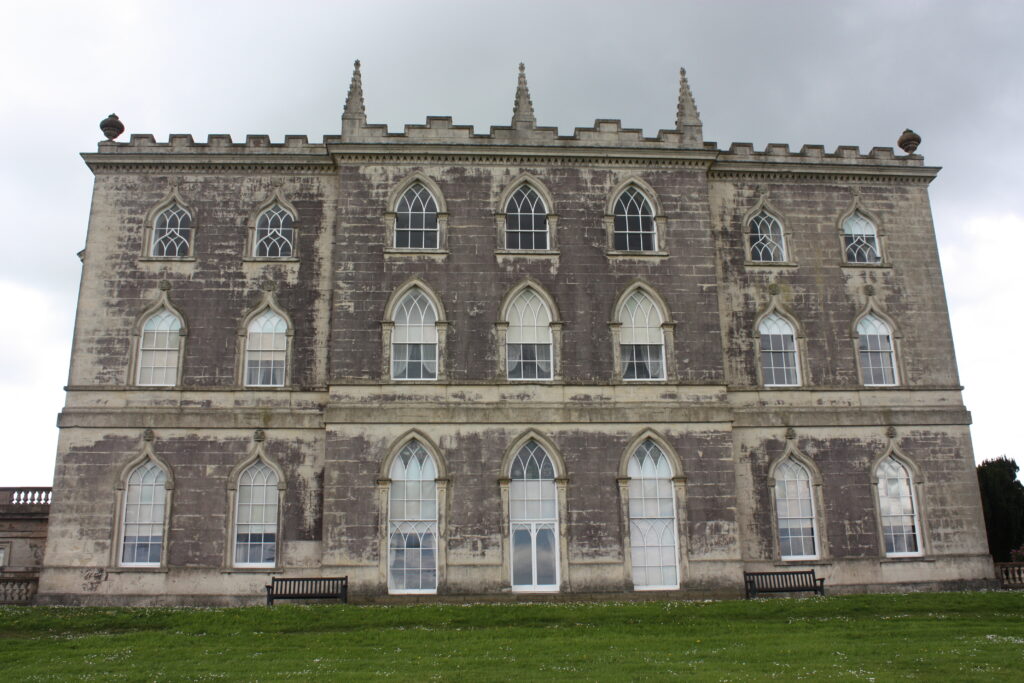
What makes the building famous is its double personality, traditionally read as the competing tastes of Bernard Ward, 1st Viscount Bangor, and his wife, Lady Ann Bligh. The entrance side is classical Palladian, columns holding up a triangular pediment. The opposite side is Georgian Gothic, with pointed windows, battlements and finials. The split runs straight through the interior, down the centre of the house. Bernard Ward himself was elevated to the Peerage of Ireland as 1st Baron Bangor in May 1770 and created 1st Viscount Bangor in January 1781.
The Insane 2nd Viscount and the Emptying of the House
The grimmest chapter here needs no ghost. Under a settlement made in 1748, the property passed in May 1781 to the 1st Viscount’s eldest son, Nicholas Ward, 2nd Viscount Bangor, who was clearly insane. When his younger brother Edward died in 1812, leaving a young son, the youngest brother Robert took his chance: he moved the insane Lord Bangor out to a smaller house in Downpatrick and stripped Castle Ward of everything valuable.
The house then stood empty. It stayed that way until the 2nd Viscount died in September 1827, when it was inherited by Edward’s son, another Edward, as 3rd Viscount. He and his descendants restored the building and its furnishings. On the death of Maxwell Ward, 6th Viscount Bangor, in 1950, house and estate went to the Government of Northern Ireland in lieu of death duties, and in 1952 the government presented the house and its gardens to the National Trust.
10 February 1973: The Bomb in the Grounds
The most recent violent death on the estate is a matter of record rather than folklore. On 10 February 1973, Leonard O’Hanlon, aged 23, and Vivienne Fitzsimmons, aged 17, both members of the Provisional Irish Republican Army, were killed when the bomb they had planted exploded prematurely in the grounds of the Castle Ward estate. Two people died on this land within the memory of people still living nearby, which is worth holding in mind before treating anything here as light entertainment.
What the Record Actually Says About Ghosts at Castle Ward
Very little, and it would be dishonest to pretend otherwise. The documented history of Castle Ward contains no catalogue of apparitions, no named resident spectre, no recorded sightings attached to a particular room or staircase. What it contains instead is the raw material that ghost stories are usually built from: a Jacobean defensive tower, a mansion demolished in the 1850s, a lunatic peer carried off to Downpatrick, a great house left dark and looted for fifteen years, and a fatal explosion in the grounds in 1973.
Add a globally recognised screen identity as Winterfell and the estate acquires an atmosphere that visitors are primed to interpret. If you hear a Castle Ward ghost story told locally or online, treat it as exactly that, a story, unless someone can show you where it came from. The history is dramatic enough without embellishment.
Visiting Castle Ward: Mills, Laundry and the Lough Shore
Castle Ward is open to the public, so this is one of the more straightforward places on this guide to see properly. The 332 hectares (820 acres) of landscaped gardens include a shore on Strangford Lough, and alongside the house you can take in the fortified tower house in the farmyard, the Victorian laundry, a theatre, a saw mill and a working corn mill. There is a restaurant and a shop for the practicalities.
It sits 7 miles from Downpatrick and 1.5 miles from Strangford village, which makes it an easy addition to a day on the Lecale coast. From 1985 to 2010 the estate also hosted Castleward Opera, an annual summer opera festival, now ended. Check National Trust opening arrangements before travelling, since the house and the outbuildings do not always keep the same hours as the grounds. Go for the architecture: standing at the junction where Palladian becomes Gothic is the single strangest experience the place reliably delivers.
Address: Castle Ward, Strangford, County Down, Northern Ireland
See Castle Ward for Yourself
Sources
- Dictionary of Irish Architects
- National Trust – Castle Ward
- Index of Deaths from the conflict in Northern Ireland
- GeoHack – Castle Ward
- Wikipedia: Castle Ward
Frequently Asked Questions
Where is Castle Ward Strangford County Down located?
Castle Ward Strangford County Down is located at Castle Ward, Strangford, County Down, Northern Ireland.
Can you visit Castle Ward Strangford County Down?
Castle Ward Strangford County Down is open to the public. Always follow posted rules and respect private property.
Reader sightings
Nobody has reported anything here yet. If you have been, you would be the first.
Report your own visit to The Mad Viscount and the Split House: Haunted Castle Ward
How haunted is this place?
Be the first to rate
Ghost Tours Nearby

Affiliate links: BeyondHaunted may earn a commission, at no extra cost to you.

Leave a Reply