

Reviewed by Josh N · Updated October 3, 2026 · How we verify
Reported Phenomena
- Apparition in green dress
- Blue bottle sighting
- Unexplained technical faults
- Backstage sightings
Reported by visitors & local legend. Stories, not verified claims.
Olive Thomas worked the roof of this building before she worked the screen, and the New Amsterdam Theatre ghost that Broadway people have talked about for a century is said to be her. The theater stands at 214 West 42nd Street in New York, the oldest operating Broadway house in the city, and the woman whose name gets called out at the end of a shift there died in a Paris hospital in 1920 at the age of 25. The history is well documented. The haunting is not: it is a legend that grew in the years after her death, kept alive by staff tradition, press coverage, and a steady trickle of sightings that nobody has ever verified.
Quick Facts on the New Amsterdam
- Opened: 1903, designed by the architects Herts and Tallant
- Nickname: “The House Beautiful,” for its Art Nouveau interior and Beaux-Arts exterior
- Home of: the Ziegfeld Follies, 1913 to 1927
- Converted to film: 1937, with decline through the 1970s
- Restored: by Disney Theatrical Productions, reopening in 1997 after a two-year, $36 million project
- Reported ghost: Olive Thomas, born Olive R. Duffy, October 20, 1894, died September 10, 1920
The House Beautiful and the Room Above It
When the New Amsterdam opened in 1903 it was a showpiece of engineering as well as decoration, fitted with modern systems for heating, air filtration and even vacuum cleaning. Between 1913 and 1927 it became the home of the Ziegfeld Follies, the lavish revues that defined Broadway spectacle in the era of elaborate sets and expensive costumes.
The part of the building that matters most to this story is the roof garden. Florenz Ziegfeld staged a second, more risque show up there called The Midnight Frolic, which ran after hours and was aimed squarely at wealthy male patrons with money to spend on the young women performing for them. Olive Thomas, whose popularity in the Follies got her cast in the Frolic, worked that room. Her admirers sent gifts. One rumor of the day held that the German ambassador Albrecht von Bernstorff had given her a string of pearls worth $10,000.
The theater’s fortunes fell with the street around it. By 1937 it had switched from live performance to film screenings, and by the 1970s both the building and 42nd Street were in bad shape. Disney Theatrical Productions took on the restoration in the mid-1990s, and the reopening in 1997 is usually credited as a turning point in the broader revival of Times Square. The house has since carried The Lion King, Mary Poppins and Aladdin.
Who Olive Thomas Actually Was
She was born in Charleroi, Pennsylvania, the middle of three children. After her father’s death the family moved to the mill town of McKees Rocks, and her mother worked in a local factory while Olive and her brothers often stayed with their grandparents. She left school at 15 to help support her siblings and took a job selling gingham at Joseph Horne’s department store for $2.75 a week. At 16, in April 1911, she married Bernard Krug Thomas in McKees Rocks. They separated in 1913 and she moved to New York City.
In 1914 she entered and won a “Most Beautiful Girl in New York City” contest run by the commercial artist Howard Chandler Christy, which launched her as an artists’ model. She posed for Harrison Fisher, Raphael Kirchner, Penrhyn Stanlaws and Haskell Coffin, and appeared on magazine covers including the Saturday Evening Post. Fisher wrote her a letter of recommendation to Ziegfeld, though Thomas later disputed that version and said she “walked right up and asked for the job.” She made her stage debut in the Ziegfeld Follies of 1915 on June 21, 1915.
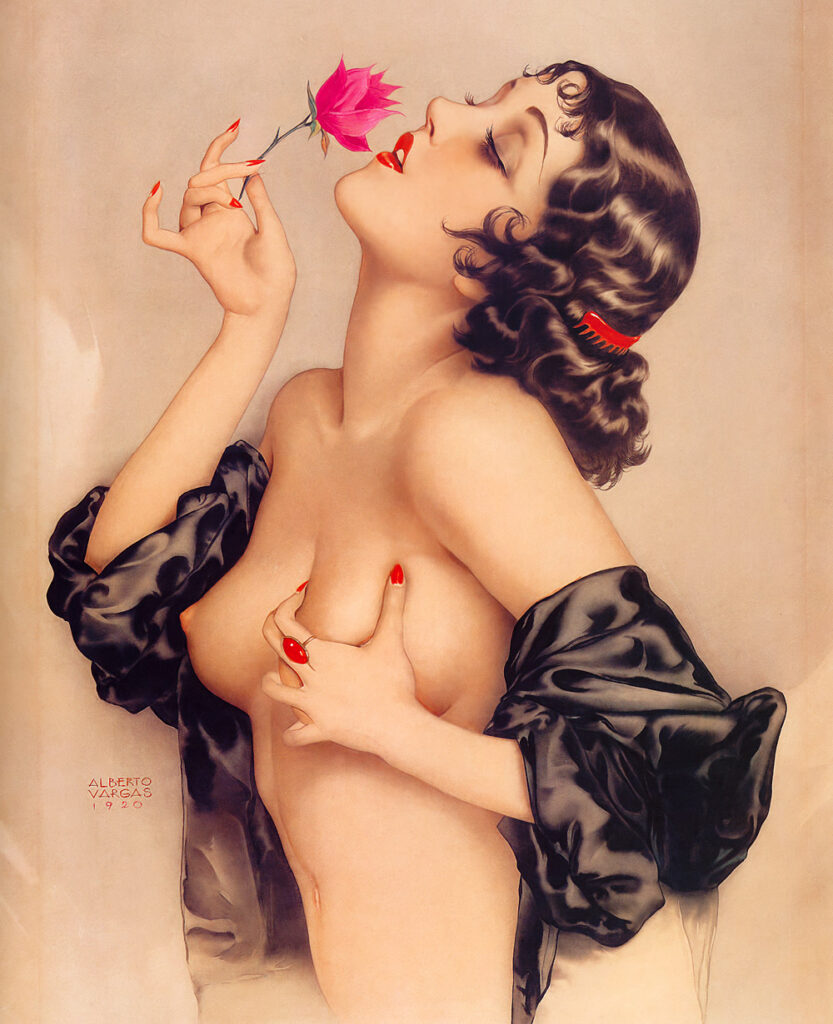
She had an affair with Ziegfeld, who was married to the actress Billie Burke, and ended it when he refused to leave Burke. From 1916 she built a film career that ran to more than 20 features in four years, including Upstairs and Down, Toton the Apache and The Flapper, in which she became the first actress to play a lead character who was a flapper. Alberto Vargas, Ziegfeld’s artist in residence, called her “one of the most beautiful brunettes that Ziegfeld ever glorified” and painted her from memory after she died.
On October 25, 1916, she eloped with the actor Jack Pickford, younger brother of Mary Pickford, in New Jersey, with the actor Thomas Meighan as their only witness. Mary Pickford later wrote that the family did not approve at the time, and added that “I could understand why Florenz Ziegfeld never forgave Jack for taking her away from the Follies.”
Five Days in Neuilly: The Death That Made the Legend
In August 1920 Thomas and Pickford traveled to Paris on what was meant to be a second honeymoon. On the night of September 5, 1920, they were out in the bistros of the Montparnasse Quarter and returned to their suite at the Hotel Ritz around 3 a.m. Thomas, intoxicated and exhausted, swallowed a mercury bichloride solution. Accounts vary, but authorities speculated she believed the flask held drinking water or a sleeping tonic, and the label was in French. She was taken to the American Hospital in Neuilly-sur-Seine and died there five days later, at 11:00 AM on September 10, 1920, of acute nephritis caused by the mercury.
The press filled the five days with rumor: suicide after a fight, suicide after a syphilis diagnosis, drug addiction, orgies, even a claim that Pickford had tricked her into drinking poison for insurance money. Pickford denied all of it, telling the Los Angeles Herald-Examiner on September 13, 1920, “She took the poison by mistake.” Her death was ruled accidental that same day by the Paris physician who performed the autopsy. It is remembered as one of the first great Hollywood scandals.
Pickford brought her body home. An Episcopal service was held at St. Thomas Episcopal Church in New York City on September 29, 1920, and according to The New York Times police escorts were needed: hundreds of actors and onlookers crowded in, several women fainted, and men had their hats crushed in the rush to see the casket. She is interred in a crypt at Woodlawn Cemetery in the Bronx. Her estate, valued at $27,644, was split between her mother, her two brothers and Pickford, who gave his share to her mother.
The Green Dress and the Blue Bottle
The ghost story did not arrive with the funeral. It accumulated in the years that followed, and the New Amsterdam is the building it attached itself to, presumably because of those late nights in the roof garden.
What staff and performers describe is remarkably consistent, which is either evidence of something or evidence of a well-rehearsed story. She is reported walking the building in a beaded green dress, carrying a blue bottle, the image people associate with her Follies period. The habit among workers is to say goodnight to her out loud before locking up. Technical faults in the house are sometimes blamed on her, half seriously. Playbill has called her Broadway’s most mentioned ghost, and NY1 has covered the legend as part of the theater’s working culture.
None of this is documented activity. There is no record of Olive Thomas dying in or near the theater, and her death happened in a hospital on the outskirts of Paris. Treat the sightings as a tradition the building maintains about one of its own rather than as an event anyone can confirm.
Her afterlife in print and on stage has helped. Sarah J. Baker’s documentary Olive Thomas: Everybody’s Sweetheart premiered in 2004, Michelle Vogel published a biography in 2007, and the musical Ghostlight, about her life, opened at the Signature Theatre in New York City on September 26, 2011 as part of the New York Musical Theatre Festival. Laini Giles’s 2015 novel The Forgotten Flapper is narrated by Thomas’s ghost, haunting the New Amsterdam.
Seeing the New Amsterdam Theatre for Yourself
This is a working Broadway house, not a site you wander into. Most people experience it by buying a ticket to whatever Disney production is running, and the interior is worth the price on its own: the restoration brought back the decorative scheme that earned the building its nickname. Tours are offered only occasionally, so check ahead rather than turning up expecting one.
The building is private property and the backstage areas where the sightings are reported are not open to the public. Do not attempt to access closed parts of the theater. If you want the rest of the story in physical form, Thomas’s crypt is at Woodlawn Cemetery in the Bronx, a long way uptown from the roof where she worked.
Sources
- Olive Thomas: The Life and Death of a Silent Film Beauty
- Olive Thomas, the original 'Flapper' and a Mon Valley native, still fascinates
- The Life and Death of Olive Thomas (Asu (official site))
- The Mysterious Death of Olive Thomas
- Women Faint At Olive Thomas Rite
- Wikipedia: Olive Thomas
Frequently Asked Questions
Where is The Haunted History Of The New Amsterdam Theatre located?
The Haunted History Of The New Amsterdam Theatre is located at 214 West 42nd Street, Manhattan, New York, NY 10036.
Can you visit The Haunted History Of The New Amsterdam Theatre?
The Haunted History Of The New Amsterdam Theatre is open to the public. Always follow posted rules and respect private property.
Reader sightings
Nobody has reported anything here yet. If you have been, you would be the first.
Report your own visit to Goodnight, Olive: The New Amsterdam Theatre Ghost on 42nd Street
How haunted is this place?
Be the first to rate
Ghost Tours Nearby
 NYC Gangsters and Ghosts Walking Tourfrom $35
 New York City Ghost Tour of Greenwich Villagefrom $39
 Roosevelt Island Tramway and Self Guided History Tourfrom $10
Affiliate links: BeyondHaunted may earn a commission, at no extra cost to you.



Leave a Reply