
Reviewed by Josh N · Updated August 27, 2026 · How we verify
Reported Phenomena
- Joc-O-Sot apparition
- Phantom marching sounds
- Shadow figures
- Disembodied whispers
- Sudden cold spots
- Electromagnetic anomalies
Reported by visitors & local legend. Stories, not verified claims.
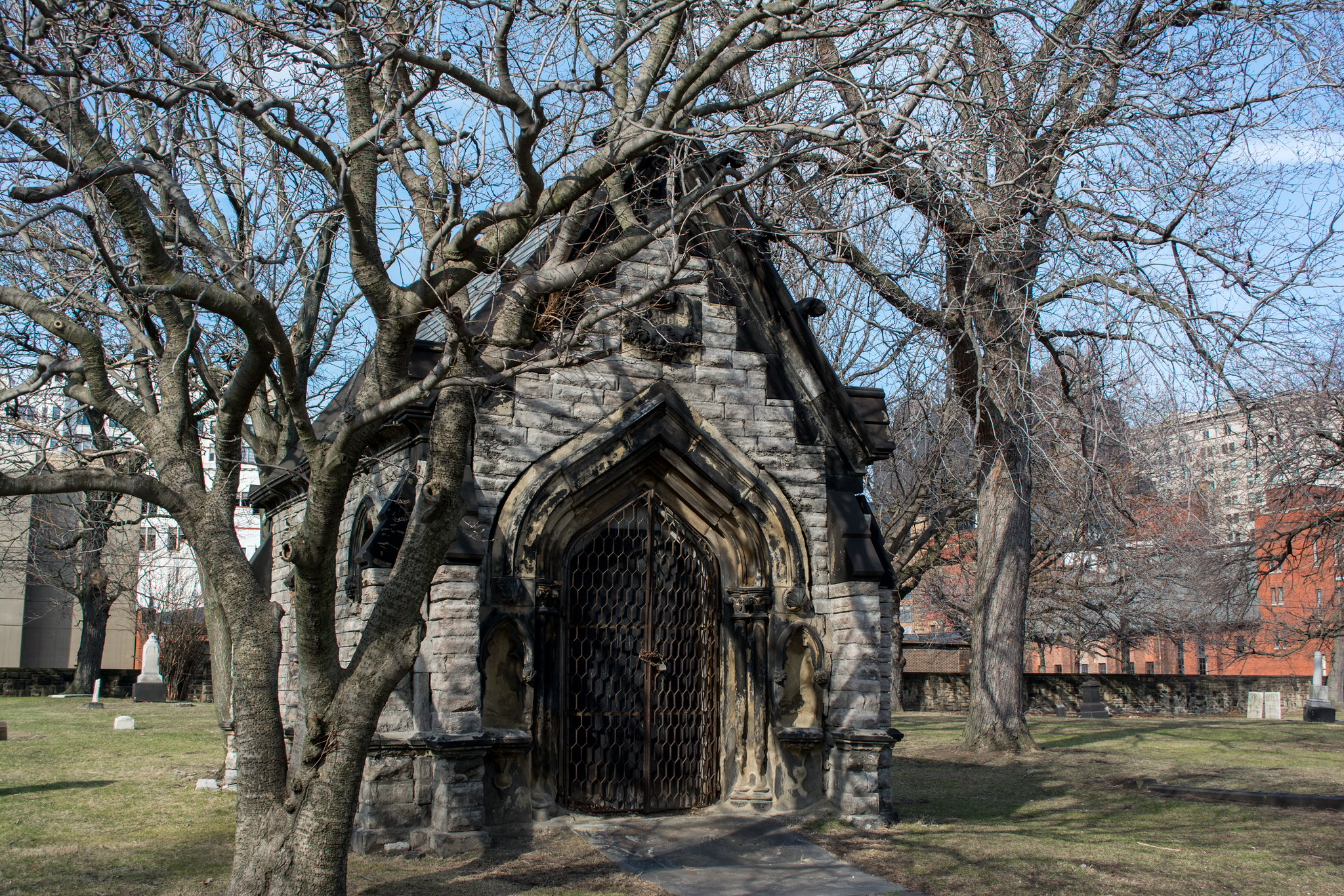
Erie Street Cemetery sits in a hollow of downtown Cleveland, Ohio, hemmed in by parking decks, a stadium crowd on game nights, and a bridge approach that was deliberately curved to avoid it. It is the oldest surviving cemetery in the city, and it has spent most of its existence being encroached upon, argued over, and defended. That long fight to stay in the ground is the real story here. The ghost stories, and there are several, grew up in its shadow.
Erie Street Cemetery at a Glance
- Established: 1826, at what was then the edge of Cleveland
- Name: taken from the original name of East 9th Street
- Size: roughly nine acres in Downtown Cleveland
- Interments: more than 17,000
- Status: Cleveland City Landmark, official Ohio historical site since October 2009, and listed on the National Register of Historic Places as the Erie Street Cemetery Historic District on September 16, 2024
- Access: open burial ground, daylight visiting
Cleveland’s First Permanent Burial Ground
When the cemetery opened in 1826 it replaced a community burial ground that had sat just south of Public Square. It was the city’s first permanent cemetery and it was open to members of all faiths, which in 1820s Ohio was not a given. At the time it stood on the outskirts of town. The town then spent two centuries growing around it.
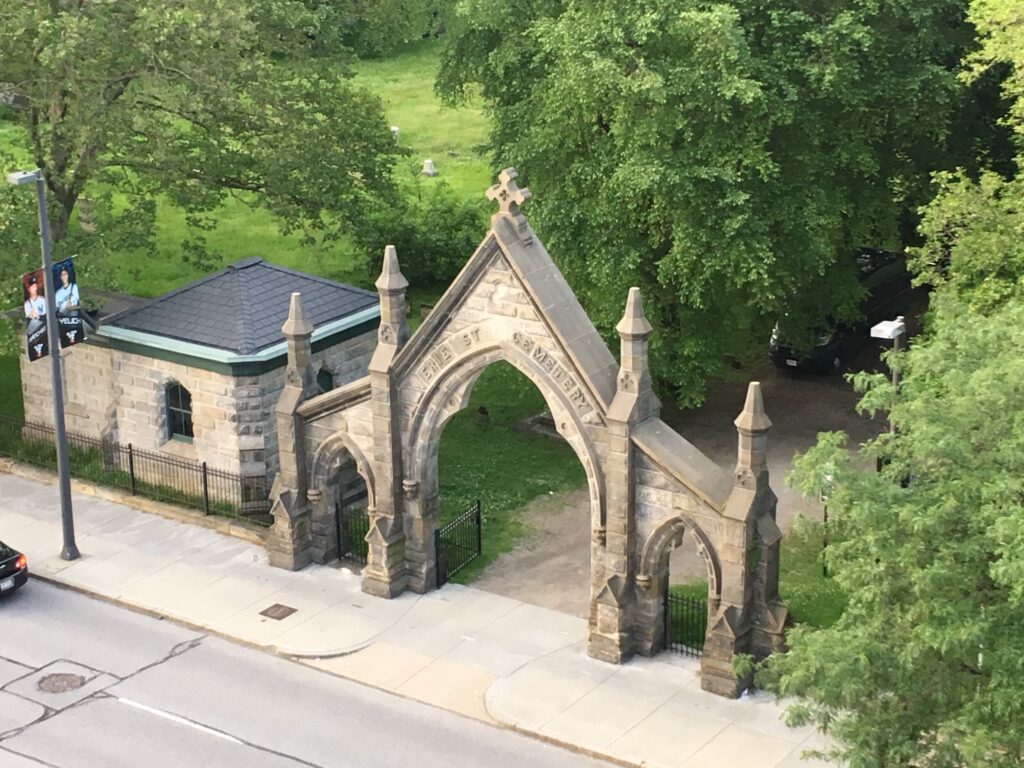
The people buried here are, in effect, the founding roster of Cleveland. Lorenzo Carter, recorded as the city’s first permanent white settler and an early community leader, lies here. So does John W. Willey, Cleveland’s first mayor, who served from 1836 to 1837. David Eldridge, described as the first person of European descent to die in the Western Reserve, is buried here as well. Among the more than 17,000 interments are veterans of conflicts running from the Revolutionary War through the Spanish-American War, a span of American military history rare in a single small plot.
Mayors, Philanthropists and Missing Remains
Several of the cemetery’s most cited residents are no longer physically present, which is worth knowing before you go hunting for a specific stone. Leonard Case Jr., the philanthropist who gave his name to the Case Institute of Technology, was removed to Lake View Cemetery, though his headstone remains at Erie Street. The same is true of Willey. Lorenzo A. Kelsey, mayor in 1848, was also moved to Lake View, and George Hoadley, mayor in 1846, was reinterred at Highland Park Cemetery in Highland Hills.
Others remain. John W. Allen, a lawyer and politician who served as Mayor of Cleveland from 1841 to 1843, is buried here. So are Joshua Mills, a physician who was mayor from 1838 to 1839 and again in 1842; Josiah A. Harris, mayor in 1847; and Jabez W. Fitch, Lieutenant Governor of Ohio from 1878 to 1880. Also interred is Joc-O-Sot, a Meskwaki chief who died in 1844 and who is, by a wide margin, the figure most often attached to the cemetery’s ghost stories.
The Bridge That Was Built Around the Graves
The cemetery came close to disappearing. During the administration of Mayor Tom L. Johnson in the early twentieth century, bodies were moved out of Erie Street to the municipally owned Highland Park Cemetery, and parts of the grounds were vacated outright to make way for city streets. That is the origin of the removals listed above and of the cemetery’s odd, clipped footprint.
Resistance organized in 1915 with the founding of the Pioneers’ Memorial Association, formed specifically to advocate for the burial ground. The decisive moment came a decade later. In 1925, City Manager William R. Hopkins decided to route the Lorain-Carnegie Bridge around the cemetery rather than through it, and the site’s future was effectively secured. Later upkeep came from outside as much as from City Hall: improvements and maintenance have been carried out by groups including the Works Progress Administration and the Cleveland Grays. More recently, honors students at Cuyahoga Community College have researched the lives of people buried here.
What Visitors Report Among the Stones
Everything in this section is reported experience rather than documented event. There is no official record of anything unexplained at Erie Street Cemetery, and no investigation has produced a verified result. What exists is a long-running body of visitor and ghost hunter testimony, most of it circling the same few claims.
- Joc-O-Sot. The Meskwaki chief’s grave is the focus of the cemetery’s best known legend. Witnesses describe an apparition in traditional attire near the stone, and the marker’s cracked, weathered condition has long been folded into the telling as evidence of a burial that never settled. The Black Hawk War connection often repeated locally belongs to the legend as it is told, not to the cemetery’s documentary record.
- Phantom military sounds. Given a burial ground holding veterans from the Revolutionary War through the Spanish-American War, it is unsurprising that visitors report marching footsteps and distant shouting after dark. Downtown Cleveland is a noisy place, and the cemetery sits beside a bridge approach.
- Shadow figures and cold spots. Dark shapes moving between monuments, whispering with no visible source, and sudden temperature drops are all reported.
- Equipment anomalies. Ghost hunting groups cite unusual electromagnetic readings here. In a downtown plot ringed by traffic, power infrastructure and iron fencing, that proves considerably less than it sounds.
Visiting Erie Street Cemetery
This is an active historic cemetery in the middle of a working downtown, not an attraction, and it is best approached in daylight. The rewards of a daytime visit are genuine: pioneer-era stones, a run of nineteenth century mayors, veterans’ markers spanning four wars, and the visible evidence of a burial ground that was carved into by street projects and then saved by a bridge engineer’s decision. Note that several headstones, including Willey’s and Case’s, mark people whose remains were relocated elsewhere.
Read the marker recording the Ohio historical designation and the City Landmark status before you leave; they explain more about why the place still exists than any night visit will. If you come hoping for the reported activity, expect nothing sustained. The accounts describe glimpses and sounds, not encounters. Stay on the paths, disturb nothing, and treat the stones as the point of the trip.
Sources
- Erie Street Cemetery
- Erie Street Cemetery (Case (official site))
- Cuyahoga Community College honors students want to breathe new life into Cleveland's Erie Street Cemetery
- Loc (official)
- Wikipedia: Erie Street Cemetery
Address: 2254 East 9th Street
Frequently Asked Questions
Where is Erie Street Cemetery located?
Erie Street Cemetery is located at 2254 East 9th Street.
Can you visit Erie Street Cemetery?
Erie Street Cemetery is open to the public. Always follow posted rules and respect private property.
Reader sightings
Nobody has reported anything here yet. If you have been, you would be the first.
Report your own visit to Joc-O-Sot’s Cracked Stone: Erie Street Cemetery, Cleveland
How haunted is this place?
Be the first to rate
Ghost Tours Nearby
 Phantom's Parade on Prospect: Cleveland Ghost Toursfrom $26
 Buckland Museum of Witchcraft and Magick- Cleveland – Admissionfrom $10
Affiliate links: BeyondHaunted may earn a commission, at no extra cost to you.
Leave a Reply