
Reviewed by Josh N · Updated August 27, 2026 · How we verify
Reported Phenomena
- Lady in Pink apparition
- Phantom orchestra music
- Disembodied weeping
- Shadow movement
- Sudden cold drafts
- Unexplained sounds
Reported by visitors & local legend. Stories, not verified claims.
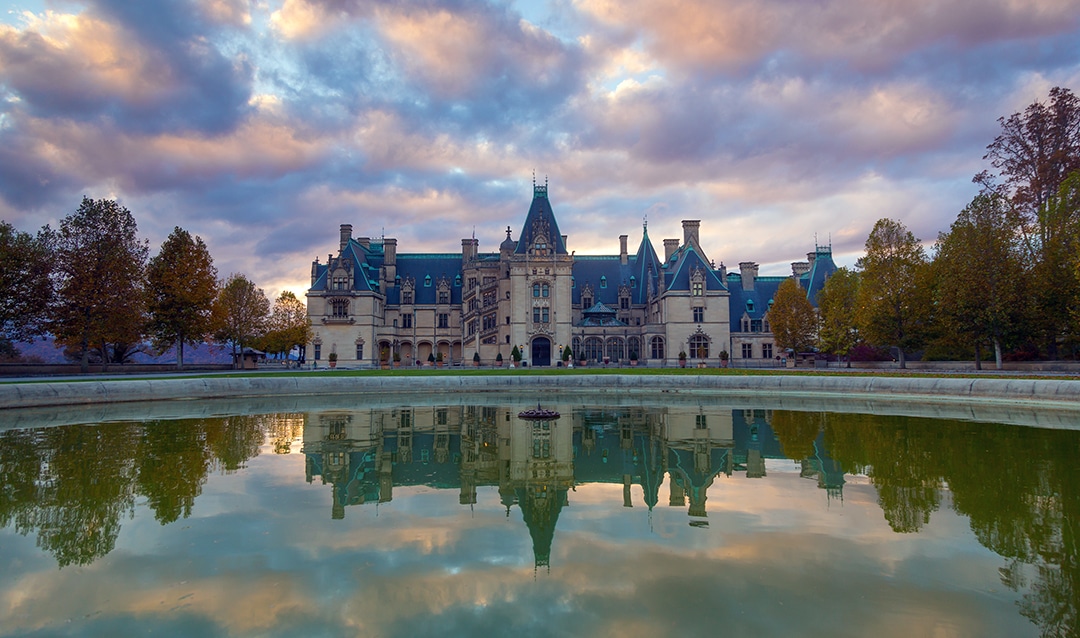
Ask about Biltmore Estate ghosts in Asheville and you get a short list of stories that circulate among visitors and tour-goers rather than anything the estate’s own documented history records: a woman in a pink gown, music with no musicians, a weeping voice in the corridors. What is beyond dispute is the setting. The house George Washington Vanderbilt II built in the mountains of North Carolina is the largest privately owned home in the United States, 250 rooms of French Renaissance ambition dropped into the Blue Ridge, and it is still owned by his descendants. A building that size generates noise, draughts and reflections on its own. Whether it generates anything else is the question people keep bringing back down the four-mile drive.
Biltmore by the Numbers
- Built for George Washington Vanderbilt II between 1889 and 1895, in Chateauesque style, by architect Richard Morris Hunt
- 178,926 square feet of floor space, 250 rooms, 35 bedrooms, 43 bathrooms, 65 fireplaces, 16 chimneys
- Opened to family and friends on Christmas Eve 1895 at a reported cost of about $5 million
- Grounds originally 125,000 acres, today roughly 8,000 acres bisected by the French Broad River
- Designated a National Historic Landmark in 1963; around 1.4 million visitors a year
The “Little Mountain Escape” That Swallowed 700 Parcels of Land
Vanderbilt began visiting the Asheville area in the 1880s with his mother, Maria Louisa Kissam Vanderbilt, and liked the scenery and climate enough to plan a summer house he called his “little mountain escape.” His siblings had already built at Newport, on the Gold Coast of Long Island and at Hyde Park. He went further inland and much, much bigger.
The name is a construction: De Bilt, his ancestors’ place of origin in the Netherlands, joined to more, meaning open rolling land. To assemble the setting he bought nearly 700 separate parcels totalling 125,000 acres, including more than 50 farms and at least five cemeteries. Part of the land had been the community of Shiloh. An estate spokesman later said much of the ground had been “in very poor condition, and many of the farmers and other landowners were glad to sell.” That detail matters to anyone interested in the folklore here: whatever else Biltmore is, it is a mansion standing on ground that used to belong to a great many other people, and on land that included burial grounds.
Construction started in 1889 and required roughly 1,000 workers and 60 stonemasons, a woodworking factory and brick kiln built on site, and a three-mile railroad spur to haul materials in. Vanderbilt travelled overseas repeatedly to buy tapestries, carpets, prints and decorative objects dating from the fifteenth century onward. Frederick Law Olmsted laid out the grounds, unimpressed with the state of the land and recommending a park near the house, farms along the river, and commercial timber forest beyond.
Deaths, Departures and a House That Stopped Being a Home
The human history of Biltmore is not tragic in the usual haunted-house sense, but it is full of endings. Vanderbilt married Edith Stuyvesant Dresser in Paris in 1898. Their only child, Cornelia, was born at Biltmore in the Louis XV Room in 1900 and grew up on the estate. In 1914 Vanderbilt died unexpectedly of complications from an emergency appendectomy, having already begun selling 87,000 acres to the federal government under the pressure of income tax and ruinous upkeep. Edith completed the sale, and that land became the nucleus of the Pisgah National Forest.
Edith lived intermittently in an apartment created in the former Bachelors’ Wing until Cornelia married John Francis Amherst Cecil in April 1924. The Cecils’ two sons were born at Biltmore in the same room where their mother had been born. In March 1930, at the request of the City of Asheville, the couple opened the house to the public to shore up its finances during the Great Depression.
Then the departures. The Cecils divorced in 1934 and Cornelia left the estate never to return. John Cecil kept his residence in the Bachelors’ Wing until his death there in 1954. Their eldest son occupied rooms in the wing until 1956, at which point Biltmore House ceased to be a family residence and became a historic house museum. The house closed entirely from 1941 to 1945, and in 1942 it took in 62 paintings and 17 sculptures shipped by train from the National Gallery of Art in Washington for safekeeping, among them Gilbert Stuart’s portrait of George Washington and works by Rembrandt, Raphael and Anthony van Dyck. They were stored in the Music Room, which had been left unfinished with bare brick walls and was not completed and opened to the public until 1976.
The Lady in Pink and the Music Nobody Plays
None of the following is documented history. These are stories told and retold by visitors and repeated in local ghost lore, without a verified origin, a named witness or a record of the death that would explain them. Read them as folklore attached to a famous building.
The best known is the Lady in Pink, described as a figure in a flowing pink gown moving through the halls and upper rooms, usually explained in the telling as a woman searching for a lost love. No one names her, and no incident in the estate’s recorded history corresponds to the tale.
The second recurring account is music: a spectral orchestra or the sound of a party carrying through the Banquet Hall, the largest room in the house at 42 by 72 feet with a barrel-vaulted ceiling 70 feet high, a table that seats 64, and an organ gallery holding a 1916 Skinner pipe organ. A room built to amplify a dinner for 64 people will do interesting things with a distant voice or a heating system, which is worth remembering before reaching for the supernatural.
The third is a weeping woman, heard rather than seen, sobbing somewhere along the corridors. Beyond the named figures, visitors and staff have reported the standard vocabulary of a large old building: movement at the edge of vision, unexplained sounds, sudden cold draughts. Biltmore has 65 fireplaces, 16 chimneys, an interior divided into six sections by brick fire walls, three kitchens, and the largest basement in the country containing laundries, a heated 70,000-gallon swimming pool and servants’ quarters. It also contains a concealed passageway off the two-story Library leading to the guest rooms, and secret door panels beside the Billiard Room fireplace that opened into the Bachelors’ Wing, where female guests and staff were not permitted. Hidden doors in a house this size are not evidence of a haunting, but they explain a good deal about why the place feels as though it is keeping something back.
Visiting Biltmore Estate
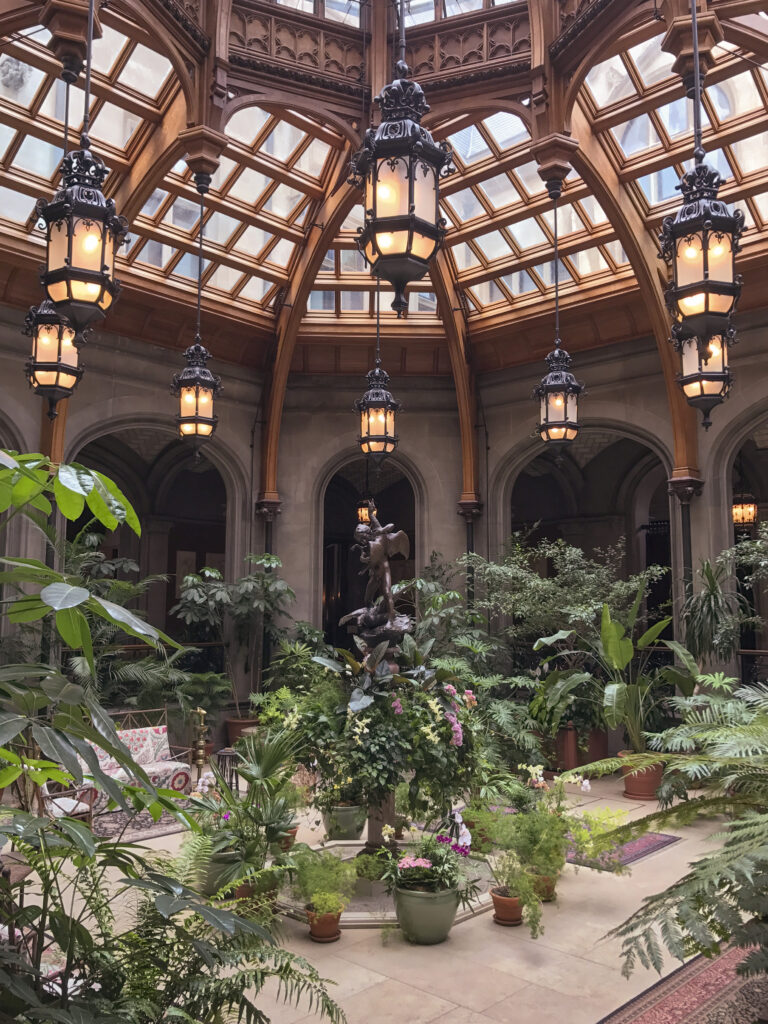
Biltmore is a fully commercial operation and one of the largest employers in the Asheville area, overseen by The Biltmore Company, a family trust. That means a visit is a daytime, ticketed, well-signed experience rather than a night vigil. The house tour takes in the marbled Entrance Hall, the sunken octagonal Winter Garden with Karl Bitter’s Boy Stealing Geese fountain, the Banquet Hall, the Tapestry Gallery, the Library with its 10,000 volumes in eight languages, and the cantilevered Grand Staircase of 107 steps winding around a four-story chandelier of 72 bulbs. The Louis XV Room suite was restored and opened to the public for the first time in a century in 2011.
Outside, Olmsted’s 75 acres of formal gardens, the conservatory, the Bass Pond and the Lagoon are all walkable, and the estate’s approach road was deliberately planted to look rustic and unkempt so that arriving guests would relax before the house appeared. Antler Hill Village opened in 2010 with shops, restaurants and the winery, which was converted from the former dairy barn in 1985. If you want to stay on the grounds, the 210-room Inn on Biltmore Estate opened in 2001 and the more casual 209-room Village Hotel followed in 2015.
One practical note: the estate closed temporarily after Hurricane Helene struck in September 2024. The group sales office was destroyed, but Biltmore House, the conservatory and several other structures came through without serious damage, and the estate reopened in November 2024, with its operators pledging $2 million toward recovery efforts in Western North Carolina. Check current conditions before travelling.
Go for the architecture, the Vanderbilt story and the gardens, all of which are documented and extraordinary. If you also want the ghost stories, bring them with you, because the house itself offers no evidence for them.
See Biltmore Estate for Yourself
Sources
- The Adirondack Park: a political history
- Biltmore Estate (Bluffton (official site))
- The Vanderbilt Family
- Answer Man: Cemeteries on Biltmore Estate? Who lived there before Vanderbilts?
- Biltmore House
- Wikipedia: Biltmore Estate
Address: 1 Lodge Street
Frequently Asked Questions
Where is Biltmore Estate located?
Biltmore Estate is located at 1 Lodge Street.
Can you visit Biltmore Estate?
Biltmore Estate is a place where you can stay overnight. Always follow posted rules and respect private property.
Reader sightings
Nobody has reported anything here yet. If you have been, you would be the first.
Report your own visit to Biltmore Estate Ghosts: the Lady in Pink and the Music Room
How haunted is this place?
Be the first to rate
Ghost Tours Nearby
 Adult Comedy Ghost Tour Ghosted by LaZoomfrom $44
 Asheville Night-Time Walking Ghost Tourfrom $27
 The Asheville Abyss Ghost Tour: Ashes to Apparitionsfrom $26
Affiliate links: BeyondHaunted may earn a commission, at no extra cost to you.
Nearby Haunted Locations
- 1Grove Park InnNorth Carolina3.7mi
- 2Paint Rock Pictographs and the Singing in the WoodsNorth Carolina32mi
- 3The 1922 Telescope That Explained the Brown Mountain LightsNorth Carolina46mi
- 4Ghosts of the Greenville Tuberculosis HospitalSouth Carolina47mi
- 5Hells GateSouth Carolina55mi
- 6Rowena and the Black DogTennessee68mi
Leave a Reply