

Reviewed by Josh N · Updated September 30, 2026 · How we verify
Reported Phenomena
- Woman's laughter in trees
- Feeling of being watched
- Unexplained sounds
- Figures among the boulders
Reported by visitors & local legend. Stories, not verified claims.
Two towns share the woods where the abandoned village of Dogtown once stood. The site sits inland on Cape Ann in Massachusetts, split between the city of Gloucester and the town of Rockport, and what remains of it is a grid of moss-filled cellar holes, cart roads that go nowhere useful, and house-sized granite boulders. No one has lived here since the 1820s. The stories, though, kept moving in long after the last family moved out.
Quick Orientation to Dogtown Common
- Also called Dogtown Commons, Dogtown Common, or Dogtown Village; originally known as the Common Settlement.
- First settled in 1693, abandoned by 1828, with the last structure razed in 1845.
- Grew to roughly 5 square miles, with an estimated 60 to 80 homes at its peak.
- Most of the land is held in trust by Gloucester and Rockport and is protected in perpetuity.
- Open to hikers, bikers, dog-walkers, cross-country skiers, geologists, and historians.
From Common Settlement to a Hundred Families
Settlers came inland in 1693 for a practical reason: distance. The interior of Cape Ann offered protection from pirates and from unfriendly natives, and the high ground had been used as common land for wood and for pasturing cattle and sheep. By the early 1700s that common land was opened up to individual settlement, and the village filled in. By the middle of the century as many as 100 families lived in Dogtown, and the settlement stayed stable until after the American Revolution.
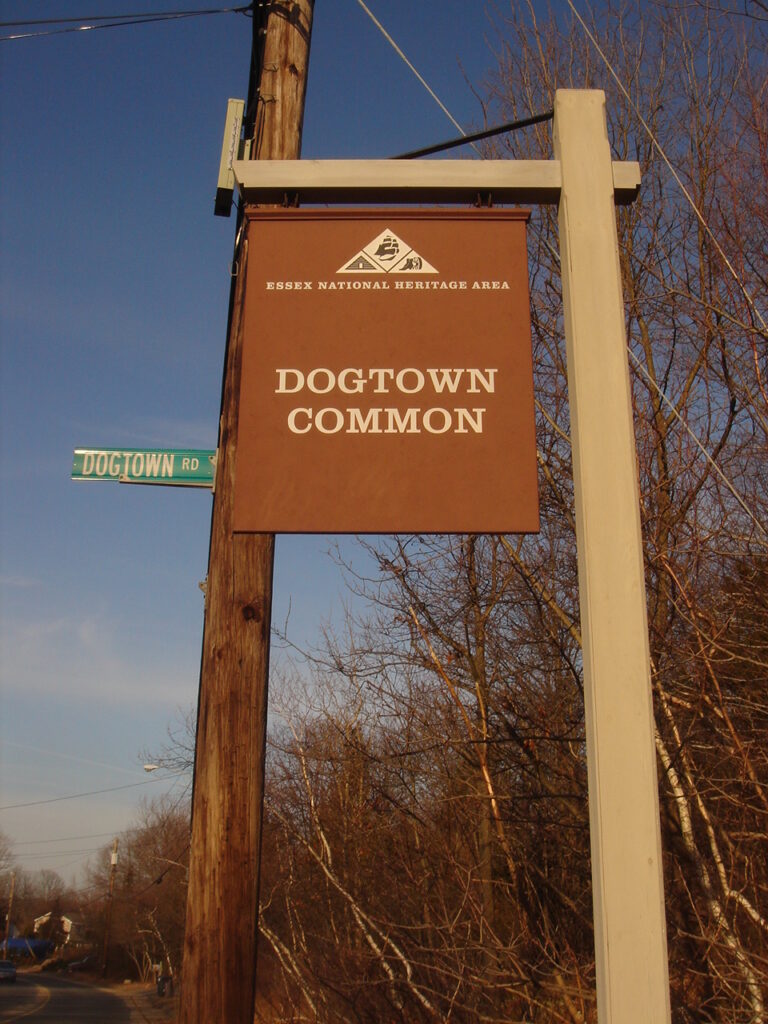
The name itself is unsettled. According to legend it comes from dogs that women kept for protection while their husbands were away fighting in the Revolution. That legend arrives eighty years after the first settlers did, which is worth noticing. A second explanation is grimmer and fits the end of the story better: as the last inhabitants died, their pets went feral and stayed on among the empty houses.
Why Dogtown Emptied Out
Nothing dramatic killed Dogtown. Economics did. When the Revolution ended, the waters around Cape Ann were safe from enemy ships again, cargo could move freely, and the fishing industry out of Gloucester Harbor revived. That success opened into international shipping, timber, and quarried rock, all of it happening down at the water rather than up in the woods. New coastal roads were built that ran past the old village toward a booming Gloucester, and the inland settlement lost its reason to exist.
Most of the farmers had moved away by the end of the War of 1812, when the village had become a risk for coastal bombardment. What remained was a place with a dwindling reputation, an embarrassment to its neighbors, occupied by people who had nowhere better to be.
Tammy Younger, “Queen of the Witches”
Some of the last occupants of Dogtown were suspected of practicing witchcraft, and that suspicion is the root of nearly every ghost story attached to the place today. The best known of them was Thomazine “Tammy” Younger, described by writer Thomas Dresser as the “Queen of the Witches.” By the accounts that survive, she intimidated people passing her house so thoroughly that they handed over fish and corn simply to be allowed through. Whether that is witchcraft or an effective toll operation is left to the reader.
Another reputed witch often attached to Dogtown, a woman named Peg Wesson, did not actually live there. She lived in Gloucester. The conflation is a good example of how the village became a magnet for any local story that needed somewhere eerie to happen.
Black Neil, the Last Resident
By 1828 the village was all but abandoned. The final resident was a freedman named Cornelius “Black Neil” Finson, who was found in 1830 living in a cellar hole with his feet frozen. He was removed from Dogtown and taken to a poor house in Gloucester. Fifteen years later the last standing structure was razed.
The land did not immediately return to wilderness. Cleared open field studded with boulders made decent pasture, and nearby residents grazed animals in private lots there into the 1920s, when the last plots were given up. The dense forest walkers move through now grew in during the decades after that.
Roger Babson’s Carved Boulders
The strangest feature of Dogtown is not a ruin at all. During the Great Depression, Roger Babson, grandson of Gloucester historian John J. Babson, paid unemployed stonecutters to carve inspirational inscriptions into 36 boulders scattered through the woods. He also mapped and numbered the cellar holes left by the village’s former residents, which is why the holes along Dogtown Road off Cherry Street on the Gloucester side still carry numbers corresponding to names in his grandfather’s history of the town.
The area is peppered with house-sized boulders. One, called the Whale’s Jaw, genuinely resembled one until a picnic campfire got out of control in 1989 and the formation collapsed. The northwest corner of Dogtown is the Norton Memorial Forest, 121 acres named for Frederick Norton, a NASA physicist and MIT professor whose family owned land at the edge of the settlement. Beginning in the 1930s he planted more than 100,000 trees and forty different species of ferns there and cut and maintained trails.
What People Report in the Dogtown Woods
None of what follows is documented. It is anecdotal, passed along by hikers and paranormal enthusiasts, and there is no verified record of anything supernatural occurring in Dogtown.
The most commonly repeated account is the sound of a woman laughing somewhere among the trees with no one visible. Visitors also describe unexplained noises, brief glimpses of figures between the boulders, and a persistent sense of being watched while walking the old roads. Those experiences are usually linked back to the witchcraft reputation of the village’s last residents, with the folklore holding that spellwork done here left something behind in the ground.
The discovery of a schoolteacher’s body in Dogtown in 1984 hardened the area’s dark reputation locally and fed talk of curses. That was a crime, not a haunting, and the two are worth keeping separate.
Walking Dogtown Today
Dogtown is open, free, and genuinely worth a day. The trust land held by Gloucester and Rockport is criss-crossed by trails and old roads, and the Babson Boulders Trail links the carved stones. Bring a map. The woods are dense, the trail network is confusing, cell reception is unreliable, and people get turned around here regularly. Solid footwear matters more than a flashlight.
Treat the cellar holes as what they are: the archaeological remains of a real community. Do not dig, move stones, or build fires. The Whale’s Jaw is a standing reminder of what a careless campfire costs.
See Dogtown for Yourself
Sources
- 5 haunted hikes in New England: Do you dare?
- Dogtown (Dogtown Common or Dogtown Village)
- The Mysterious Boulders In Gloucester's Dogtown Woods
- The Mystery of Dogtown: New England's Most Famous Abandoned Settlement
- Babson Boulder Trail Map
- Wikipedia: Dogtown, Massachusetts
Frequently Asked Questions
Can you visit Dogtown?
Dogtown is open to the public. Always follow posted rules and respect private property.
Reader sightings
Nobody has reported anything here yet. If you have been, you would be the first.
Report your own visit to Witches, Boulders and the Abandoned Village of Dogtown
How haunted is this place?
Be the first to rate
Ghost Tours Nearby

Affiliate links: BeyondHaunted may earn a commission, at no extra cost to you.
Leave a Reply