
Reviewed by Josh N · Updated August 26, 2026 · How we verify
Reported Phenomena
- Solitary shoreline figure
- Apparition vanishing into lake
- Feeling of being watched
- Unexplained beach sounds
Reported by visitors & local legend. Stories, not verified claims.
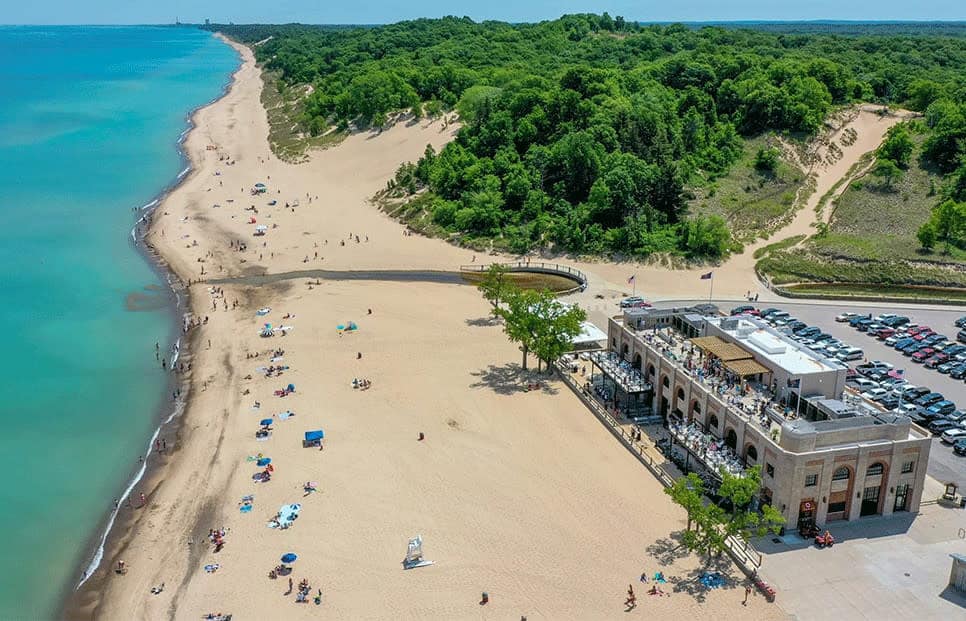
Ask a lifeguard, a camper or a naturalist at Indiana Dunes State Park what the strangest thing about the place is, and sooner or later the conversation turns to Diana of the Dunes. The park sits in Porter County, Indiana, on the southern shore of Lake Michigan, roughly 47 miles east of Chicago, and it is the most visited state park in Indiana. It is also the setting for one of the Midwest’s most durable ghost stories: a woman seen walking the beach alone, then gone. The park’s own list of attractions puts “haunted shores” alongside the singing sand and the smelt fishing, which tells you how thoroughly the legend has fused with the landscape.
Indiana Dunes State Park in Brief
- Location: Porter County, Indiana, on Lake Michigan, surrounded by and within the authorized boundaries of Indiana Dunes National Park
- Established: 1925, one of the first sites Richard Lieber considered when building the Indiana state park system
- Recognition: designated a National Natural Landmark in 1974
- Size of the wild part: the Dunes Nature Preserve covers 1,530 acres of the park’s eastern two thirds, reachable only on foot
- Access: open to the public with an entrance fee, as at all Indiana state parks
Wind, Ice and Blowouts: How This Shoreline Was Built
The dunes are not scenery so much as an ongoing process. Winds coming off Lake Michigan carry sand inland and drop it wherever plants, hills or existing dunes interrupt the flow. When lake levels fell at the end of the Ice Age the shoreline receded, new dunes formed nearer the water, and vegetation and then forest closed over the older ridges behind them.
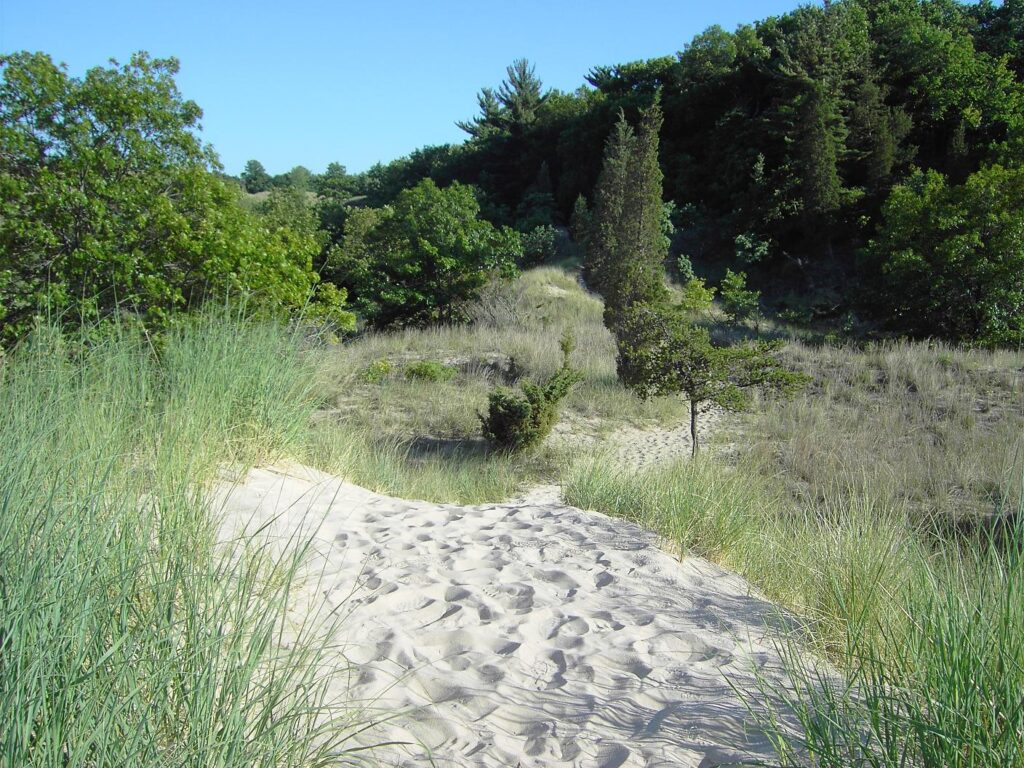
Where that armor of roots is broken, by a fallen tree, an animal trail or a shortcut worn by hikers, the wind gets back into the loose sand and hollows out a “blowout.” The three largest in the park are Beach House, Furnessville and Big Blowout. Big Blowout has stripped the sand off an area of dead trunks now known as the Tree Graveyard, and the preserve also holds the Ancient Pines Nature Area, a prehistoric forest uncovered the same way. Nothing supernatural is required to explain the mood of those places. Standing among bleached stumps that the wind spent centuries burying and then uncovering does a good deal of the work on its own.
Potawatomi Trails and the Remains of Petit Fort
Long before there was an entrance gate, this stretch of shoreline was part of the territory of Native peoples including the Potawatomi and the Miami, who used the region as a link in wider trading networks and valued the dunes both for their resources and as landmarks. Traces of a later era survive too, at the site known as Petit Fort, believed to have been a French trading post or residence. The park today interprets its history alongside its ecology, and several of the hiking trails pass historic structures as well as dune and wet prairie habitat.
Alice Mabel Gray, the Woman Behind the Legend
Diana of the Dunes was a real person before she was a ghost story. Alice Mabel Gray came to the dunes to live away from modern society, and the newspapers of her day gave her the nickname that stuck. She died in 1925 of uremic poisoning, the same year the state park was formally established, and the two facts have been tangled together in local retellings ever since.
What is documented is a life: a woman who chose solitude on a wild shoreline, and who became a regional celebrity for it. What is legend is everything that came after. The story of her spirit lingering on the beach is folklore, passed hand to hand for a century and now embedded in the region’s culture to the point that it is honored with an annual Diana of the Dunes Festival and Pageant. There is no record that establishes a haunting, and none of the accounts below have been verified.
What People Say They See on the Beach
The reports cluster on the open shoreline rather than in the campground or the Nature Center, and they are remarkably consistent in shape if not in detail:
- A solitary female figure walking the sand at a distance, most often at dusk or after dark
- The figure vanishing when approached, or appearing to move toward and into the water
- A sense of being watched or accompanied along quieter stretches of beach away from the swimming area
- Sounds along the shore that witnesses cannot place, often reported on the roughly two miles of non-swimming beach
Some of this has plain competition for an explanation. The park’s sand is genuinely known to “sing,” squeaking and humming underfoot. Fog rolls off Lake Michigan. Distances on an unlit beach are hard to judge, and a person a quarter mile away who steps behind a dune has effectively vanished. None of that disproves anything. It does mean a careful visitor should hold their own experience loosely.
Walking the Dunes: Trail 8, Trail 10 and Mt. Tom
Sixteen miles of trail run through the park, and all eight of them enter the Dunes Nature Preserve. Two are worth singling out. Trail 8 climbs over the Tremonts, the three high dunes of Mt. Tom at 192 feet above lake level, Mt. Holden at 184 feet and Mt. Jackson at 176 feet, running 1.5 miles from the Wilson Shelter to the beach at the Pavilion and Beach House. Trail 10 is the longest at 5.5 miles and among the easier ones, starting at the Pavilion, heading east along the open beach past the Beach House and Furnessville blowouts, then turning inland through Paradise Valley, following a branch of Dunes Creek through the Pinery and along the marsh to the Nature Center. The bird observation tower over the marsh is on this route.
There is an observation platform near the top of Mt. Tom. On a clear day the Chicago skyline stands above the forested dunes to the west, with Gary, Indiana, in view as well. If you want the legend at its most atmospheric, Trail 10’s beach section is where the stories live, and it can be walked in daylight without any special arrangement.
Visiting Indiana Dunes State Park
A small section of shoreline is set aside as a lifeguarded public swimming beach between Memorial Day and Labor Day weekends. The remaining two miles or so of clean sand beach is open for sunbathing and beachcombing, and dogs are allowed on the non-swimming portion provided they are kept on a short leash and cleaned up after. A beach house with concessions operates in the summer season.
The Nature Center runs year round and includes a wildlife observation window, a library and a large auditorium, with an interpretive naturalist offering public hikes and programs. That is the best route to the park’s real history if you want it from a person rather than a signboard. The campground was rebuilt entirely in 2004 and has 140 sites on sand with level asphalt pads, 50-amp hookups, picnic tables, water hydrants and two shower and restroom buildings, most of them keeping their trees for shade and linked to the beach by a short level forest path. A separate Youth Tent Area is also available.
Cycling is not permitted throughout the park, but the Calumet Trail passes through and connects to Indiana Dunes National Park and nearby communities. One boundary detail catches people out: the National Park Service owns the water from the ordinary high water mark to 300 feet offshore, so the beach and the lake in front of it are administered by different agencies. There is an entrance fee, as at every Indiana state park, and the Nature Preserve’s trails range from easy to genuinely rugged. Stay on marked paths. Cutting across dune faces is exactly how new blowouts start.
A Note on Chasing the Story After Dark
Indiana Dunes State Park keeps posted hours, and the dunes are a working ecological preserve rather than a set. Do not enter closed areas or wander the beach after the park has shut for the night. The legend of Diana of the Dunes has survived a hundred years of retelling and will still be there in the morning, when the light on the Tree Graveyard is arguably better anyway.
See Dunes State Park for Yourself
Sources
- 2018 / 2019 Estimated Fiscal Year Visits for Indiana State Parks (In (official))
- South Shore Journal – Alice Gray, Dorothy Buell, and Naomi Svihla: Preservationists of Ogden Dunes
- Loc (official)
- Wikipedia: Indiana Dunes State Park
Address: 1600 N. County Road 25 East
Frequently Asked Questions
Where is Dunes State Park located?
Dunes State Park is located at 1600 N. County Road 25 East.
Can you visit Dunes State Park?
Dunes State Park is open to the public. Always follow posted rules and respect private property.
Reader sightings
Nobody has reported anything here yet. If you have been, you would be the first.
Report your own visit to Diana of the Dunes and the Haunted Shores of Porter County
How haunted is this place?
Be the first to rate
Ghost Tours Nearby
 Chicago River Ghost & Dark History Night Cruisefrom $46
 Chicago Gangsters and Ghosts Walking Tourfrom $38
 Chicago Architecture and True Crime: Halloween Editionfrom $35
Affiliate links: BeyondHaunted may earn a commission, at no extra cost to you.

Leave a Reply