
Reviewed by Josh N · Updated August 27, 2026 · How we verify
Reported Phenomena
- Apparition in period clothing
- Unexplained cold touches
- Sense of unseen presence
- Photo and audio anomalies
- Activity in House chamber
Reported by visitors & local legend. Stories, not verified claims.
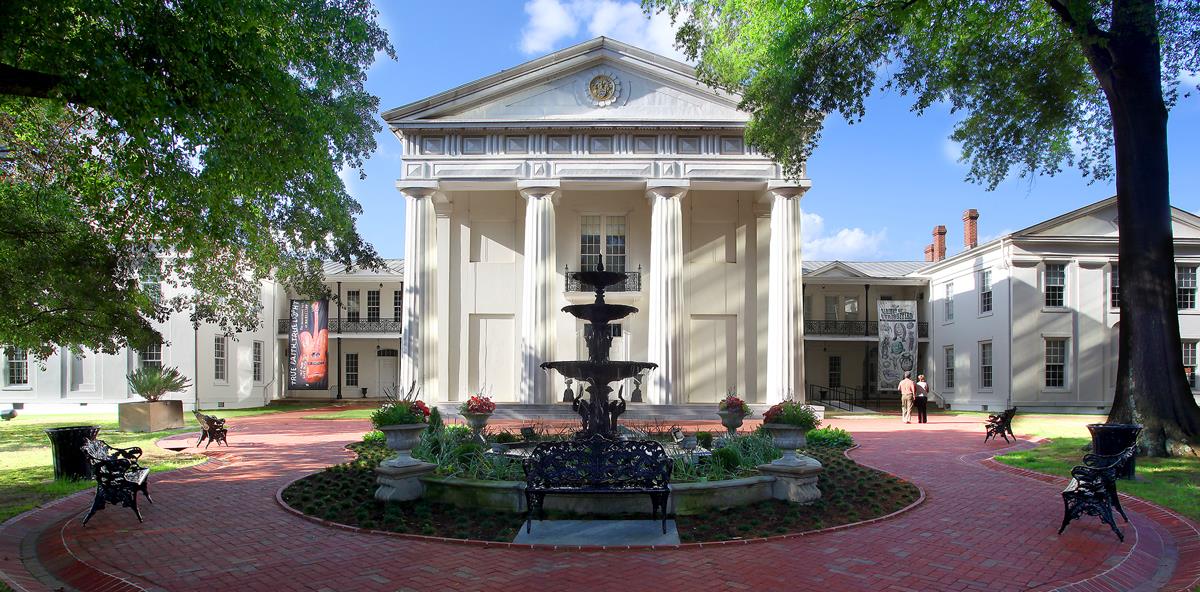
Arkansas’s first capitol still stands on Markham Street in Little Rock, and the Old State House Museum now occupies a building whose most notorious moment happened in the chamber where laws were being written: a Speaker of the House killed a sitting representative with a knife during a legislative session. That was December 1837. Visitors and staff have been reporting a figure in period clothing in the same rooms ever since, though nothing about those accounts has been verified.
Quick Orientation
- Oldest surviving state capitol building west of the Mississippi River
- Constructed between 1833 and 1842, commissioned by Governor John Pope
- Served as the Arkansas capitol from 1842 until 1912
- Designated a National Historic Landmark in 1997
- Operates today as a state history museum
Gideon Shryock’s Greek Revival Design, and the Version Arkansas Could Afford
Governor John Pope commissioned the State House, and the architect hired was Gideon Shryock, who had already designed the Kentucky State Capitol in Frankfort. Shryock chose Greek Revival, the language of American public buildings in that era. His original design proved too expensive for a territory with thin finances, so his assistant George Weigart revised the plans and oversaw the work.
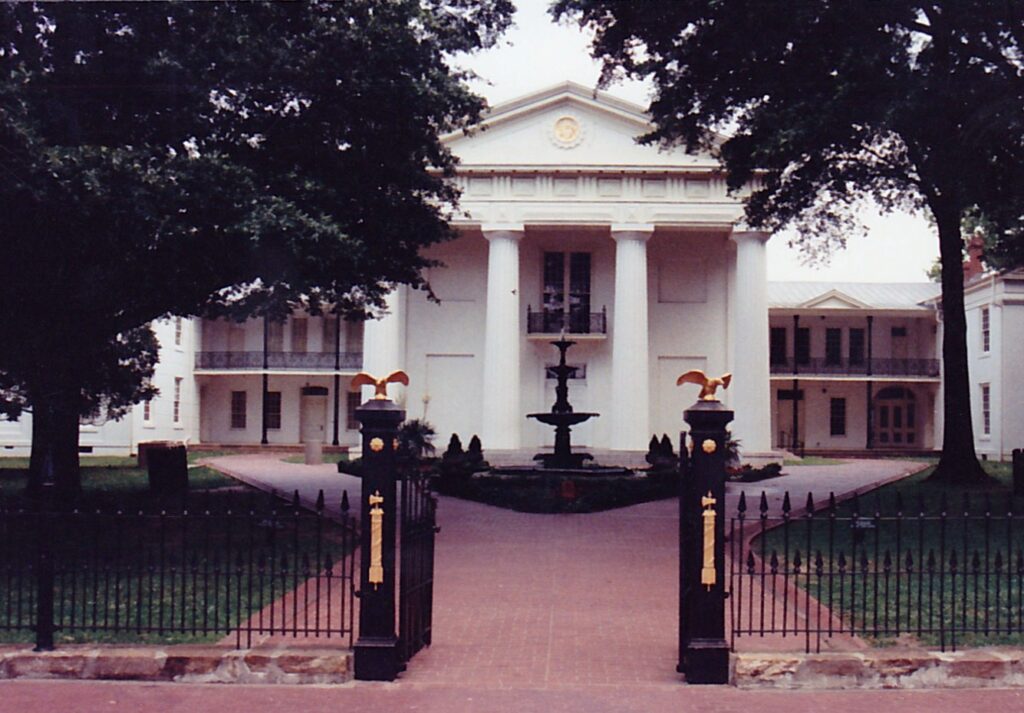
Construction ran from 1833 to 1842, which is a long time to build one statehouse, and the Arkansas General Assembly did not wait for the scaffolding to come down. Legislators moved into the building while construction was still going on. The building would remain the seat of Arkansas government until the new Arkansas State Capitol was finished in 1912.
December 4, 1837: Speaker John Wilson and Representative Joseph J. Anthony
This is the incident that anchors every ghost story told about the place, and it is worth getting the facts straight because popular retellings frequently reverse them.
On December 4, 1837, during the first session of the General Assembly held in the building, Speaker John Wilson killed Representative Joseph J. Anthony in a knife fight on the floor of the state House of Representatives. Wilson was the man holding the gavel. Anthony was the man who died. Any account that has Wilson dying in the chamber, or Wilson haunting the room as the victim of the fight, has drifted from the record.
What that means for the hauntings is simple enough: the apparition reported in the old House chamber is commonly named as Wilson by visitors and by local lore, but the identification is folklore, not documentation. There is no evidence connecting any reported experience in the building to either man.
Secession, Occupation, and the 1868 Constitution
The knife fight is not the only violent history the walls hold. After Abraham Lincoln’s election in 1860, an initial secession convention met in March 1861 and the Unionists prevailed. Then South Carolina fired on Fort Sumter and Lincoln called up troops. A second convention assembled at the State House on the morning of May 6, 1861, and after intense debate an ordinance of secession passed with five opposing votes. Four of those delegates relented when unanimity was urged on them. Isaac Murphy of Madison County held out under enormous pressure and did not.
After the Union victory at the Battle of Bayou Fourche in September 1863, Federal troops occupied the building for the rest of the war.
Reconstruction brought another convention to the same rooms, this one deciding whether Arkansas would accept the Fourteenth Amendment, permit suffrage for Black men over 21, and create public schools for both Black and white children. After contentious debate the proposals were approved in a new constitution that emerged in February 1868 and was ratified that March. The building was also a prize in the Brooks-Baxter War and was fortified during that struggle. The cannon known as “Lady Baxter” still sits on the grounds.
Lady Baxter, the Fountain, and the Three Graces
The grounds carry their own layers. A three-tiered fountain that stood in front of the States exhibit building as part of the Arkansas display at the 1876 Philadelphia Centennial Exposition was moved to the State House grounds in 1877; a recast version occupies the spot now. In 1885 an iron statue of the Three Graces, representing Law, Justice and Mercy, was placed on top of the State House. It was removed in 1928.
Medical School, War Memorial, Museum
Once the new capitol opened in 1912, the old building went through a long second life. For a time it housed a medical school. It then served as an Arkansas war memorial and as office space for federal and state agencies, and as a meeting place for patriotic organizations. In 1947 the General Assembly passed acts designating it a museum.
The front entrance is also a piece of modern political history: Bill Clinton announced his presidential campaign there on October 3, 1991, and held his election night celebrations there on November 3, 1992, and November 5, 1996. The building underwent major renovation in 1996 and was designated a National Historic Landmark in 1997.
What People Report Inside the Old House Chamber
The reported phenomena cluster in one place: the legislative chamber where the 1837 killing happened.
Visitors and staff describe a man in nineteenth century clothing, seen briefly and then gone. Others report cold touches with no source, sometimes described as the sensation of icy hands. Staff have said they have felt an unseen presence in the building after hours, on at least one occasion alongside a sighting of a figure in period dress. Photographs and audio recordings taken in the building are sometimes said to contain anomalies.
All of this is reported experience rather than documented event. There is no investigation, measurement or official record supporting any of it, and the museum’s own interpretation of the building is historical rather than paranormal. What is documented is that a man was stabbed to death on that floor by the presiding officer of the House, which is unusual enough without a ghost attached.
Visiting the Old State House Museum
This is a working state history museum in downtown Little Rock, not a haunted attraction, and it should be approached that way. Permanent collections include battle flags, the inaugural gowns of the First Ladies of Arkansas, art pottery, and African-American quilts, with special exhibits staged periodically. The grounds, with Lady Baxter and the recast Centennial fountain, are worth a walk before you go in.
Check the museum’s current hours and exhibit schedule before travelling, and if you want to see the old House chamber where the fight occurred, ask staff where it sits within the current exhibit layout. Do not expect a ghost tour. Expect a well kept nineteenth century capitol with a genuinely brutal footnote in its first legislative session.
See The Old State House for Yourself
Sources
- Old State House, Little Rock
- Old State House Museum
- Encyclopedia of Arkansas
- Three Graces Statue Arrives, Old State House
- National Park Service
- Wikipedia: Old State House (Little Rock, Arkansas)
Address: 300 West Markham Street
Frequently Asked Questions
Where is Old State House located?
Old State House is located at 300 West Markham Street.
Can you visit Old State House?
Old State House is open to the public. Always follow posted rules and respect private property.
Reader sightings
Nobody has reported anything here yet. If you have been, you would be the first.
Report your own visit to Old State House Museum: Knife Fight on the House Floor
How haunted is this place?
Be the first to rate
Leave a Reply