

Reviewed by Josh N · Updated September 8, 2026 · How we verify
Reported Phenomena
- Woman in white
- Period-dressed apparitions
- Phantom rose scent
Reported by visitors & local legend. Stories, not verified claims.
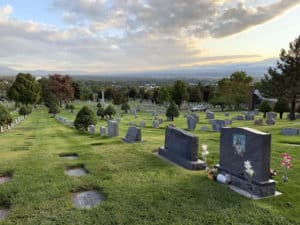
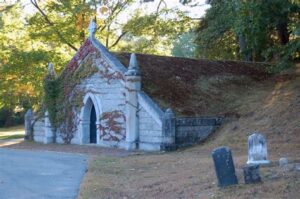
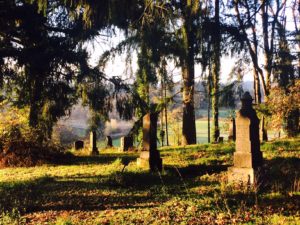
The town is gone and the graveyard is not, which is most of the story of Mercur Cemetery in a single sentence. It sits in the dry hills of Tooele County, Utah, above the site of a gold camp that boomed twice, burned nearly to the ground once, and emptied out so completely that by 1930 not one building was left standing. What survives is a hillside of markers, a reclaimed mine, and a set of ghost stories that locals and paranormal groups have repeated for decades.
Mercur in Brief
- Where: Tooele County, Utah, at an elevation of roughly 2,042 meters
- Founded: 1870, as Lewiston, then reborn under the name Mercur after 1891
- Peak population: around 5,000 in the town’s heyday
- End: by 1916 there was only one building left, and by 1930 it was gone
- Access: the cemetery sits on private property associated with the mine site and may require permission
Lewiston: The Boom That Died Before Mercur Was Born
The first settlement here was not called Mercur at all. It came into being in 1870 as Lewiston, after gold was discovered at the head of Lewiston Canyon, six miles west of present-day Cedar Fort. A small gold rush followed, peaking around 1873, and the population climbed as high as 2,000. During the mid-1870s silver boomed instead, silver mines opened, and quartz mills were built to process the ore. A million dollars’ worth of silver bullion went down the valley before the ore quickly gave out. Lewiston was a ghost town by 1880.
That should have been the end of it. In 1879, a Bavarian miner named Arie Pinedo had found a deposit of cinnabar in the area. The ore held gold as well as mercury, but the processes available at the time could not pull the gold out of it. Similar discoveries were made through the 1880s, and all of them ran into the same wall.
Gill Peyton, Cyanide, and the Town’s Second Life
In 1890 a group of Nebraska “farmers” bought the Mercur claim through an over optimistic promoter, opened the mine, and put in a basic amalgamation mill. It was a flop; the ores were not workable by the old method. One of the partners, Gilbert S. “Gill” Peyton, a former druggist, had heard of the new and still unperfected cyanide process. Facing the loss of his own and his relatives’ money, he worked out the difficulties, and by December 1891 he had proved the cyanide process worked on Mercur ore. It was the first such successful operation in the United States, and the method went on to dominate western gold metallurgy.
The town that grew back on the old site could not reuse the name Lewiston, which by then belonged to another place, so the residents settled on Mercur, taken from the Nebraska company and originally from Pinedo’s claim. A branch railroad was built in the fall and winter of 1894. A dozen mining operations worked the district, the largest being the Golden Gate Mining Company, which ran the biggest cyanide mill in the United States from 1898 to 1902 in a structure designed by a young Daniel C. Jackling. In 1902, Joseph DeLamar sold the Golden Gate operation to the Derns and their partners, who formed Mercur Consolidated.
At its height the town held about 5,000 people, and the names on the ground reflected that mix. Mercur supported a large Italian immigrant community, drawn by high wages and the romance of the American West, and Columbus Day became a major civic event with parades, games, and performances by the Mercur City Band. Many miners were members of the Church of Jesus Christ of Latter-day Saints, though there was no church organization in town until a branch was formed in 1896 under Charles B. Felt. Missionaries Moses W. Reynolds, James Duckworth, and Sidney S. Reynolds arrived in 1899, and a ward was organized in Mercur on July 1, 1900, with George W. Bryan as bishop.
The Fire of 1902 and the Slow Emptying
In 1902 a fire that started in the business district burned almost the entire city to the ground. Mercur rebuilt and mining resumed, but the reprieve was temporary. The ward was discontinued in 1913 because the mines had closed and most of the population had moved away. By 1916 a single building remained standing, and by 1930 even that was gone. The mine itself came back one more time: the Mercur Gold Mine went into production again in 1985 under a Barrick Gold subsidiary, operations ended in 1997, the processing mill ran until late 1998, and a reclamation and restoration project was set to continue up to 2010.
Through all of it, the cemetery stayed. It is the most substantial physical record left of a place that twice put thousands of people on a mountainside and twice let them go.
The Woman in White and the Smell of Roses
The hauntings attached to Mercur Cemetery belong entirely to oral tradition and local retelling. Nothing in the documented history of the town supports them, and readers should treat them as folklore rather than record.
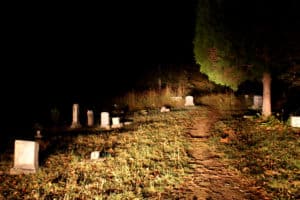
The accounts that circulate are consistent enough to list. Visitors describe apparitions dressed in early twentieth century clothing, matching the era when the town was at its largest. Several reports center on a sorrowful woman in white, said by tellers of the story to be mourning a lost lover, though no name or grave is ever attached to her. Others mention the sudden scent of roses on a hillside where no flowers are growing, with no obvious source and no wind to explain it.
None of these has a documented witness, a date, or an investigation behind it in the sense a historian would accept. What they do have is persistence. In a place stripped of buildings, the stories have become the only architecture left.
Visiting Mercur Cemetery
This is not a roadside stop. The cemetery lies on private property connected to the mining operation, and access may require permission; showing up unannounced is a good way to be turned around, or worse, cited. Anyone planning a trip should confirm the current access situation before driving out.
The setting is high, dry, and exposed, with no services and no shade, so carry water and tell someone where you are going. Whatever you make of the woman in white, the markers here belong to real miners, wives, and children who lived through two collapses and a fire that took nearly the whole town. Walk carefully, leave the stones alone, and take nothing.
Sources
- Last load of ore trundles out of Mercur mine
- The alumni quarterly and fortnightly notes
- Mercur, UT
- Mercur, Utah
- Archives (official)
- Wikipedia: Mercur, Utah
Frequently Asked Questions
Can you visit Mercur Cemetery?
Mercur Cemetery is on private property and best viewed from a distance. Always follow posted rules and respect private property.
Reader sightings
Nobody has reported anything here yet. If you have been, you would be the first.
Report your own visit to Mercur Cemetery: The Graveyard That Outlived a Gold Town
How haunted is this place?
Be the first to rate
Leave a Reply