
Reviewed by Josh N · Updated August 27, 2026 · How we verify
Reported Phenomena
- Girl at window
- Child singing or humming
- Objects thrown
- Stern older woman
- Cold spots
- Doors closing alone
- Unexplained noises
Reported by visitors & local legend. Stories, not verified claims.
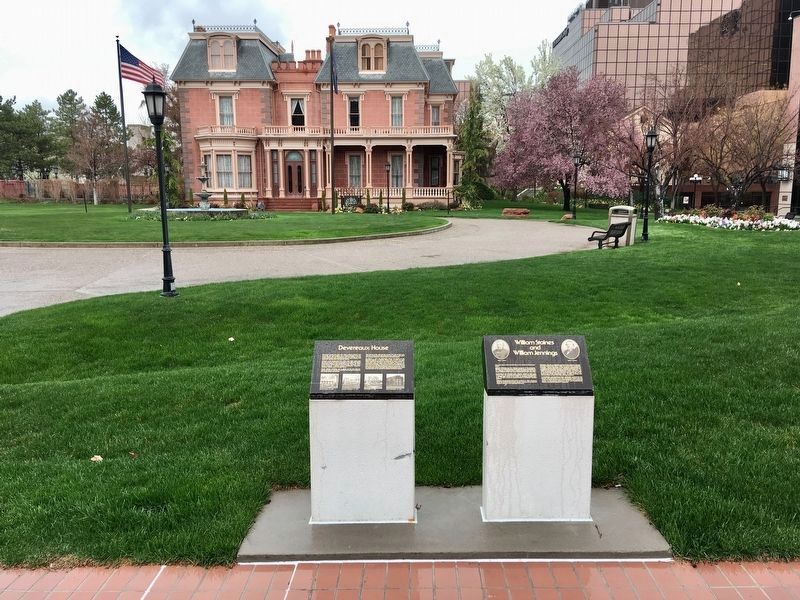
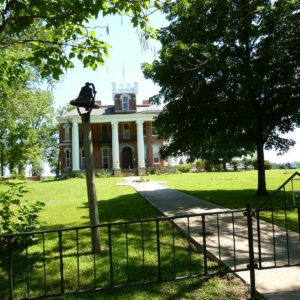
Stand on West South Temple in Salt Lake City, Utah, with the Delta Center behind you and the Union Pacific Depot down the block, and the Devereaux Mansion looks like something that wandered in from another century and refused to leave. It is the oldest surviving grand house in the valley, built in 1857, and it sits on an open lawn with no perimeter fence, so the grounds read as a small park wedged between office towers. Visitors have long reported a child waving from an upstairs window. Whether anyone is there to wave is another matter.
Quick Orientation to the Staines-Jennings Mansion
- Also known as: Devereaux House, the Staines-Jennings Mansion
- Built: 1857 for William Staines, designed by architect William Paul
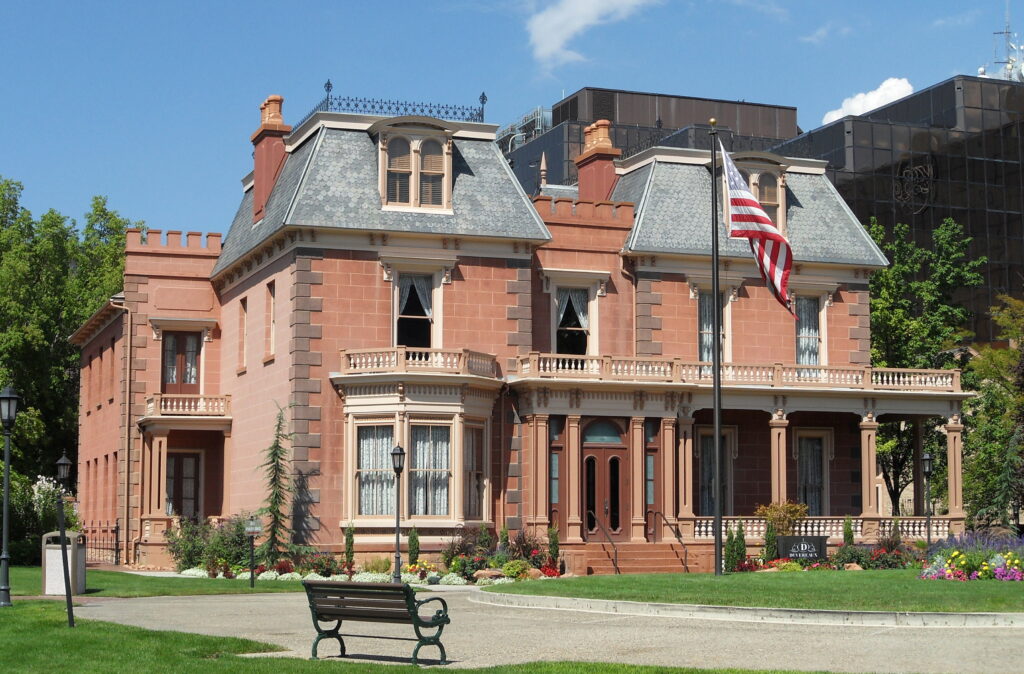
- Style: Victorian with French-influenced detailing, brick under cement plaster, mansard roof forming the third floor
- Listed: U.S. National Register of Historic Places, 1971
- Owner today: The Church of Jesus Christ of Latter-day Saints, which acquired it in 2005
The First House in the Valley Anyone Called a Mansion
William Staines commissioned the house in 1857, roughly a decade after the first Mormon pioneers reached the Salt Lake Valley, and William Paul designed it. What went up was the first residence in the valley built on a scale that could honestly be described as a mansion. Earlier accounts of the property place portions of the construction as far back as 1855, though the 1857 date is the one attached to the finished house.
Almost immediately it became the place where the territory did its socializing. Distinguished visitors were received here. Most consequentially, the house was the setting for a meeting between Brigham Young and Governor Alfred Cumming to resolve the Utah War, which makes the drawing room something closer to a negotiating table than a parlor.
Brigham Young’s oldest son, Joseph Angell Young, bought the house for $20,000 in 1865 and kept it only briefly, selling it in 1867 for $30,000.
William Jennings and the Name Borrowed from Birmingham
The buyer was William Jennings, a local entrepreneur widely believed to have been the Salt Lake Valley’s first millionaire and later mayor of Salt Lake City from 1882 to 1885. Jennings hired Paul again to expand the house, then landscaped the grounds around it. He gave the place the name it still carries, Devereaux, after a family property at Yardley in Birmingham, England.
The household was large. Jennings lived there with his wives Jane and Pricilla, who had eleven and fourteen children respectively. The public side of the house was busier still. Secretary of War William Seward and General Philip H. Sheridan were guests in the 1860s, and General William Tecumseh Sherman came in the 1870s, visits that were read at the time as a signal of federal tolerance toward polygamy in Utah.
Inside, the plan is formal and legible: a large stair hall with a drawing room to the left and a library to the right, a banquet room behind the parlor, a dining room behind the library, bedrooms filling the second floor, and, in the attic, servants’ quarters alongside a billiard room. Contemporaries singled out the quality of the woodwork and fittings. A wide porch wraps the south and east sides.
Treatment Clinic, Mining Offices, and the Fire of 1979
Jennings died in 1886, and the house began a long slide through unglamorous uses. It passed through several owners. At one point it operated as an alcohol treatment facility, the Keely Institute. Later it held offices for a mining equipment company. The great social center of the territory spent decades as somebody’s back office.
The State of Utah acquired the property in the 1970s and approved public funds for its restoration in 1978. A year later, a fire came close to finishing the building off entirely, and demolition was a live possibility. The restoration went ahead anyway in the early 1980s, after which Devereaux served as a reception center and housed the Chart House restaurant. The Church of Jesus Christ of Latter-day Saints took ownership in 2005 and maintains it as a historic site, used occasionally for receptions and events.
The Girl Who Waves from the Upstairs Window
None of what follows is documented in the historical record. It comes from visitors, staff, and the accumulated word of mouth that attaches to any building this old and this visible, and it should be read as reported experience rather than established fact.
The best known figure is a small girl, described as roughly eight years old and dressed in clothing of the 1850s. People report seeing her at an upstairs window, waving down at the street. Others say they have heard her singing or humming quietly somewhere in the house. She is also blamed for the occasional temper: objects said to be thrown or swept to the floor when something displeases her.
A second presence is described very differently. An older woman, taken by those who report her to be either a former matriarch of the household or a head housekeeper, is characterized as stern and territorial, less a wistful apparition than a caretaker who would prefer you did not touch anything.
Beyond the two figures, the reported phenomena run to the familiar: cold spots that do not track with drafts, unexplained noises in empty rooms, and doors that swing shut with nobody near them. Given that the building has burned once, been rebuilt, and served as everything from a clinic to a restaurant, an old house making old house noises is not the least likely explanation.
Seeing Devereaux Mansion Today
The grounds are the easy part. Because the lawn was preserved without a fence when the city grew up around it, you can walk right up to the house and take in the mansard roof, the wraparound porch, and the plastered brick from a few feet away. It sits amid the Triad Center, the Delta Center, the Union Pacific Depot, and The Gateway development, which makes the contrast worth the trip on its own.
Interior access is a different question. The house is not a general admission museum. It is a maintained historic site used now and then for receptions and private events, so getting inside depends on what is scheduled and whether the owner is opening it. Check ahead rather than turning up expecting a tour, and treat the property as what it is: private ground that happens to be generous about its lawn.
See Devereaux Mansion for Yourself
Sources
- National Park Service
- Library of Congress
- geohack.toolforge.org
- Wikipedia: Devereaux House (Salt Lake City)
Address: 340 West South Temple Street
Frequently Asked Questions
Where is Devereaux Mansion located?
Devereaux Mansion is located at 340 West South Temple Street.
Can you visit Devereaux Mansion?
Devereaux Mansion is open to the public. Always follow posted rules and respect private property.
Reader sightings
Nobody has reported anything here yet. If you have been, you would be the first.
Report your own visit to Devereaux Mansion: The Girl at the Window on South Temple
How haunted is this place?
Be the first to rate
Ghost Tours Nearby
 Salt Lake Ghost Tour: Salt, Spooks, & Shadowsfrom $26
 Salt Lake City Haunted Old Town Bus Tourfrom $30
 Shadows of Old Salt Lake Walking Tourfrom $20
Affiliate links: BeyondHaunted may earn a commission, at no extra cost to you.
Leave a Reply