Reviewed by Josh N · Updated May 11, 2026 · How we verify
Reported Phenomena
- Spectral figures
- Shadow figures
- Phantom footsteps
Reported by visitors & local legend. Stories, not verified claims.
Address: 135 Church Street, Charleston, SC 29402
Phone: 843-720-3968 through the City of Charleston, with Charleston Stage box office listed at 843-577-7183
Official information: Theatre Page
Visiting note: The City of Charleston says the historic building is open daily for tourists to view, while performances, rentals, and box office hours vary by season. Check Charleston Stage before planning a show visit.
Why Dock Street Theatre Is So Famous
Dock Street Theatre is one of the most historic performance spaces in Charleston and one of the most talked-about haunted locations in South Carolina. The site is tied to early American theater, antebellum hotel life, Charleston social history, and a long list of ghost stories that still follow the building today.
The important thing to know is that the current building is not simply one original 1730s theater preserved without change. The site has changed many times. The name reaches back to the early Dock Street playhouse, while the structure visitors see today is largely connected to the old Planter’s Hotel and the 1930s restoration that turned the site back into a theater.
A Short History of Dock Street Theatre
The original Dock Street Theatre was constructed in 1736, making the site one of the most important places in early American theater history. The City of Charleston describes Dock Street as the first building designed solely for theatrical performances.
A Charleston Museum archaeological report notes that the original theater was constructed in 1736, burned in 1754, and was rebuilt that same year. The report also makes clear that only small fragments of colonial buildings remain in the present structure.
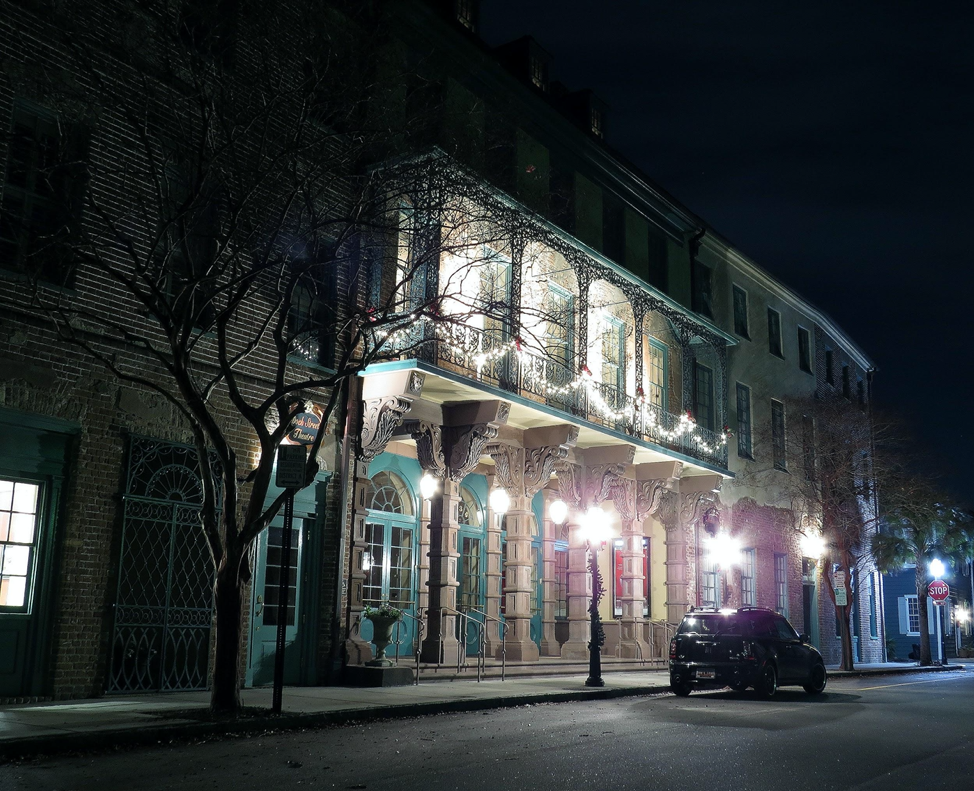
By the early 1800s, the site had entered a new chapter. The main portion of the present building was constructed around 1809 as Planter’s Hotel. The National Park Service describes the building as Charleston’s last surviving antebellum hotel.
The hotel became a popular stop for wealthy planters from the South Carolina midlands who came to Charleston during horse-racing season. It was also known for food and drink, and several sources note that Planter’s Punch may have originated there.
Key historic points include:
- The original theater site dates to 1736.
- The present building is closely tied to Planter’s Hotel, built around 1809.
- The famous Church Street façade includes the balcony and brownstone columns associated with the hotel era.
- The building was adapted into a theater again during a Works Progress Administration project in the 1930s.
- The City of Charleston still manages the building as an active performing arts venue.
From Hotel Ruin to Restored Theater
After the Civil War, Planter’s Hotel declined along with much of Charleston’s economy. The 1886 earthquake caused further damage, and by the early 20th century the building was nearly empty and in poor condition.
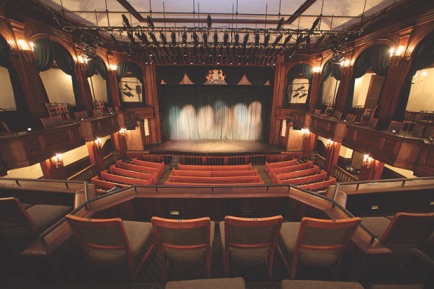
In the 1930s, the property was revived through a Works Progress Administration project. Instead of reopening the building as a hotel, Charleston turned it back into a theater. The Charleston Museum report says the project created an 18th-century-style theater interior behind the old hotel façade, while retaining some hotel spaces such as the lobby and ballrooms.
That layered history is part of what makes Dock Street Theatre feel so unusual. It is not just a theater. It is also a former hotel, a preserved architectural landmark, a Depression-era restoration project, and a living performance space.
The Haunted Reputation of Dock Street Theatre
Dock Street Theatre is often listed among the most haunted places in Charleston. The stories are usually connected to three things: its theatrical past, its years as Planter’s Hotel, and the number of people who passed through the building over nearly three centuries.
The most repeated reports include:
- A woman in a red dress seen inside or near the building.
- Footsteps heard on the stage after the theater is empty.
- Seats creaking in the balcony or upper rows when no one is there.
- Shadowy figures seen near the second floor.
- Lights, doors, or other objects behaving strangely after hours.
These are reported ghost stories, not verified historical events. The history of the building is well documented, but the hauntings remain part of Charleston folklore.
Nettie Dickerson, the Woman in Red
The most famous ghost story at Dock Street Theatre centers on a figure often called Nettie Dickerson. According to local legend, Nettie was associated with the Planter’s Hotel during the 19th century and died after being struck by lightning while standing on or near a hotel balcony.
Today, people who repeat the story usually describe her apparition as a woman in a red dress. Some accounts call her the “Woman in Red,” while others simply call her Nettie. Spoleto Festival USA describes Nettie as the most commonly sighted ghost at Dock Street Theatre and says witnesses often describe her as wearing a tattered red dress.
There is an important factual caution here: Nettie’s story is famous, but the details are difficult to verify through primary historical records. The safest way to tell it is as a long-running Charleston legend tied to the building’s hotel era.
Junius Brutus Booth and the Planter’s Hotel
Another name connected to Dock Street Theatre’s haunted reputation is Junius Brutus Booth, the famous 19th-century actor and father of John Wilkes Booth. He stayed at Planter’s Hotel when traveling theatrical troupes came through Charleston.
The Charleston Museum report says Booth was reportedly involved in an altercation with his manager, Mr. Flynn, during his stay. Spoleto Festival USA also recounts the story, saying Booth attacked the hotel manager after a performance.
Because Booth was a dramatic and troubled figure, later ghost lore has attached him to the building. Some ghost tours and paranormal accounts claim that his spirit haunts the stage or theater areas. The historical part is that Booth did stay at the hotel and was tied to a violent incident there. The ghostly part remains folklore.
Why Dock Street Theatre Feels Haunted
Dock Street Theatre has the kind of layered history that naturally attracts ghost stories. It sits in Charleston’s French Quarter, surrounded by churches, old streets, graveyards, and buildings that have survived fires, war, earthquakes, neglect, and restoration.
Several features help explain its paranormal reputation:
- The building has served different purposes over time.
- Its hotel era brought in travelers, performers, wealthy planters, workers, and locals.
- The balcony and upper floors create a strong visual setting for ghost stories.
- The theater is active at night, when empty seats, backstage spaces, and old stairways can feel especially atmospheric.
- The building’s history is old enough that legend and documentation sometimes overlap.
For a paranormal location, that mix matters. The more a building changes hands, survives disasters, and gathers stories, the more likely it is to become part of a city’s haunted identity.
Dock Street Theatre Today
Dock Street Theatre remains an active cultural venue. The City of Charleston says the theater operates year round for local arts groups, touring companies, private events, and meetings. Charleston Stage has been closely associated with the theater for decades and lists Dock Street Theatre as its performance home.
Visitors can appreciate it as a historic building even without attending a show. For those interested in the paranormal side, the exterior, balcony, and surrounding streets are often included in Charleston ghost tours. Anyone hoping to enter the building should check official hours, scheduled performances, and access rules first.
Is Dock Street Theatre Really Haunted?
Dock Street Theatre has a strong case as one of Charleston’s most atmospheric haunted landmarks. Its documented history is rich enough on its own: an early theater site, a famous antebellum hotel, a WPA restoration, notable guests, archaeological discoveries, and centuries of Charleston life.
The ghost stories add another layer. Nettie Dickerson, the Woman in Red, is the best-known spirit connected to the theater, while Junius Brutus Booth gives the site another eerie historical association. The reported encounters are not proven, but they have become a lasting part of the building’s identity.
For anyone researching haunted places in South Carolina, Dock Street Theatre deserves a place near the top of the list. It is historic, beautiful, active, and deeply tied to Charleston’s haunted storytelling tradition.
Never trespass on property that isn’t yours without permission. Ghost hunting can be dangerous, so always use caution and follow all local rules.
Sources
City of Charleston, Dock Street Theatre.
National Park Service, Dock Street Theatre.
Ghost City Tours, “The Ghosts of the Dock Street Theatre.”
Frequently Asked Questions
Where is Dock Street Theater located?
Dock Street Theater is located at 135 Church Street, Charleston, SC 29402.
Can you visit Dock Street Theater?
Dock Street Theater is open to the public. Always follow posted rules and respect private property.
Reader sightings
Nobody has reported anything here yet. If you have been, you would be the first.
Report your own visit to Dock Street Theatre in Charleston, South Carolina: Haunted History of America’s First Playhouse
How haunted is this place?
5 · 1 vote
Ghost Tours Nearby
 Haunted Evening Horse and Carriage Tour of Charlestonfrom $45
 Real Hauntings of Charleston! (Small Group Ghost Tour)from $32
 City of the Dead The Dark Hauntings of Charlestonfrom $32
Affiliate links: BeyondHaunted may earn a commission, at no extra cost to you.
Leave a Reply