
Reviewed by Josh N · Updated September 2, 2026 · How we verify
Reported Phenomena
- Apparitions in the auditorium
- Unexplained overnight sounds
- Sense of presence
- Figures seen upstairs
Reported by visitors & local legend. Stories, not verified claims.
Cincinnati Music Hall sits on ground that held the dead long before it held an orchestra. The red brick pile at 1241 Elm Street in Ohio, finished in 1878 and facing Washington Park in Over-the-Rhine, is a National Historic Landmark and the home of five major performing arts organizations. It is also, in the words of its own history, a building raised over a pauper’s cemetery, and that single fact has done more for its reputation among ghost hunters than any single reported sighting.
Music Hall at a Glance
- Where: 1241 Elm Street, across from Washington Park in Over-the-Rhine, minutes from downtown Cincinnati
- Completed: 1878, first performance on May 14, 1878
- Architect: Samuel Hannaford, of Hannaford and Porter
- Recognition: named a National Historic Landmark in January 1975 by the U.S. Department of the Interior for its distinctive Venetian Gothic architecture
- Resident companies: Cincinnati Symphony Orchestra, Cincinnati Pops Orchestra, Cincinnati Opera, Cincinnati Ballet and the May Festival Chorus
- Status: fully operating venue, reopened in 2017 after a $143 million renovation
- Reported activity: figures and voices in the house after hours, described by staff and performers, never verified
What Was on the Elm Street Lot Before the Music Hall
The site’s institutional history begins long before any music was played on it. On September 13, 1818, the City of Cincinnati bought a plot of land from Jesse Embree for $3,200 on the west side of Elm Street, just north of 12th Street. On January 22, 1821, the Ohio State Legislature passed an act establishing “a Commercial Hospital and Lunatic Asylum for the state of Ohio,” and the state’s first insane asylum went up in Cincinnati on four acres bounded by the Miami and Erie Canal. That institution became the parent of the Orphan Asylum, the City Infirmary, the Cincinnati Hospital and Longview Asylum.
Then came the cholera outbreak of 1832. Afterward the land was used as a pauper’s cemetery, and it stayed that way until 1857, when the city had grown too close for the use to be tolerable. Complaints from neighboring property owners pushed the “Pest House” out beyond the city limits, and on January 29, 1859, the city converted the property into Elm Street Park. The land and its buildings were used for exposition purposes until 1876, when the site was turned over to the Music Hall Association.
That sequence is the documented record, and it is worth separating from the version usually repeated on ghost tours. The burials are real history. What happened to every set of remains when the ground was opened is a murkier question, and it is precisely where the building’s folklore takes over.
Rain on a Tin Roof: Why Reuben Springer Built It
The immediate predecessor on the block was Exposition Hall, a huge wooden structure 250 feet long, 100 feet wide and 80 feet tall, thrown up when the city’s industrial exposition organizers and German musicians planning for the North American Saengerbund agreed to share a building. With three attached temporary structures it offered more floor space than the 1853 World’s Fair in New York City, and it hosted the 1876 Republican National Convention that nominated Rutherford B. Hayes.
Its roof was covered in tin. According to lore, a thunderstorm broke over an 1875 May Festival performance and the rain on that roof grew so loud the chorus was drowned out and the music had to stop. Sitting in the audience was Reuben R. Springer, a wealthy Cincinnatian who concluded the city needed something permanent. In May 1875 he wrote to department store owner John Shillito offering $125,000 on two conditions: that the site be free from taxation, and that the community match his gift. When the public subscription reached only $106,000, Springer added another $20,000, then offered a further $50,000 toward exposition wings if $100,000 more could be raised. Music Hall finally cost $300,962.78, with the exposition wings adding $146,331.51.
Construction began in 1876 and was fast tracked, through weather and supply problems, to be ready for the 1878 May Festival. The first performance took place on May 14, 1878, when an estimated 6,000 people heard Gluck’s opera Alceste and Beethoven’s Eroica. The North and South Exposition Halls were finished on September 2, 1879.
Three Buildings Wearing One Face
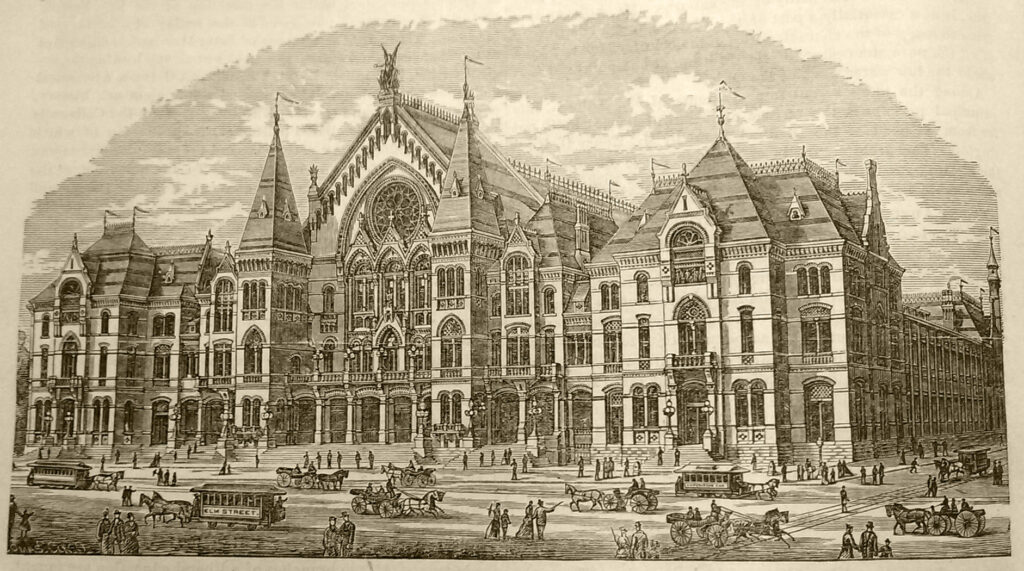
Hannaford’s design is considered one of the last and best examples of the Victorian Gothic Revival style: a steeply pitched gable roof, corbelled brick, window tracery, and the great rose window on the facade. What most visitors do not register is that Music Hall is not one building but three, joined by second story passageways: the central hall flanked by the North and South Exposition Buildings. Carriage passageways were built in so patrons could get inside in bad weather.
Each of the three wears its own sandstone carvings advertising its purpose: musical instruments including French horns on the center building, flowers and birds on the South Exposition Hall for its horticultural use, scientific tools on the North Exposition Hall for its mechanical one. Much of the exterior’s carved and painted brick detail is gone. During the renovation carried out between 1969 and 1975, the facade was sandblasted and the majority of that detail was destroyed.
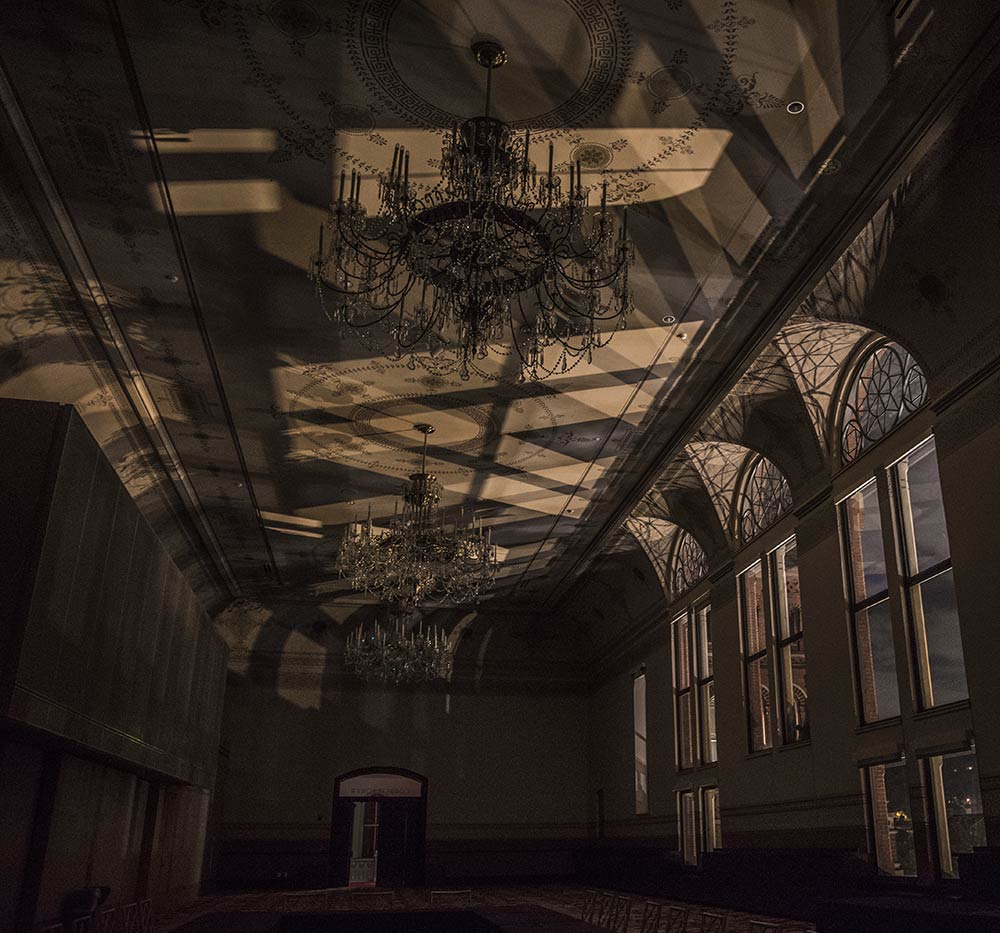
Inside, Springer Auditorium carries the founding patron’s name and seats 2,289 for symphony concerts and 2,439 for the Pops. Before recent work traded seat count for seat size, it was the second largest traditional auditorium or opera house by capacity in the country. Its chandelier arrived from Czechoslovakia in pieces, was bought by the Corbett family, and was installed in the early 1970s: roughly 1,500 pounds, 21 feet across, with 96 candles each lit by an individual bulb. Elsewhere in the complex are the Music Hall Ballroom, nearly 20,000 square feet and the second largest meeting space in the city, known as the Topper Ballroom before 1974; Corbett Tower on the third floor, originally Dexter Hall and once a performance space for the College of Music of Cincinnati; and Wilks Studio, added in the most recent renovation.
Presidents, Conventions and the Grateful Dead
For roughly a century the hall doubled as Cincinnati’s convention center, until the Duke Energy Convention Center took that role in the 1970s. President Ulysses S. Grant spoke there on December 12, 1879, to a crowd the Cincinnati Enquirer described as overflowing. William McKinley, Theodore Roosevelt, Benjamin Harrison and Dwight D. Eisenhower all appeared there too. From June 22 to 24, 1880, the Democratic National Convention met in the building and nominated Winfield S. Hancock for president, an event notable for the Western Union telegraph wires strung into the hall.
The music list is just as broad: Frank Sinatra in 1941 and again in 1993, Ella Fitzgerald, Johnny Cash, Ray Charles, Fats Domino, the Velvet Underground in 1966, Big Brother and the Holding Company with Janis Joplin in 1968, the Grateful Dead and Pink Floyd both in 1972, Miles Davis, Bruce Springsteen in 1996, the White Stripes in 2005. B. B. King played the hall five times, beginning in 1970.
What Staff Say Happens at Three in the Morning
The accounts here are testimony, not evidence, and the people who work in the building do not agree with one another about them. Various employees have described strange events; others say they have never experienced anything at all.
In the 2005 documentary Music Hall: Cincinnati Finds Its Voice, Cincinnati Opera CEO Patricia K. Beggs put it flatly: “Ghosts? Um, yes. Indeed, there are Music Hall ghosts.” Erich Kunzel, the late conductor of the Cincinnati Pops, described working alone through the night on arrangements and said, “So I’ve met these people. They’re not in the offices, but when you go out into the house they’re there, they’re upstairs…. If you think I’m crazy just come here sometime at three o’clock in the morning. They’re very friendly.”
Set against that, Marie Gallagher, who worked at Music Hall for 25 years, and facilities engineer Ed Vignale have both reported experiencing nothing unusual. Vignale offered the obvious explanation for at least some of it: the hall’s acoustics are built to project sound, and a building designed to carry a chorus to 2,000 people will carry a footstep just as efficiently.
Reported phenomena at the hall cluster around a few things:
- Figures seen in the house and in the upper levels of Springer Auditorium, generally described as harmless
- Sounds with no traceable source during empty hours, particularly overnight
- A sense of presence reported by people working alone in the building late
One detail of the lore predates the concert hall entirely: ghosts were first reported before Music Hall was built, after the ground was first excavated for an Exposition Hall elevator. The building’s paranormal reputation has been amplified by television. It was selected as one of the Travel Channel’s Most Terrifying Places in America and was featured on the SYFY series Ghost Hunters. None of that constitutes proof of anything, and the hall’s management markets it as a concert venue, not a haunted attraction.
Getting Inside Cincinnati Music Hall
This is a working performance hall, which makes it one of the easier reputedly haunted buildings in the country to enter: buy a ticket. The Symphony, Pops, Opera, Ballet and May Festival all perform in Springer Auditorium, and the venue also books pop and rock acts. The Ballroom and Corbett Tower host receptions, dinners and private events.
The building came close to being lost. In June 2014 it was placed on the National Trust for Historic Preservation’s annual list of America’s 11 most endangered historic places. In 2016 it closed for a 14 month, $143 million renovation that added 30,000 square feet of usable space and rebuilt the performance and event rooms, with roughly half the money from private donors and half from public sources including the City of Cincinnati and State of Ohio tax credits. It reopened to the public on October 6 and 7, 2017, with a weekend of performances and building tours. Anyone hoping to see the parts of the hall that visitors do not normally reach should watch for tour offerings tied to those programs rather than expecting after hours access on a concert night.
Sources
- National Trust for Historic Preservation Announces 27th Annual List of America's 11 Most Endangered Historic Places
- The Crystal Chandelier in Music Hall – SPMH – Society for the Preservation of Music Hall
- The Longview State Hospital
- 15 Nov 1877, Page 8 – The Cincinnati Enquirer at Newspapers.com
- Cincinnati's Musical Festival
- Wikipedia: Cincinnati Music Hall
Frequently Asked Questions
Where is Cincinnati Music Hall located?
Cincinnati Music Hall is located at 1241 Elm St, Cincinnati, OH 45202.
Can you visit Cincinnati Music Hall?
Cincinnati Music Hall is open to the public. Always follow posted rules and respect private property.
Reader sightings
Nobody has reported anything here yet. If you have been, you would be the first.
Report your own visit to Cincinnati Music Hall: Ghosts Above a Pauper’s Cemetery
How haunted is this place?
Be the first to rate
Ghost Tours Nearby
 Darkside of Brewing Tour: Tales of Cincinnati's Haunted and Gruesome Pastfrom $45
 Ultimate Queen City is Haunted Tourfrom $32
 Phantoms of the Pig Iron Past: Cursed Cincinnati Ghost Toursfrom $26
Affiliate links: BeyondHaunted may earn a commission, at no extra cost to you.
Leave a Reply