
Reviewed by Josh N · Updated January 6, 2026 · How we verify
Reported Phenomena
- Spectral figures
- Disembodied voices
- Phantom footsteps
- Cold spots
- Sense of being watched
Reported by visitors & local legend. Stories, not verified claims.
Address: 203 N Amity Street, Baltimore, MD 21223
Website: https://www.poeinbaltimore.org
Hours: Typically limited and seasonal. Hours vary by year and special events, so visitors should always confirm in advance.
Admission: Free, donations encouraged
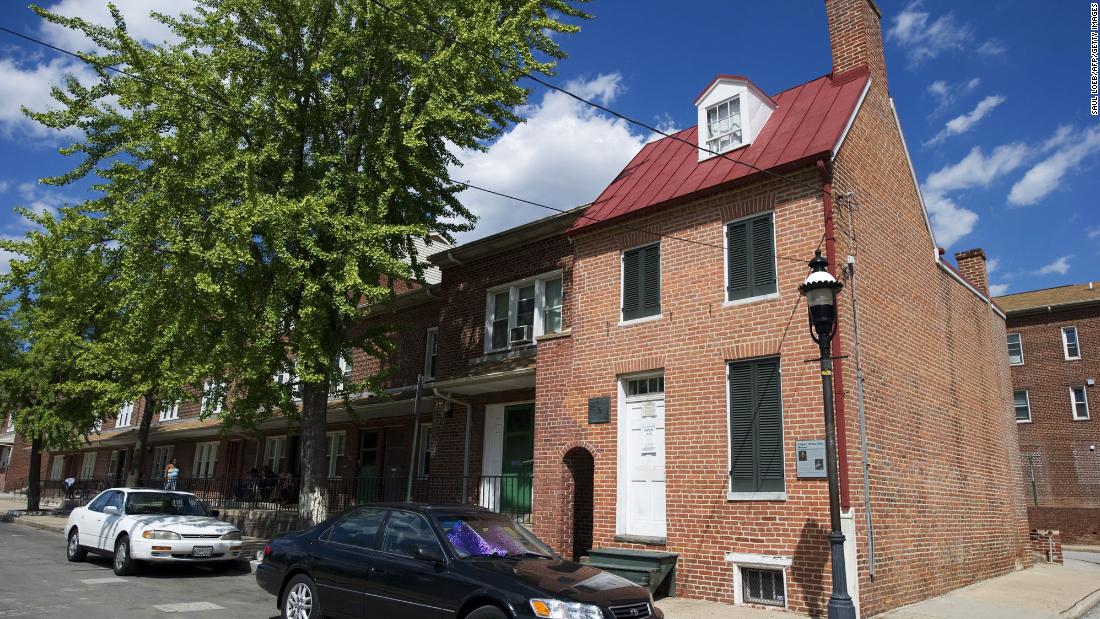
The Edgar Allan Poe House in Baltimore, Maryland is one of the most important literary landmarks in the United States and one of the most debated paranormal sites connected to an American author. Located in the historic Poppleton neighborhood, this small brick rowhouse is where Edgar Allan Poe lived during the early 1830s while building the foundation of his literary career. Today, it stands as a museum dedicated to his life, his work, and the darker themes that continue to define his legacy.
Baltimore itself played a major role in Poe’s personal and professional life. The city is also where he died under mysterious circumstances in 1849, adding another layer of intrigue to the house that preserves his early years.
Historical Background of the Edgar Allan Poe House
Poe lived in this modest two-story home from roughly 1832 to 1835 with his aunt Maria Clemm, his cousin Virginia Clemm, and his grandmother Elizabeth Cairnes Poe. At the time, Poe was struggling financially but beginning to gain recognition as a writer and editor.
During his stay in Baltimore, Poe is believed to have written or revised several early works, including parts of “Berenice,” “Morella,” and possibly early drafts of stories that would later define his Gothic style. The house reflects the poverty Poe endured, with cramped rooms, steep staircases, and minimal furnishings. It is a stark contrast to the grandeur often associated with famous authors, but an accurate reflection of his reality.
The house was saved from demolition in the early 20th century and eventually opened as a museum in 1949, marking the 100th anniversary of Poe’s death. It is now maintained by the Edgar Allan Poe Society of Baltimore.
Edgar Allan Poe’s Connection to Maryland
While Poe was born in Boston and raised in Virginia, Maryland became one of the most significant places in his life. Baltimore was home to his extended family and later became the city tied forever to his death and burial. Poe is buried at Westminster Hall and Burying Ground, only a short distance from the house.
If you are exploring haunted and historic locations in the state, this site is often considered essential reading for anyone interested in literary history in Maryland.
Reported Paranormal Activity at the Poe House
Over the years, staff members, visitors, and paranormal investigators have reported unexplained activity inside the house. While the museum does not officially promote the home as haunted, accounts from firsthand witnesses continue to circulate.
Reported experiences include:
- Unexplained footsteps on the narrow staircase when no one else is present
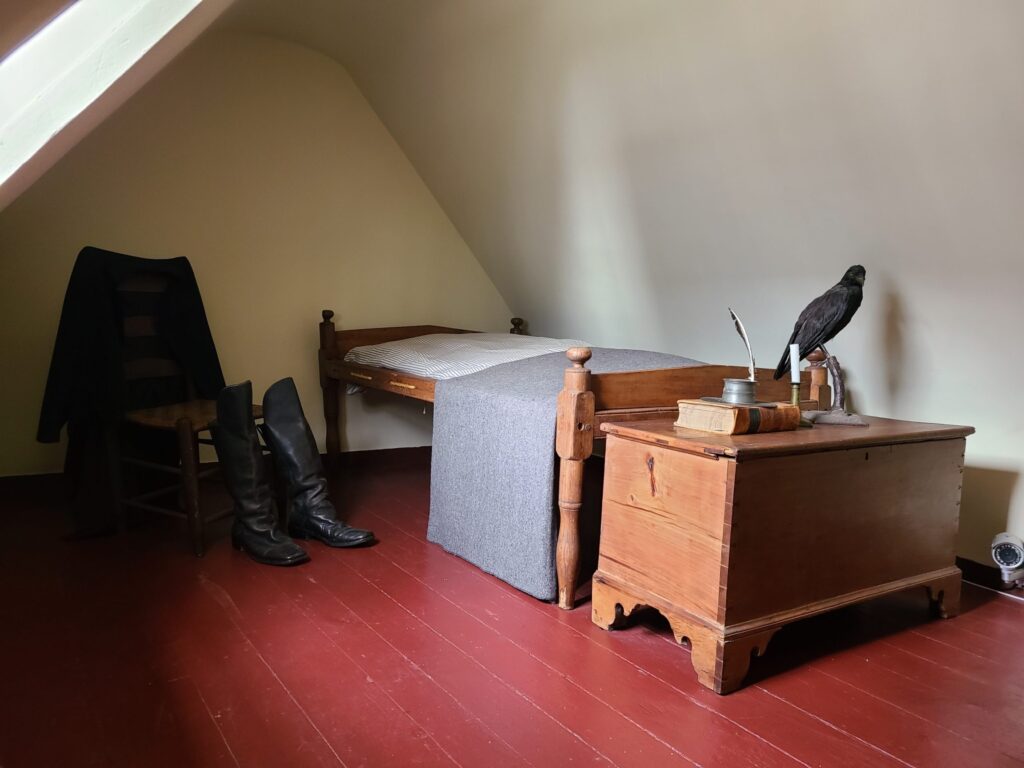
- Cold spots, particularly in the bedroom where Poe is believed to have slept
- The sensation of being watched in the upper floor rooms
- Electronic voice phenomena captured during private paranormal investigations
- Objects appearing to move or shift slightly between tours
Some visitors claim to feel sudden sadness or anxiety while inside the house, emotions often associated with Poe’s troubled life and writing style. Others report an overwhelming calm, as if the space is quietly observing rather than threatening.
There are no verified visual apparitions linked conclusively to Poe himself, but several investigators believe the energy in the house is residual rather than intelligent.
The House Today as a Museum
The Edgar Allan Poe House is preserved as a snapshot of early 19th-century working-class life. Exhibits include period furniture, reproduction artifacts, and interpretive panels explaining Poe’s family life, literary rise, and personal struggles.
Because of its size, tours are intimate and often guided, allowing visitors to ask detailed questions and explore the house at a slow pace. Photography policies vary depending on events and preservation concerns.
The house occasionally participates in literary events, anniversary commemorations, and Poe-themed programming tied to Baltimore’s broader celebration of his legacy.
Edgar Allan Poe’s Enduring Legacy
Few American writers have inspired as much fascination, speculation, and myth as Edgar Allan Poe. His influence stretches far beyond literature into psychology, horror cinema, true crime, and modern paranormal culture. The Baltimore house stands as a rare physical connection to a man whose inner world was far darker and more complex than the small rooms he once inhabited.
Whether visited for its historical importance or its eerie atmosphere, the Edgar Allan Poe House remains one of the most compelling literary landmarks in the country.
Exploring historic sites like this can be rewarding, but never trespass on property that is not open to the public. Ghost hunting and paranormal exploration can be dangerous, so always use caution and follow local laws.
Sources
Baltimore Heritage on Poe House: https://baltimoreheritage.org
Edgar Allan Poe Society of Baltimore: https://www.poeinbaltimore.org
Maryland Historical Trust: https://mht.maryland.gov
Frequently Asked Questions
Where is Edgar Allen Poe Home located?
Edgar Allen Poe Home is located at 203 N Amity Street, Baltimore, MD 21223.
Can you visit Edgar Allen Poe Home?
Edgar Allen Poe Home is open to the public. Always follow posted rules and respect private property.
Reader sightings
Nobody has reported anything here yet. If you have been, you would be the first.
Report your own visit to Edgar Allan Poe House in Baltimore: History and Hauntings
How haunted is this place?
Be the first to rate
Ghost Tours Nearby
 Baltimore Bewitched: Raven's Revenge, Bones & Ballads Ghost Tourfrom $26
 Baltimore Haunted Pub Crawl Fells Point Ghosts Bars and Poefrom $35
 The Original Fells Point Ghost Walk by Baltimore Ghost Toursfrom $26
Affiliate links: BeyondHaunted may earn a commission, at no extra cost to you.


Leave a Reply