
Reviewed by Josh N · Updated August 27, 2026 · How we verify
Reported Phenomena
- Spectral figures
- Phantom footsteps
- Cold spots
- Sense of being watched
- Screams & cries
Reported by visitors & local legend. Stories, not verified claims.
Address / Location: Arsenal Street, Augusta, Maine — on the east bank of the Kennebec River, just north of the former Augusta Mental Health Institute
The Arsenal is situated on a roughly 41-acre parcel.
Address: Arsenal Street
Historical Background & Use
Construction & Military Role (1828–1905)
- The Arsenal was commissioned by Congress in 1827, in response to tensions following the War of 1812 and concerns about border security in Maine. DigitalMaine
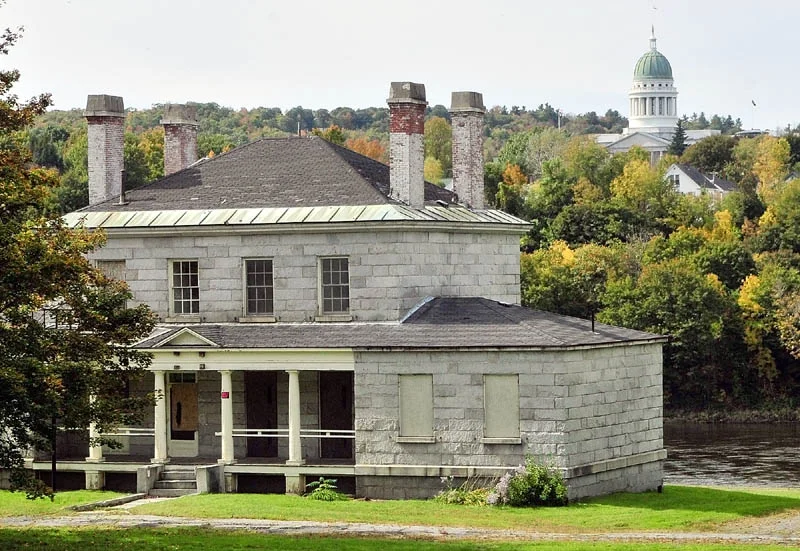
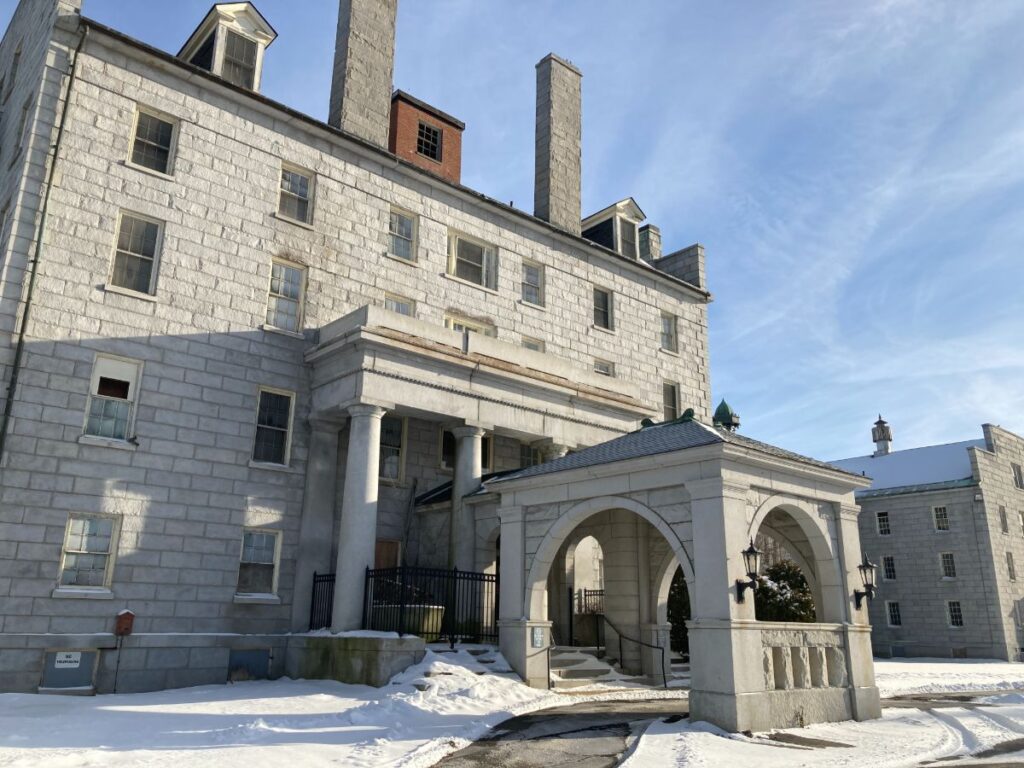
- Construction spanned from 1828 through about 1838. The complex originally included eight major granite buildings: officer and commandant’s quarters, barracks, stables, carriage shop, magazine buildings, a laboratory (for ordnance work), and ancillary structures. Clio
- A granite retaining wall and river wharf were built to facilitate the movement of munitions and supplies via the Kennebec River. DigitalMaine
- A perimeter fence combining granite piers with iron elements enclosed the complex. Wikipedia
- During the Aroostook Boundary Dispute (~1838), federal forces assembled and tension rose. The U.S. sent General Winfield Scott to the Arsenal in Augusta to mediate with New Brunswick authorities. The dispute was eventually settled in the 1842 Webster-Ashburton Treaty. CORE
- Over the mid-19th century, the Arsenal served primarily as a storage and ordnance depot. Though some arms were manufactured, the remote location limited large-scale production. Maine Preservation
Transition to Mental Health Use (1905 onward)
- In 1901, the U.S. Army formally ceased operations at the Arsenal. Wikipedia
- In 1905, federal ownership was transferred to the State of Maine for integration into the adjacent Maine Insane Hospital (later the Augusta Mental Health Institute, AMHI). Maine Preservation
- All wooden outbuildings (stables, shops, carriage house, etc.) were removed. The granite structures of the Arsenal were repurposed for hospital needs—housing patients, offices, support services. Wikipedia
- Interior modifications included installing new floors, iron staircases, kitchens, dining, and other institutional spaces to support hospital operations. DigitalMaine
- The Augusta Mental Health Institute (AMHI) was in continuous use until its closure in 2004, when operations shifted to the newer Riverview Psychiatric Center. Wikipedia
Preservation, Ownership, and Deterioration
- The Arsenal was listed on the National Register of Historic Places in 1970 and designated a National Historic Landmark in 2000, in recognition of its architectural integrity and significance as an early 19th-century military depot. Maine Preservation
- In 2007, the property was sold to a private developer (Main Street I LLC, led by Thomas Niemann of North Carolina). Maine Preservation
- The developer replaced several leaking roofs, but overall renovation and repurposing stalled. Wikipedia
- Over time, vandals damaged windows, removed copper and iron hardware, sprayed graffiti, and broke into buildings. Centralmaine.com
- In 2012, the Maine Attorney General’s office warned the owner of legal action unless the site was secured from vandalism, weather, and neglect. Wikipedia
- In 2022, the Augusta City Council deemed the buildings “dangerous,” citing fire hazard, structural decay, and inadequate maintenance, and gave the developer 90 days to make major repairs. Maine Preservation
- Public access has been limited due to safety and security concerns, though the Greenway Trail that skirts the property remains open under easement agreements. Centralmaine.com
Ghost Lore, Haunting Reports & Public Reputation
Institutional Suffering & Lore
- When the Arsenal property became part of the mental hospital, many adults and children with psychiatric conditions were housed there. Treatments of that era often included restraints, experimental therapies, and methods now viewed as harsh or abusive. DigitalMaine
- Some sources claim thousands died on the grounds during its period as a hospital, and that many were buried in unmarked graves on or near the property, though definitive burial records are scarce or inaccessible. Haunted Rooms America
- Because of the hospital’s status and the secrecy sometimes surrounding patient care, stories of residual torment, cries, and ghostly figures are widespread in local lore. Maine Haunted Houses
Reported Phenomena & Anecdotes
- Numerous accounts—including from paranormal websites—describe apparitions, heard murmurs or sobbing, footsteps in empty halls, and sensations of cold spots or unseen presences. Maine Haunted Houses
- Some investigations and ghost-tour operators include Kennebec Arsenal on haunted tours in Augusta. It has been featured in local ghost-tour lists and media coverage of haunted Maine. 94.9 HOM
- In the “Most Haunted Places in New England,” the site is often highlighted, connecting its past as a mental hospital to supposed paranormal echoes of suffering. New England
Architectural & Structural Notes (Risk & Interest)
- The original Arsenal design remained largely unchanged until conversion in 1905 to hospital use, making it one of the few surviving pre-1840 armory types in the U.S. Clio
- Many interior original features were lost or obscured during hospital renovations (floor leveling, new partitions, removal of vaults or armory infrastructure). DigitalMaine
- The site suffers from water infiltration, structural degradation, missing materials (metal, stonework), vandalism, and deferred maintenance. These raise hazards: unstable floors, falling masonry, mold, lead paint, rusted metal. Centralmaine.com
- Some of the tunnels or sub-structures rumored in lore may be former support passages or vaults, but their precise layout is unclear; many are sealed or unsafe. Maine Haunted Houses
Access, Legal & Safety Considerations
- The property is privately owned and entry without permission is illegal. Centralmaine.com
- The developer has blocked vehicle access to parking areas, citing past illegal activity (vandalism, trespass, drug or solicitation reports). Centralmaine.com
- Security has increased: video surveillance, security personnel, signage. Centralmaine.com
- Some public paths remain open (e.g. the Greenway Trail), though careful observation (not entry) is the legal and safe option. Centralmaine.com
- Because of structural decay, hazard zones inside the buildings are serious: collapsing walls, weak floors, poor lighting, unseen risks. Any sanctioned investigation must include structural assessment, liability waivers, proper safety gear, and permission from owners or local authorities.
Caution: Never trespass on property that isn’t yours without permission. Ghost hunting is dangerous—always use caution, proper equipment, and legal access.
Frequently Asked Questions
Where is Kennebec Arsenal located?
Kennebec Arsenal is located at Arsenal Street.
Reader sightings
Nobody has reported anything here yet. If you have been, you would be the first.
Report your own visit to Ghosts of the Kennebec Arsenal
How haunted is this place?
Be the first to rate
Leave a Reply