Reviewed by Josh N · Updated March 19, 2026 · How we verify
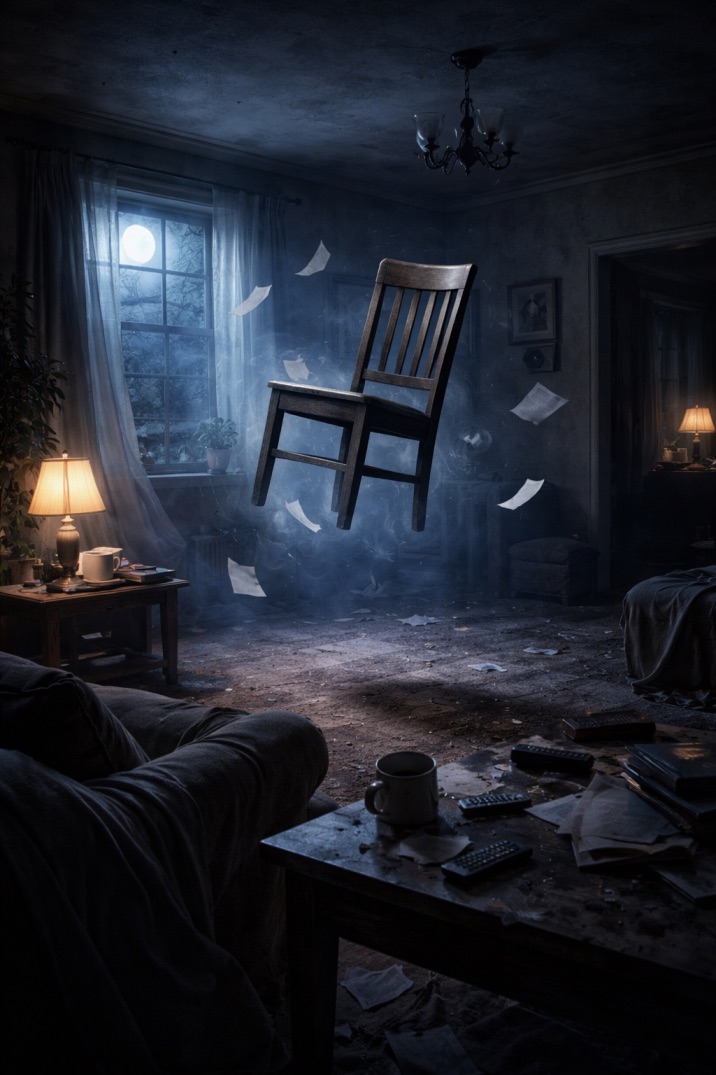
Few paranormal topics are as unsettling as the idea of a poltergeist. Unlike the classic ghost story, where an apparition appears in a hallway or a voice whispers from an empty room, a poltergeist account usually centers on motion, noise, and chaos. People describe pounding on walls, objects flying across rooms, furniture shifting on its own, lights malfunctioning, or household items breaking for no obvious reason. That combination of fear and physical disturbance is exactly why poltergeist stories have remained so compelling in folklore, paranormal investigation, and popular culture.
At the same time, poltergeists sit at the crossroads of belief and skepticism. In folklore and occult traditions, they are often treated as disruptive spirits. In parapsychology, they have sometimes been framed as expressions of psychokinesis linked to a living person rather than a dead one. In skeptical and medical discussion, many reported experiences can overlap with misinterpretation, pranks, structural noises, environmental factors, sleep-related hallucinations, or other natural explanations.
That tension is what makes the subject so fascinating. So what are poltergeists, exactly? The answer depends on whether you approach the subject through folklore, paranormal belief, psychical research, or critical investigation. What can be said with confidence is that the term has a long history, a recognizable set of reported features, and a reputation for being one of the most dramatic forms of alleged haunting.
What does the word poltergeist mean?
The word poltergeist comes from German. Britannica explains that it combines Polter, meaning “noise” or “racket,” with Geist, meaning “spirit.” Merriam-Webster similarly defines a poltergeist as a “noisy usually mischievous ghost” blamed for unexplained disturbances such as rappings. That basic meaning matters because it captures the core idea better than almost any modern movie depiction: a poltergeist is not primarily known for appearing, but for causing commotion.
Cambridge Dictionary also reflects that popular understanding, describing a poltergeist as a spirit or force that moves furniture and throws objects around in a house. Across sources, the common thread is not simply “ghost,” but a specific kind of reported disturbance involving sound, motion, breakage, or mayhem in a domestic setting.
What is the difference between a poltergeist and a ghost?
People often use the two words interchangeably, but they are not quite the same in folklore or paranormal writing. A ghost is generally understood as the spirit or specter of a dead person that may appear to the living. A poltergeist, by contrast, is typically described through its effects: loud knocks, thrown items, broken objects, shifting furniture, strange electrical behavior, or other seemingly physical disruptions. In other words, a ghost is often imagined as a presence you see or sense, while a poltergeist is more often described as a force you hear or feel acting on the environment.
That distinction is not absolute. In popular storytelling, a haunting may gradually be labeled a poltergeist haunting once activity becomes more aggressive. But historically and in reference works, poltergeist cases are usually a narrower category marked by repeated disturbances that appear violent, mischievous, or destructive.
What signs are commonly associated with poltergeist activity?
Reported poltergeist cases tend to repeat the same kinds of claims over and over. Researchers and reference sources commonly describe:
- unexplained knocking, banging, or rapping sounds
- furniture moving without an obvious cause
- small items being thrown or displaced
- objects breaking suddenly
- doors opening or closing on their own
- localized fires, water incidents, or electrical oddities in some cases
The Society for Psychical Research’s Psi Encyclopedia overview notes that poltergeist reports have traditionally included raps and knocks of unknown origin, violent movement of furniture and objects, and in some cases fires or inundations. Britannica echoes many of those same features, including noises, sudden movement, breakage, and occasional destructive incidents.
One reason poltergeist stories are so memorable is that they seem more external and physical than other paranormal claims. A strange shadow might be dismissed as imagination. A chair moving across a room or dishes crashing from a shelf feels, to a witness, much harder to rationalize in the moment. That does not prove a supernatural cause, but it does help explain why poltergeist claims tend to leave such a strong impression on the people involved.
How old is the idea of the poltergeist?
The belief behind the word is older than the English-language term itself. Human cultures have long told stories about troublesome spirits, household disturbances, and unseen forces that intrude into ordinary domestic life. Britannica places poltergeists within occult and supernatural belief, and the broader ghost tradition is rooted in the long-standing idea that the dead or unseen beings can interact with the living world.
What makes poltergeist stories especially durable is that they often grow out of everyday spaces: family homes, bedrooms, kitchens, barns, schools, or workplaces. They are not usually framed as distant legends from remote ruins. They are stories about a normal place becoming unpredictable. That domestic setting gives the phenomenon a peculiar power in folklore because it turns the familiar into something threatening. This is one reason poltergeist narratives keep resurfacing across centuries, even when the details change with the era.
How do paranormal researchers interpret poltergeists?
Within paranormal literature, there has never been just one explanation. Some believers treat poltergeists as spirits of the dead. Others describe them as non-human entities, demonic forces, or disturbances attached to a place. But in parapsychology, one of the best-known alternative theories is recurrent spontaneous psychokinesis, often shortened to RSPK or RSP.
The idea, discussed in the Psi Encyclopedia and other parapsychology references, is that some alleged poltergeist events may not be caused by an external ghost at all. Instead, they may reflect unconscious psychokinetic effects associated with a living individual, often called the “agent.” In many case discussions, that person is described as someone under emotional strain, frequently an adolescent, though that pattern is not universal and remains controversial. Importantly, this is a parapsychological theory, not an accepted scientific explanation.
That theory became influential because it tried to explain why some reports seemed to cluster around a particular person rather than a particular dead individual. It also attempted to account for why the activity in many stories appears brief, erratic, and hard to reproduce under controlled conditions. Even among those interested in paranormal research, however, there is no consensus that RSPK has been demonstrated.
Famous alleged poltergeist cases
The Bell Witch
One of America’s most famous spirit legends is the Bell Witch of Tennessee. The Tennessee State Museum describes the Bell Witch as an alleged apparition said to have tormented John Bell and his family in Robertson County beginning around 1816. Stories associated with the case include disembodied voices, thrown objects, and physical assaults, though the legend expanded significantly over time and became deeply embedded in Tennessee folklore.
The Bell Witch matters because it shows how quickly a local haunting narrative can evolve into a major regional legend. It also illustrates a recurring pattern in poltergeist lore: an alleged unseen force becomes known less through a clear visual apparition than through noise, attacks, and dramatic disruption. As a historical matter, the Bell Witch is best understood as an important American folklore case rather than a proven supernatural event.
The Enfield Poltergeist
Few modern cases are more famous than the Enfield Poltergeist, centered on a London home in the late 1970s. The Psi Encyclopedia summarizes reported phenomena including knockings, doors moving, furniture overturning, objects being hurled, picture frames ripped from walls, and occasional small fires. The case became internationally known through investigators, media coverage, and later books and films.
Enfield is also a good example of why the subject remains controversial. Believers argued that some of the incidents were genuine and could not be explained away. Skeptics argued that at least part of the case involved deliberate trickery or exaggerated reporting. Even in sympathetic accounts, the case is not presented as simple or clean. It sits in that murky middle ground where strong witness conviction, media amplification, and evidence of fakery can all coexist.
The Rosenheim case
Another often-cited case is the Rosenheim poltergeist of 1967 in Germany. It is frequently discussed in paranormal literature because of claims involving unusual electrical disturbances and because technicians and outside observers reportedly became involved. That case continues to circulate in parapsychology discussions as an example of a seemingly well-observed anomaly, but it remains disputed and is not accepted as proof of paranormal forces by mainstream science.
Why do poltergeist stories seem so believable to witnesses?
One reason is simple: many reports are grounded in ordinary sensory experience. A person hears a heavy bang, sees an object fall, notices a door move, or feels sure something touched them in bed. Experiences like that can be emotionally overwhelming, especially when they happen at night, recur over time, or involve children. A person does not need to believe in ghosts in advance to feel frightened by a sequence of events that appears pattern-like and intentional.
Another reason is that human beings are natural pattern-makers. When several odd things happen in a short span, people try to connect them into a single narrative. If the explanation offered by family, friends, media, or local folklore is “haunting” or “poltergeist,” the experience may begin to feel even more coherent and convincing. That does not mean witnesses are dishonest. It means interpretation happens fast, especially under stress and fear.
Skeptical and natural explanations for alleged poltergeist activity
A balanced discussion of poltergeists has to include the fact that many reported signs have ordinary explanations.
1. Hoaxes, pranks, and exaggeration
This is the explanation skeptics return to most often, especially in high-profile cases. In the Enfield case, for example, critics argued that some incidents were staged and that the evidence was weakened by the lack of controlled conditions. Once a haunting receives attention, it can also become easier for witnesses or bystanders to embellish details, intentionally or not.
That does not automatically invalidate every witness in every case. It does mean that any dramatic report involving thrown objects or moving furniture should be approached carefully, particularly when children, media attention, or emotionally charged family dynamics are involved.
2. Structural, mechanical, and environmental causes
Homes make noise. Pipes knock. foundations settle. air pressure shifts doors. shelves fail. vibrations from traffic or appliances can move loose items. Even when a cause is natural, it may not be obvious in the moment. Merriam-Webster’s example usage for “poltergeist” even includes a mundane reveal: dishes seemed to be knocked off shelves, but the cause turned out to be vibrations from passing trains.
Environmental factors can also influence perception. In a widely discussed paper, Vic Tandy and Tony Lawrence proposed that a standing air wave around 19 Hz could, under certain conditions, contribute to unusual sensory experiences suggestive of a haunting. That does not explain all haunting or poltergeist reports, but it is a reminder that unusual physical environments can affect how a place feels and how events are interpreted.
3. Carbon monoxide and other health hazards
Carbon monoxide poisoning is one of the most important non-paranormal possibilities to consider in any allegedly haunted home. The CDC lists common symptoms including headache, dizziness, weakness, upset stomach, vomiting, chest pain, and confusion. Because confusion and altered perception can accompany exposure, a dangerous household leak can sometimes be mistaken for something supernatural.
This matters for practical reasons, not just skeptical ones. If someone believes they are experiencing a haunting, checking for carbon monoxide, faulty heating systems, wiring problems, mold, or other safety issues is far more important than debating ghosts first. A frightening experience can be emotionally intense and still have a medical or environmental cause.
4. Tinnitus and unexplained sounds
Not every mysterious noise in a house is actually in the house. The American Academy of Audiology explains that tinnitus is the perception of sound in the ears or head in the absence of an external sound. Ringing, buzzing, roaring, and similar internal sounds can be misread as external phenomena, especially late at night in a quiet environment.
Tinnitus does not explain moving objects, of course, but it does help account for why some people sincerely report hums, tones, or persistent sounds that others cannot hear. In a paranormal setting, that can easily be folded into a larger haunting narrative.
5. Sleep paralysis and hypnagogic hallucinations
Many haunting stories involve a person waking at night, sensing a presence, feeling pressure, being unable to move, or seeing a figure in the room. Cleveland Clinic explains that sleep paralysis can occur as a person is falling asleep or waking up and may involve hallucinations, including the sensation that a dangerous person is in the room. Cleveland Clinic also notes that hypnagogic hallucinations are brief hallucinations that occur while falling asleep and are common.
Again, this does not explain every alleged poltergeist case, especially those centered on multiple witnesses or claimed object movement. But it does explain why deeply paranormal-feeling nighttime experiences can arise from ordinary sleep phenomena. For many people, the experience is terrifying precisely because it feels real while it is happening.
Are poltergeists considered real?
That depends on what standard of proof you apply. In folklore and paranormal belief, poltergeists are absolutely “real” as a category of experience and storytelling. They have a stable identity in language, legend, psychical research, and modern media. Britannica and major dictionaries recognize the term because the concept is long established in culture.
But if the question is whether science has confirmed poltergeists as actual disembodied entities that move objects around homes, the answer is no. Britannica notes that paranormal subjects are commonly treated as pseudoscience, and the major cases most often cited remain controversial rather than conclusive. Evidence is usually anecdotal, conditions are rarely controlled, and disputes over fraud, misperception, and interpretation are common.
That leaves poltergeists in a strange category: culturally vivid, experientially powerful, but evidentially unresolved. For believers, that unresolved quality keeps the mystery alive. For skeptics, it is the reason the subject demands caution. For most readers, it is why poltergeists remain one of the most compelling ideas in the paranormal world.
What should you do if you think you’re experiencing a poltergeist?
Start with the practical. Rule out safety hazards, faulty appliances, loose shelving, pest activity, bad wiring, carbon monoxide, and structural causes. Document what is happening with times, dates, weather, house conditions, and whether anyone else witnessed it. Be especially careful with dramatic claims involving fires, smells, dizziness, or nighttime episodes. Those details can point toward a real-world cause that needs immediate attention.
If nothing obvious explains the disturbances, that does not automatically make the cause supernatural. It just means more investigation is needed. The strongest approach is calm, methodical, and safety-first. That mindset protects you whether the explanation turns out to be paranormal, psychological, environmental, or entirely mundane.
Final thoughts
So, what are poltergeists? In the simplest sense, they are alleged noisy, disruptive unseen forces associated with banging sounds, moving objects, breakage, and domestic chaos. In folklore, they are often framed as malicious spirits. In parapsychology, they have sometimes been interpreted as psychokinetic effects tied to a living person. In skeptical inquiry, they are often explained through hoaxes, environmental conditions, perception errors, health issues, or sleep-related experiences.
What makes poltergeists endure is not that they have been proven, but that they sit so close to ordinary life. A haunted castle is easy to keep at a distance. A kitchen cabinet slamming shut by itself is not. That is why the poltergeist remains one of the most haunting ideas in paranormal culture: it suggests that the chaos is not somewhere else. It is in the house with you.
Sources
- Merriam-Webster, “Poltergeist.”
- Encyclopaedia Britannica, “Poltergeist.”
- Psi Encyclopedia, “Poltergeists (Overview).”
- Tennessee State Museum, “Tennessee Legends: The Bell Witch.”
- Cleveland Clinic, “Sleep Paralysis.”
- Tandy, Vic, and Tony R. Lawrence, “A Ghost in the Machine.”
Reader sightings
Nobody has reported anything here yet. If you have been, you would be the first.
Leave a Reply