Reviewed by Josh N · Updated March 17, 2026 · How we verify
Few American paranormal stories have held on as tightly as the tale of the Hopkinsville Goblin. Depending on who is telling it, this is either one of the strangest alleged alien encounters in U.S. history or one of the most famous examples of fear, folklore, and misidentification colliding in real time. What makes the case so enduring is not just the image of small, glowing-eyed creatures around a farmhouse. It is the fact that a large group of witnesses ran to police in obvious distress, officers responded in force, and the event quickly escaped local rumor to become national news.
The story is more accurately called the Kelly-Hopkinsville encounter, because it took place near the tiny community of Kelly, outside Hopkinsville, in Christian County, Kentucky, on the night of August 21, 1955. Over time, the reported beings became known as the Hopkinsville Goblins or Kelly Green Men, but that popular language came later. In the earliest retellings, the creatures were more often described as small metallic or pale humanoids, not the cartoonish bright-green aliens people often picture today.
What is the Hopkinsville Goblin?
At its core, the Hopkinsville Goblin story is about a farmhouse siege claim. According to the accounts given to police, members of the Sutton family and their visitors believed strange creatures had approached their home repeatedly over the course of several hours. The event became famous because of three things: the number of witnesses, the vivid descriptions, and the fact that law enforcement took the complaint seriously enough to investigate that night. HISTORY notes that when the witnesses arrived at the police station around 11 p.m., they were described as genuinely terrified, not playful or casual.
That fear has always been one of the strongest pillars of the legend. Police chief Russell Greenwell later said these were not the kind of people who would normally run to police for help, and one man’s pulse was reportedly measured at 140 beats per minute. Even people who reject an extraterrestrial explanation often concede that the panic appears to have been real.
How the night began
According to witness statements, the episode started around 7 p.m. when family friend Billy Ray Taylor went outside to fetch water from the backyard well. He reported seeing a bright silvery object with a colorful exhaust move silently near the house and descend beyond the property. The others did not initially believe him and treated it as a joke or exaggeration.
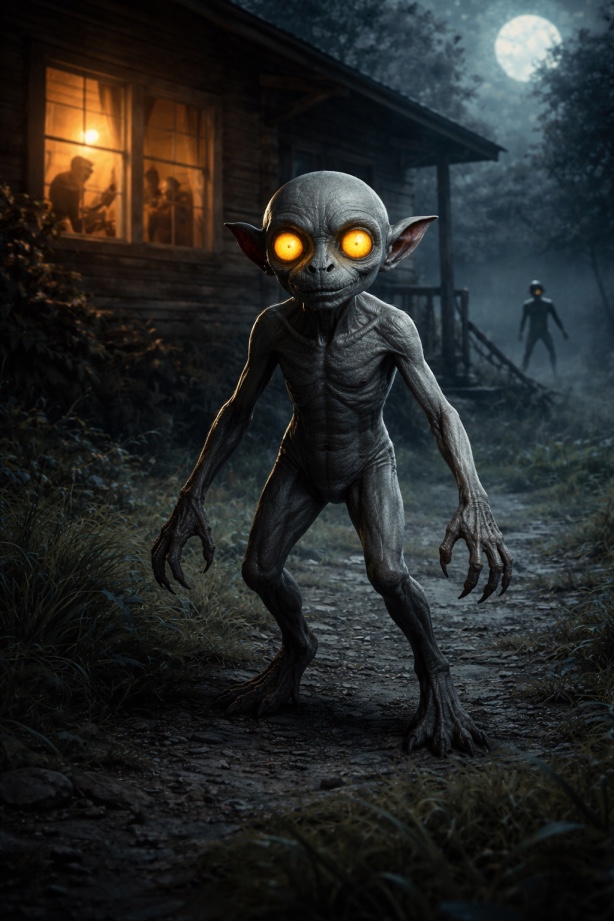
Roughly an hour later, the mood changed. After the family dog began barking, Taylor and Elmer “Lucky” Sutton went to investigate and said they saw a small glowing humanoid approaching from the dark. That moment is the hinge point in the entire story: before it, the strange object in the sky could have been dismissed; after it, the event became a full-blown farmhouse terror narrative.
What the creatures were said to look like
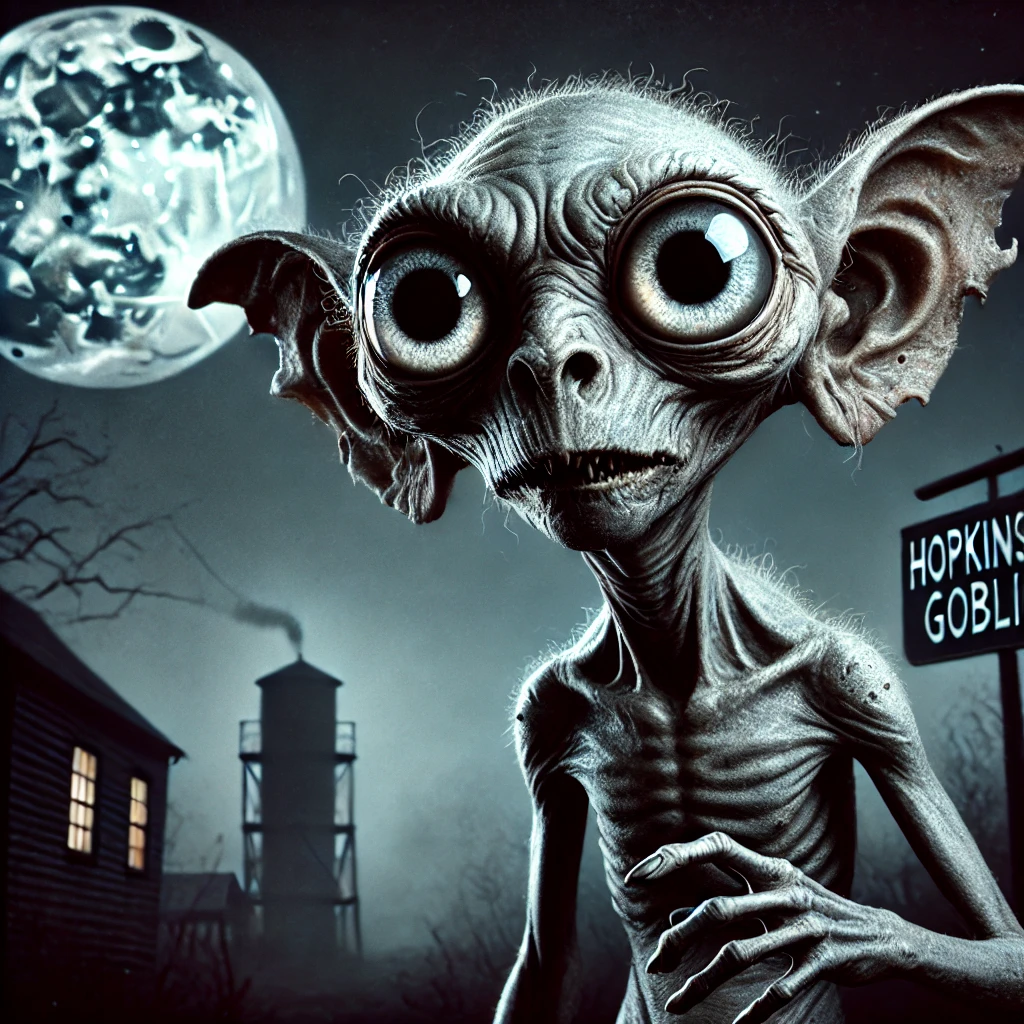
Descriptions varied in later retellings, but the most frequently cited early account described a being around three to three-and-a-half feet tall with an oversized round head, long arms that nearly reached the ground, claw-like hands, large ears or ear-like points, and yellowish glowing eyes. Witnesses also said the body seemed to shimmer or look metallic in the moonlight.
Those details matter because they shaped the creature’s afterlife in pop culture. The Hopkinsville Goblin is not remembered as a typical flying-saucer alien. It occupies a stranger space between alien, goblin, owl, and nightmare figure. That ambiguity is one reason the case still feels more unsettling than many other mid-century UFO stories.
The reported attack at the farmhouse
The men inside the house armed themselves with a shotgun and a rifle and fired at what they believed were intruders. Witnesses later said the creatures seemed oddly unaffected, flipping backward or floating away rather than collapsing in a way they expected after being shot. One was allegedly seen at a window, another on or near the roofline, and another near a tree after a hand-like shape reportedly reached down and touched Taylor’s hair under an overhang.
This part of the story is where folklore really took hold. The idea that bullets did not stop the beings transformed the report from a scary trespassing incident into something uncanny. Still, it is important to separate the verified fact from the allegation: what is verified is that the family reported these things and fired weapons; what is not verified is that nonhuman creatures were actually present.
The dash to the police station
By about 11 p.m., the group fled the property and drove to the Hopkinsville police station. HISTORY reports that there were 11 witnesses total: eight adults and three children. Their arrival was dramatic enough that local police called for backup. Soon, police, state police, military police from nearby Fort Campbell, and a newspaper photographer were involved in the response.
When investigators reached the farm that night, they found shell casings from the gunfire but no clear proof that creatures had attacked the home. They also reportedly found no proof of heavy drinking. The lack of physical evidence became central to every later interpretation, whether skeptical or believing.
What investigators found the next day
Police returned the following day and searched for signs of a landing, footprints, blood, or damage that would confirm the most dramatic parts of the witnesses’ account. According to HISTORY, they found none of those things. No saucer marks. No blood trails. No definitive scratch marks that proved a rooftop intruder.
At the same time, the story did not vanish because the witnesses remained consistent enough to keep it alive. Local radio employee Bud Ledwith interviewed the adults and created drawings based on their descriptions. Isabel Davis later produced one of the best-known in-depth investigations of the case, arguing that the witnesses were specific and unusually consistent for people supposedly inventing a mass hoax under pressure.
How a local incident became a national legend
Once newspapers and radio stations picked up the story, curiosity seekers descended on the farm. HISTORY reports that the family was mocked, swarmed, and eventually tried charging admission to control the crowds. That decision only deepened suspicion among skeptics, but it also shows how quickly the event had become a spectacle beyond the family’s control.
This is also where the mythology started to mutate. As the story spread, the number of creatures often increased in retellings, and the phrase “little green men” became attached later rather than describing the earliest core account. That distinction matters for anyone writing about the Hopkinsville Goblin today, because the popular version is already one step removed from the original reports.
Skeptical explanations: owls, meteors, and fear
The leading skeptical theory is that the witnesses misidentified owls, particularly great horned owls. HISTORY notes that investigator Joe Nickell argued Billy Ray Taylor’s bright object in the sky could align with meteor reports from that day, while the “little men” themselves could have been owls reflecting moonlight. He specifically pointed to traits that overlap with the witness descriptions: large ear-like tufts, yellow eyes, talons, and a shape that could look eerie in low light.
That explanation becomes more plausible when you look at the bird itself. Audubon and the Cornell Lab’s All About Birds both describe the great horned owl as a largely nocturnal bird with conspicuous ear tufts and yellow eyes, exactly the sort of visual features that could look uncanny at night to frightened witnesses on a rural property.
There is still debate even within skeptical tellings. A 2014 article in Frontiers in Psychology uses the Hopkinsville Goblins as an example for teaching scientific skepticism and states that the “aliens” had an earthly explanation in great horned owls, while also suggesting intoxication probably played a role. But that interpretation sits alongside historical reporting that officers found no proof of heavy drinking at the scene. In other words, the case is famous partly because even skeptical explanations do not neatly erase every uncomfortable detail.
Why the case still fascinates people
The Hopkinsville Goblin survives because it sits in a rare middle ground. It is too well-known and too witness-heavy to disappear as a forgotten local ghost story, yet too thin on hard evidence to become a solved mystery. That unresolved tension keeps the story alive. Believers see sincerity and multiple eyewitnesses. Skeptics see panic, darkness, suggestion, and familiar animals transformed into monsters.
The community itself has not tried to bury the story. Hopkinsville’s museum organization invites visitors to explore the region’s “rich – and sometimes bizarre – history,” and the city’s official tourism guide still lists Kelly “Little Green Men” Days among its annual August events. Public radio station WKMS has also documented how the encounter inspired an annual festival, a stage musical, and even pop-culture comparisons to Pokémon’s Sableye.
So what really happened?
The most honest answer is that we know something happened, but we do not know that aliens happened. What can be verified is that a frightened group went to police in 1955, described small humanoid figures around a farmhouse, and triggered a real law-enforcement response. What cannot be verified is the existence of extraterrestrial beings, goblins, or any physical craft at the site. The evidence that survives is overwhelmingly testimonial, not material.
That does not make the story worthless. Quite the opposite. The Hopkinsville Goblin is one of the clearest examples of how folklore forms in modern America. It reveals how fear, local reporting, rumor, Cold War imagination, and media amplification can turn a single strange night into a permanent national legend. Whether you read it as a UFO case, a cryptid story, or a lesson in human perception, it remains one of Kentucky’s most unforgettable mysteries.
FAQ: The Hopkinsville Goblin
Was the Hopkinsville Goblin a real creature?
There is no verified physical evidence proving a nonhuman creature was present. What is real is the 1955 report itself, the witnesses’ fear, and the police response that followed.
Where did the Hopkinsville Goblin story happen?
The event happened near Kelly, outside Hopkinsville, in Christian County, Kentucky, on the night of August 21, 1955.
How many people saw the Hopkinsville Goblin?
The best-supported summary from HISTORY says 11 people, including eight adults and three children, arrived at the police station after the event.
What is the most common skeptical explanation?
The most common skeptical explanation is misidentified great horned owls, possibly combined with meteor sightings, darkness, stress, and heightened fear.
Sources
- History.com
- Frontiersin.org
- Audubon Society
- Allaboutbirds.org
- Museums of Hopkinsville
- Visit Hopkinsville
Reader sightings
Nobody has reported anything here yet. If you have been, you would be the first.
Leave a Reply