

Reviewed by Josh N · Updated September 29, 2025 · How we verify
There’s no scientific evidence that dogs can see ghosts. But dogs perceive the world with sensory powers that often outstrip ours by orders of magnitude, especially smell, motion detection in low light, and high-frequency hearing. Those abilities routinely make dogs notice things we miss, which can look—and feel—“paranormal.” American Kennel Club
What dogs can sense that we usually can’t
Vision (low light, motion, and possibly UVA)
- Low-light & motion: Dogs’ eyes trade fine daytime detail for better motion detection in dim light, aided by a reflective layer (tapetum lucidum). This can make a dog fixate on movement humans never register. dvm360
- Color & spectrum: Dogs are dichromats (blues/yellows well; reds poorly). Importantly, the ocular lenses of dogs transmit significant amounts of UVA (315–400 nm), wavelengths typically filtered by human eyes. That means dogs may see high-energy bluish light we can’t, which can make certain surfaces, optical brighteners, or traces fluoresce to them and not to us. SpringerLink
- Breed/individual differences: Retinal wiring varies across breeds. Long-nosed (dolichocephalic) dogs tend to have a horizontal visual streak good for scanning horizons; short-nosed (brachycephalic) dogs have a more pronounced area centralis favoring detail straight ahead—differences that can change what they notice first. Visual acuity itself varies widely between breeds. PMC
Hearing (high frequencies and faint sounds)
- Typical canine hearing spans roughly ~63–47,000 Hz, well above the human top end (~20,000 Hz). High-pitched electronics, rodent activity in walls, or distant mechanical squeal can be obvious to a dog and inaudible to you. PMC
Smell (orders of magnitude beyond ours)
- Dogs have hundreds of functional olfactory receptor genes and a vast olfactory epithelium (~150–170 cm²)versus ~5–10 cm² in humans; far fewer of their olfactory genes are pseudogenes compared with humans. In practice, their smell-world is richer, more directional, and exquisitely sensitive to faint, fleeting traces. PMC
- Their vomeronasal organ (accessory olfaction) also parses social/chemical cues humans overlook. Dogs can even discriminate human stress odors in controlled, double-blind tests. PMC
Takeaway: A dog that suddenly stares down a hallway or “tracks something” across a room is very likely responding to real stimuli, just ones you didn’t see, hear, or smell. That can include UVA glint, a faint draft moving a cobweb, an ultrasonic squeak, or an odor trail from earlier activity.
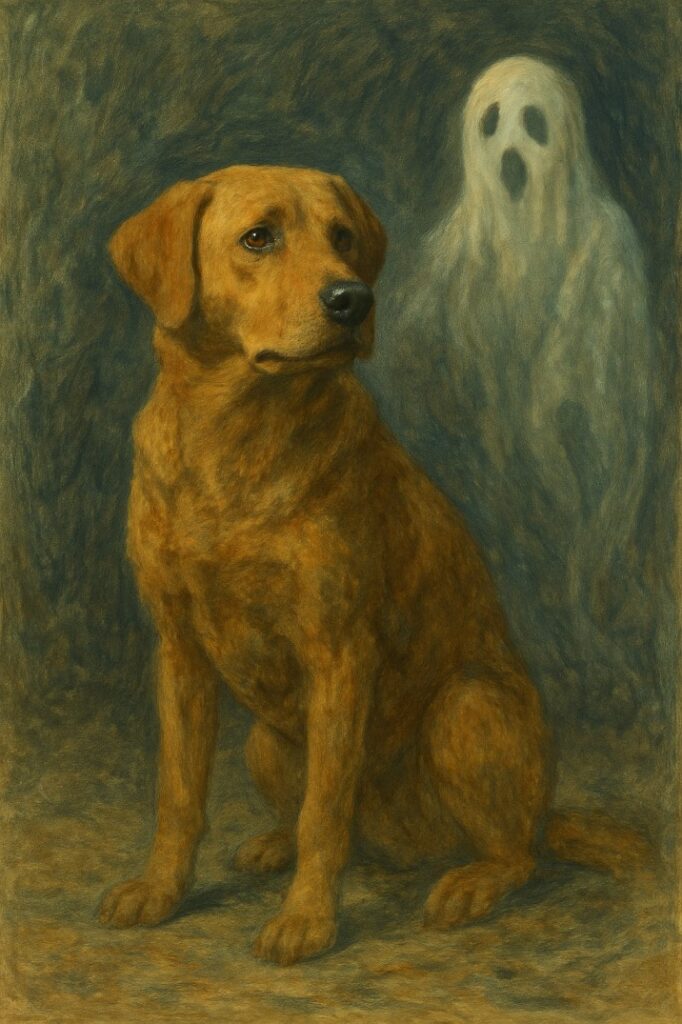
“Case studies”: What’s been tested when people claim paranormal-like abilities?
1) The “Jaytee” experiments (does a dog know when its owner is coming home?)
- Skeptical replication: Psychologist Richard Wiseman’s team ran controlled trials with randomized return times and ruled-out cues; their published analysis did not support the claim that Jaytee psychically anticipated the owner’s return. PubMed
- Proponent’s data: Rupert Sheldrake reported videotaped experiments suggesting increased window-waiting near return times; his interpretation remains controversial and is not broadly accepted by mainstream psychologists. Rupert Sheldrake – Author and Biologist
Why it matters here: This is the closest thing to a “paranormal dog” claim in the literature, and it shows how hard it is to separate subtle normal cues (routine timing, distant car sounds, olfactory trails) from extraordinary explanations.
2) Animals and earthquakes
- Motion-tagged farm animals (including dogs) sometimes change activity before tremors, possibly reacting to each other or to environmental precursors—but the phenomenon is not consistent enough for prediction, and agencies like USGS state animals cannot predict earthquakes. Scientific American
3) Medical scent detection (not paranormal, but instructive)
- Trained dogs can detect disease-linked volatile compounds (e.g., some cancers, infections) in blinded studies, with performance ranging from promising to strong depending on task and protocol—proof that dogs often respond to real but hidden chemical signals. PMC
So why do some dogs “act like they see something”?
Here are ordinary mechanisms that routinely produce “spooky” behavior:
- High-frequency or faint sounds: Distant HVAC bearings, phone chargers, pest chirps, or a neighbor’s device can fall in the 8–45 kHz band dogs hear well. Expect ear-cocking, head tilts, fixating at doors/walls. PMC
- Low-light motion + UVA/blue scatter: A draft moving a threadlike web, a flying insect, reflective dust, or detergent brighteners catching UVA can become salient moving stimuli for dogs, especially in hallways and stairwells. PMC
- Thunderstorm cues & static: Storm-phobic dogs react to pressure changes, ozone/“rain” smell, and static shocks, sometimes well before thunder reaches you. This can look like “foreboding” or staring at “nothing.” Today’s Veterinary Practice
- Human state changes: Dogs pick up stress odors and altered body language; if a house feels tense, they may patrol, stare, or stick to you. PLOS
Do some breeds notice “ghost-like” stimuli more than others?
There’s no evidence that any breed is “better at seeing ghosts.” There is evidence of sensory and visual processing differences that might make some dogs seem more reactive:
- Sighthounds (e.g., Whippet, Greyhound): Strong motion sensitivity; wide visual fields for scanning—more likely to lock onto tiny movements at distance. Acuity varies widely across breeds. Semantic Scholar
- Brachycephalic companions (e.g., Pug, Frenchie): More front-focused area centralis, potentially favoring near-field detail and eye contact with humans—may fixate where you look and where indoor lights flicker. PubMed
- Scent hounds & shepherds (e.g., Bloodhound, GSD): Larger olfactory epithelia and work selection for tracking/guarding can make them hyper-responsive to faint scents and subtle environmental change. Encyclopedia Britannica
Bottom line: Individual temperament, training, and confidence matter far more than breed when it comes to “mysterious” reactions.
Are dogs actually used in ghost hunting?
Historically: Victorian-era psychical organizations (e.g., Ghost Club, Society for Psychical Research) investigated hauntings and sometimes noted animal reactions, but credible, controlled evidence that animals detect spirits never materialized. Terrible Tours – Tours That Entertain
Today: Some tour operators and paranormal teams bring a dog as a companion/“trigger” (hoping a presence interacts with an animal) and to flag environmental change. Example: the “ghost-hunting dog of Savannah” on AKC’s site. These are anecdotal practices, not validated detection methods. American Kennel Club
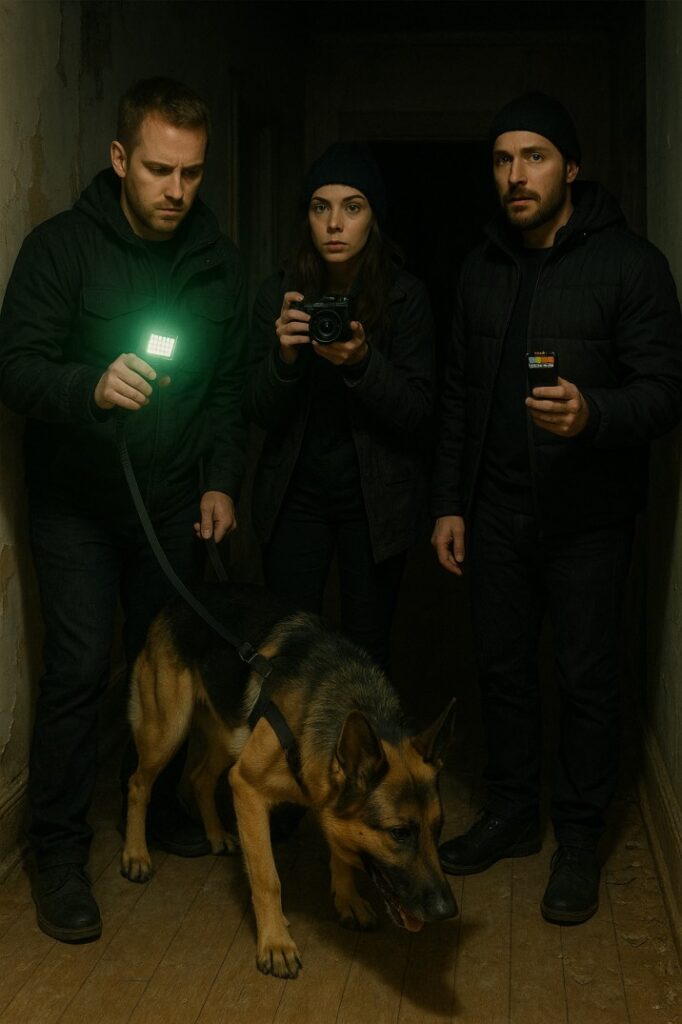
If your dog is acting like it “sees something,” a practical checklist
- Rule out health issues: Sudden staring, startle, or snapping at the air can reflect vision, hearing, neurological, or pain problems—start with your vet. (General veterinary guidance supports medical first.) dvm360
- Inspect the environment:
- Turn off ultrasonic pest repellers, switch out buzzing chargers/dimmers, and listen at night when the house is quiet. PMC
- Sweep a flashlight at floor and ceiling lines to spot webs/insects/dust motes, check vents for drafts. Blue/UV-reactive cleaners can glow to dogs. PMC
- During storms, reduce static (humidifier, anti-static sprays on bedding) and provide a safe den; storm-phobia is well documented. Today’s Veterinary Practice
- Consider your own state: If you’re anxious, your dog may mirror it—studies show dogs detect and react to human stress odors. PLOS
- Training & enrichment: Confidence-building (reinforcement games, scentwork) often reduces “mysterious” vigilance by giving the dog a job and an outlet.
What would count as real evidence that dogs sense ghosts?
- Pre-registered, blinded protocols in truly haunted-unknown and control locations, with instrumented environments (audio spanning >40 kHz, thermal/airflow/EM logs, UV/IR video) and independent observers.
- Replicable, above-chance correlations between canine alerts and environmental anomalies that are not explained by known sensory channels.
To date, no such body of evidence exists. The closest controlled lines of research (medical scent detection, stress odor discrimination) argue that dogs are reacting to natural, measurable cues. PMC
Conclusion
Dogs probably don’t see ghosts, but they often perceive real, subtle changes in a home that we miss. Understanding how dogs see (low light/motion and possibly UVA), hear (into ultrasonic), and smell (extraordinary sensitivity) demystifies most “haunting” moments. If you enjoy paranormal investigation, bringing a dog can be engaging, but treat canine reactions as leads to investigate naturally first, not proof of the supernatural. PMC
Reader sightings
Nobody has reported anything here yet. If you have been, you would be the first.







Leave a Reply