
Reviewed by Josh N · Updated August 25, 2026 · How we verify
Reported Phenomena
- Spectral monk sighting
- Figure vanishing into wall
- Headless horseman monk
- White lady apparition
Reported by visitors & local legend. Stories, not verified claims.
Red sandstone walls still stand to the wallhead in a wooded hollow north of Barrow-in-Furness, and the stories that cling to them are older than most of the guidebooks. The Furness Abbey ghosts are said to number at least three, and one of them, a headless monk on horseback, is among the better known apparitions in Cumbria. What follows separates what the record says about this place from what people claim to have seen in it.
The essentials first. Furness Abbey, also called St. Mary of Furness, dates back to 1123. It was once the second-wealthiest and most powerful Cistercian monastery in the country, behind only Fountains Abbey, before its dissolution during the English Reformation. The complex contains five Grade I listed buildings and structures and is a Scheduled Monument, and it is now in the care of English Heritage. The ruins reach a maximum height of 40 metres.
Founded in 1123 in the Vale of Nightshade
Stephen, Count of Boulogne, founded the house in 1123, originally for the Order of Savigny. The first site chosen was at Tulketh on the banks of the River Ribble, but after three years the monks judged it unsuitable and moved to Furness, into the valley known as the Vale of Nightshade, south of Dalton-in-Furness. The abbey is built entirely out of local sandstone. In 1147 it passed to the Cistercians, who gradually enlarged and rebuilt the original ornate church, and the majority of what stands today dates from the 12th and 13th centuries. By the 15th century it had been completely remodelled.
Its monks were large landowners and the most powerful body in what was then a remote border territory. Their influence reached across the Irish Sea to the Isle of Man: Rushen Abbey was built on land they owned, they held mines on the island, and they built Piel Castle to control trade between the Furness Peninsula and the Isle of Man. One of the kings of Mann and the Isles is buried at the abbey, as are many of the Bishops of Sodor and Man.
A Poisoned Chalice and the Raids from the North
Two incidents in the medieval record supply most of the abbey’s darker atmosphere. In around 1246, Abbot Laurence Acclorne died in suspicious circumstances, possibly murdered by three monks poisoning his communion chalice. Then in 1316 the abbey was sacked by Robert the Bruce and had to be abandoned for two years. When Bruce invaded England again during the Great Raid of 1322, the abbot paid to lodge and support him rather than risk the abbey’s wealth and power. The monks fortified the castle of Piel Island in 1327 to defend the abbey’s harbour. The Black Death reached them in 1349 and probably killed the majority of the community.
Alexander Pyle Surrenders the Abbey in Spring 1537
Furness remained wealthy into the 16th century, with the west tower still under construction on the eve of the Reformation. It was also badly run. The high-handed, duplicitous and bullying rule of Abbot Alexander Banke led to the abbey being raided by the Earl of Derby in 1514, though his favour with the king saw him restored to the abbacy two years later. Several Furness monks supported the Pilgrimage of Grace, which aimed to prevent Henry VIII’s Dissolution of the Monasteries, and were executed for it. Abbot Alexander Pyle surrendered the abbey in spring 1537, making it the first of the wealthier houses to fall.
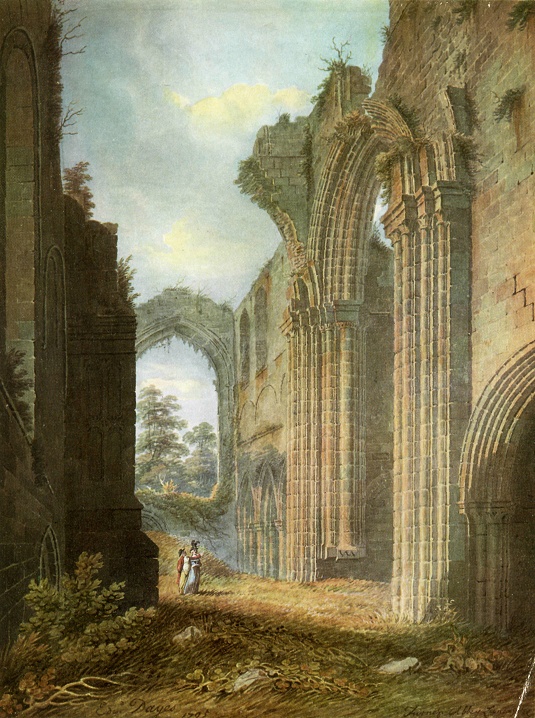
Demolition was brisk. The royal commissioners began work before the monks had even left. Some outbuildings became a manor house, which by the 18th century had descended to farm status while the massive ruins became a favourite of Romantic tourists. William Wordsworth visited several times and referred to the abbey in his 1805 autobiographical poem The Prelude; J. M. W. Turner made numerous etchings of it. Queen Victoria and her lady in waiting Augusta Stanley visited in 1848, a fact known from Stanley’s diaries. A young Theodore Roosevelt and his siblings played on the ruins in 1869, when they were not roped off or restricted. In 1896 the Chinese statesman Li Hongzhang came while touring industrial Northern England and stayed longer than expected, forcing his schedule to be rearranged. The ruins were handed over to state care in 1923.
What Still Stands: the East Range, the Sedilia and a Water-Filled Drain
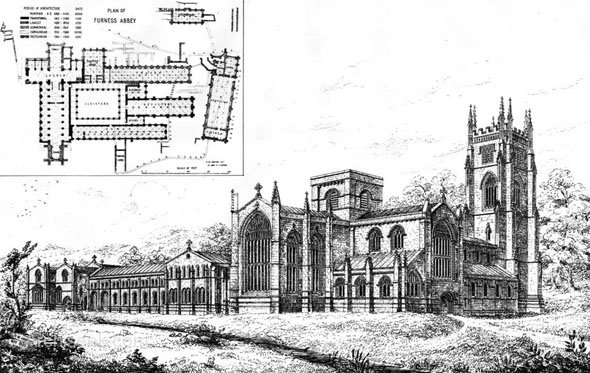
The surviving fabric is extensive and rewards a slow walk. Of the cruciform church, the late 12th century transepts, a fine example of Cistercian early Gothic architecture, and the 15th century Perpendicular Gothic presbytery still stand to the wallhead. The night stairs door remains in the south transept, and the presbytery retains an elaborate sedilia. The nave has largely been reduced to foundation level, though enough survives to show that it alternated circular and eight-shafted piers, unusually for a Cistercian church. The lower part of the 16th century west tower remains.
The south and west ranges of the cloister, which held the warming room, refectory, cellars and lay brothers’ accommodation, are mostly foundations. The east range is well-preserved: the first floor housed the dormitory, where lancet windows survive, and the ground floor has an imposing run of five round-headed arches facing the cloister. The 13th century chapter house has a vaulted vestibule opening into an elaborate room with paired lancets and blind tracery. East of the dormitory stood the reredorter, and its drain is still water-filled. A grand infirmary was built to the south in the late 13th century, its east end surviving with a vaulted chapel and buttery, the near-triangular arches echoing those at Goodrich Castle and Hereford Cathedral. Beyond the main complex, much of the precinct wall survives with three gatehouses, along with a capella ante portas, a mill and the medieval Bow Bridge.
Three Ghosts, and Whether Two of Them Are One
There are many stories claiming that Furness Abbey is haunted, and at least three figures are alleged to have been seen numerous times. None of this is documented in the way the abbey’s charters and building phases are. It is folklore and reported experience, and it should be read as such.
The first is the spirit of a monk, said to have been seen climbing a staircase and also, possibly, walking towards the gatehouse before vanishing into a wall. The second is a squire’s daughter. She was known to meet her lover at the ruined abbey after the Reformation, until he took a journey out to sea from which he never returned. The story says she returned to the abbey every day until her death, to the site the two of them had loved, and the track she walked is still known today as “My Lady’s Walk”. There have also been many sightings of a white lady, though because the accounts conflict it is unclear whether the White Lady and the squire’s daughter are meant to be the same person.
Possibly the most famous of the lot is a headless monk on horseback, who is said to ride beneath the sandstone arch near the Abbey Tavern. His death is linked in the telling to the invasion by the Scots in 1316, which is at least the one date in the abbey’s ghost lore that corresponds to a real event.
The Ley Tunnel, the Holy Grail and King John’s Jewels
A tunnel is said to run from beneath the abbey to both Piel Castle and Dalton Castle, supposedly allowing the monks to receive supplies and keep watch on the local settlements. The Piel Castle version is particularly implausible, since such a tunnel would have to run under Morecambe Bay. Rumour has also placed the Holy Grail and King John’s missing jewels somewhere inside this “Ley tunnel”. Tunnel stories of this kind attach themselves to many medieval buildings, usually because of partially-buried drains, and at Furness there are two main drains running east and west of the main buildings.
Mystery Plays Among the Ruins
The abbey has hosted a number of large-scale mystery plays, the first performed over several consecutive nights in 1958. They continued throughout the 1960s until recruiting participants, perhaps over 100 of them, became difficult. The author Melvyn Bragg attended the 1988 revival, which proved to be the last such performance at the abbey. Prince Edward has also attended a mystery play here.
Visiting Furness Abbey off Manor Road
Furness Abbey sits off Manor Road, close to Barrow’s main thoroughfare, Abbey Road, which takes its name from the abbey itself. English Heritage runs a small visitor centre containing stone carvings and effigies as well as a gift shop, and the centre and the abbey are open to the public in the summer season. In winter, venturing into the abbey is strongly discouraged, as the grounds are prone to flooding, which is worth knowing before planning an atmospheric off-season trip.
The site lies next to the Furness Line and was once served by Furness Abbey railway station, which closed in 1950. The nearest stations now are Roose and Dalton. Restoration work took place between 2008 and 2017 amid fears that part of the abbey could have collapsed, so expect a monument that has been carefully stabilised rather than one left to romantic decay.
Address: Manor Road, Barrow-in-Furness, Cumbria
See Furness Abbey for Yourself
Sources
- History of Furness Abbey
- Furness Abbey Savignac and Cistercian monasteries: precinct wall, great gatehouse, 'chapel outside the gates', south west gateway and earthworks.
- Ghostly Cumbria
- Official Guide and Street Plan
- Fisher's Drawing Room Scrap Book, 1832
- Wikipedia: Furness Abbey
Frequently Asked Questions
Where is Furness Abbey Haunted Ruins located?
Furness Abbey Haunted Ruins is located at Manor Road, Barrow-in-Furness, Cumbria.
Can you visit Furness Abbey Haunted Ruins?
Furness Abbey Haunted Ruins is open to the public. Always follow posted rules and respect private property.
Reader sightings
Nobody has reported anything here yet. If you have been, you would be the first.
Report your own visit to Headless Monk and My Lady’s Walk: Furness Abbey Ghosts
How haunted is this place?
Be the first to rate
Leave a Reply