
Reviewed by Josh N · Updated August 18, 2026 · How we verify
Reported Phenomena
- Shadow figures
- Orbs of light
- Objects moving
- Boy with soccer ball
- Toys disappearing
Reported by visitors & local legend. Stories, not verified claims.
Across the road from Derby Green in Connecticut stands a building that was once a city hall, a police station and a stage all at the same time. The Sterling Opera House opened its doors on 2 April 1889 and has spent the decades since collecting two very different reputations: as the first building in the state ever placed on the National Register of Historic Places, and as one of the most talked about paranormal sites in the lower Naugatuck Valley. Both reputations are earned in different ways, and it is worth keeping them apart.
Quick Facts on the Sterling at 112 Elizabeth Street
- Where: 112 Elizabeth Street, Derby, Connecticut, across from the Derby Green, inside the Birmingham Green Historic District.
- Built: 1889. Doors opened to the public on 2 April 1889.
- Named for: Charles A. Sterling, founder of the Derby-based Sterling Piano Company.
- Architect: H. Edwards Ficken, an Italianate Victorian specialist and co-designer of Carnegie Hall in Manhattan.
- Listed: National Register of Historic Places on 8 November 1968, the first building in Connecticut to be added.
- Status: long abandoned, in need of restoration, with tours among the town’s stated future plans.
A Theatre Stacked on Top of a Police Station
The Sterling was never purely a place of entertainment. It was built to serve both political and entertainment needs, and the arrangement was literal: the basement and the lower two levels housed Derby’s city hall and police station, while the auditorium sat above them. That double life ran from opening day until 1965.
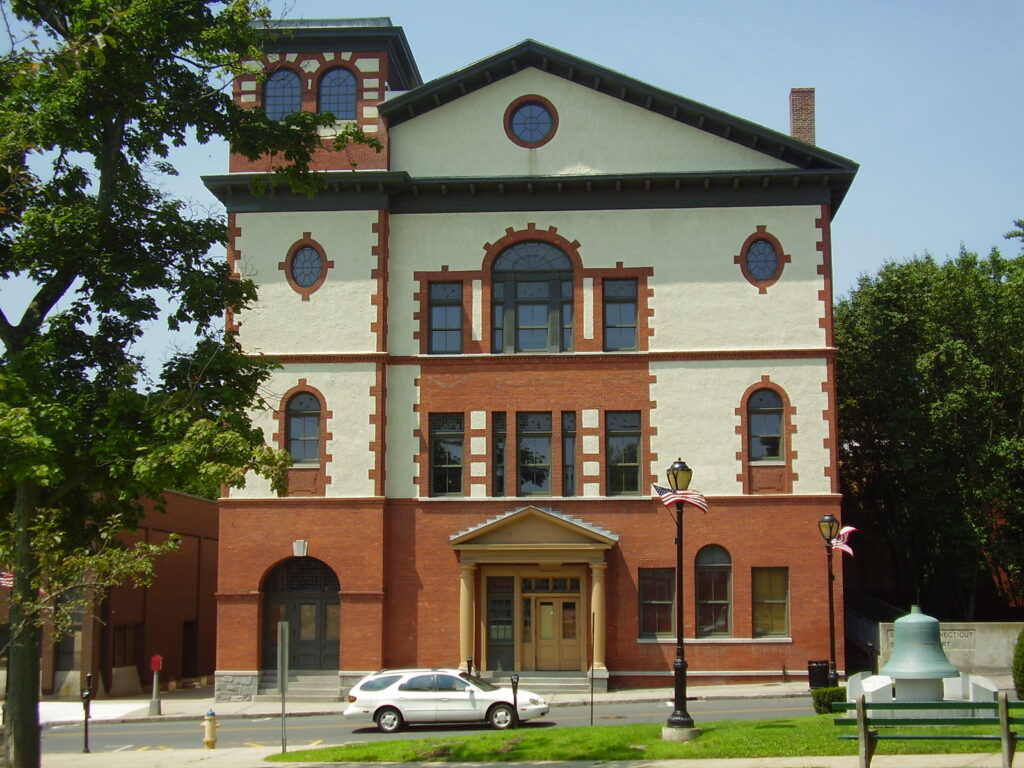
The auditorium itself was designed with care. Seating was laid out so that every viewer had an unobstructed view of the stage, and the building mixed architectural styles, an approach the record attributes to an intention to appeal to the composer Wagner. Ficken concentrated on the rooftop, the doorways and the interior walls, while another architect handled the lower levels and the exterior. The detail that ties the place to its benefactor is a pair of piano boxes flanking the stage, sized to hold two of the Sterling Piano Company’s own instruments.
Drifting Apart: The Opening Show That Helped Split Two Cities
The first production staged at the Sterling was Drifting Apart, written by James A. Herne and described as a melodramatic temperance play without the traditional didactic sermons preaching the evils of drink. It was a financial failure for Herne. It was also, in hindsight, aptly titled.
Ansonia, the neighbouring community, saw no point in another opera house being built when it already had a perfectly good one of its own. The friction around the play spilled outside the building and, by the account preserved in the Sterling’s history, had a hand in helping the two cities separate. Few theatres can claim their opening night contributed to a municipal divorce.
Houdini, Earhart and a Bare-Knuckle Champion Playing Simon Legree
For a modest valley city, the Sterling drew remarkable names. Harry Houdini performed here. So did Red Skelton and Lionel Barrymore. John L. Sullivan appeared as Simon Legree in a production of Uncle Tom’s Cabin. D. W. Griffith showed The Birth of a Nation at the venue.
Not every appearance was theatrical. On 16 March 1936 the Women’s Club brought Amelia Earhart to the opera house, where she spoke about her flying adventures. Hundreds of shows and live musical performances passed across the stage in the building’s working decades.
The Last Curtain, 30 November 1945
The final public production was Ye Olde Time Minstrel, presented by the Lafayette Men’s and Women’s Club in honour of returning soldiers of the Second World War. It ran on 30 November and 1 December 1945, and then the entertainment side of the building went dark. For a decade afterwards there was no regularly scheduled program, though occasional special performances were staged. The city continued using the lower floors as city hall and police station until 1965, when the building closed altogether.
Andy, the Soccer Balls and the Shadow Figures
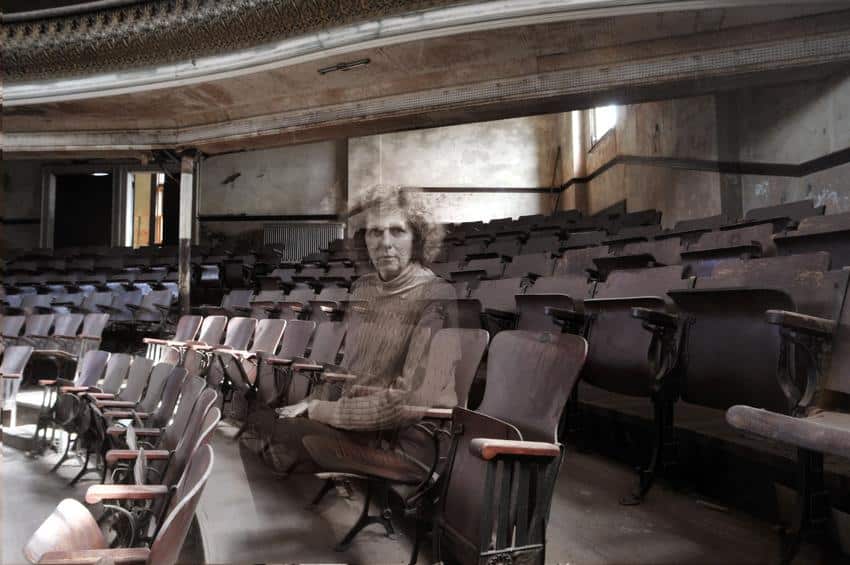
What follows is reported experience, not established fact. Visitors, investigators and municipal workers have described shadow figures, orbs of light and objects moving on their own inside the closed building.
The most repeated account concerns a small boy said to play with a soccer ball up in the balcony seats. Whoever or whatever this is, the presence is apparently happy to be called Andy. Soccer balls and other toys have been left scattered around the building, and the claim is that they shift from place to place and go missing. The other name attached to the Sterling belongs to Charles Sterling himself, who some believe still lingers in the building that carries his name.
It is worth noting a gap in the folklore. There are no tragic stories of deaths recorded at the opera house, no fire, no fatal accident, nothing of the kind that usually anchors a haunted reputation. The Sterling’s standing as one of the spookiest buildings in Connecticut rests on the accumulation of reports rather than on any single documented catastrophe.
The building’s profile grew after it featured in a 2011 episode of Ghost Hunters, which brought a national paranormal audience to a theatre most people outside the valley had never heard of.
Can You Get Inside the Sterling Opera House?
Not easily, and for now not casually. The Sterling has stood abandoned for close to half a century and shows it: peeling paint, broken windows and rusted metal are among the problems that have compounded over the years. Derby’s government wants the building restored, and in September 2011 released a plan setting out what that work would involve. The estimate ran to between three and four million dollars. A grant of $150,000, secured by U.S. Representative Rosa DeLauro, was directed at cleaning up the interior.
Future plans include opening the building for tours and returning it to service as the town’s city hall. Until access is formally restored, the realistic visit is an exterior one. The Sterling sits on Elizabeth Street facing the Derby Green, inside the Birmingham Green Historic District, a cluster of ten buildings including three churches and four monuments. Anyone hoping to get inside should check with the town or with the citizens’ group campaigning to save the building for current arrangements rather than turning up expecting a door to be open.
Sources
- History
- The Sterling Opera House. Derby, CT
- Sterling Opera House (Derbyct (official))
- Sterling Opera House in Derby, CT – Cinema Treasures
- Sterling Opera House, Derby, Damned Connecticut
- Wikipedia: Sterling Opera House
Frequently Asked Questions
Where is Sterling Opera House located?
Sterling Opera House is located at 112 Elizabeth Street.
Reader sightings
Nobody has reported anything here yet. If you have been, you would be the first.
Report your own visit to Houdini, Earhart and Andy: Derby’s Sterling Opera House
How haunted is this place?
Be the first to rate
Ghost Tours Nearby
Affiliate links: BeyondHaunted may earn a commission, at no extra cost to you.

Leave a Reply