Reviewed by Josh N · Updated March 19, 2026 · How we verify
Few figures in Japanese folklore are as mesmerizing as Jorogumo, the spider woman who appears in story after story as a creature of beauty, danger, deception, and supernatural intelligence. She belongs to the wider world of yōkai, a broad category of strange beings in Japanese folklore that includes ghosts, monsters, shapeshifters, tricksters, and other uncanny presences. In that crowded supernatural landscape, Jorogumo stands out because she embodies two fears at once: the fear of predatory nature and the fear of seductive illusion.
What makes Jorogumo so enduring is that she is not just a monster in the simple horror-movie sense. She is a folkloric trap. She looks human when she wants to. She speaks, seduces, lures, and waits. In many tellings, a man does not realize he is in danger until he is already entangled. That tension between attraction and doom is what gives the legend its staying power, and it is also why Jorogumo still feels modern even though her roots lie in older Japanese storytelling and Edo-period yōkai culture.
What is Jorogumo?
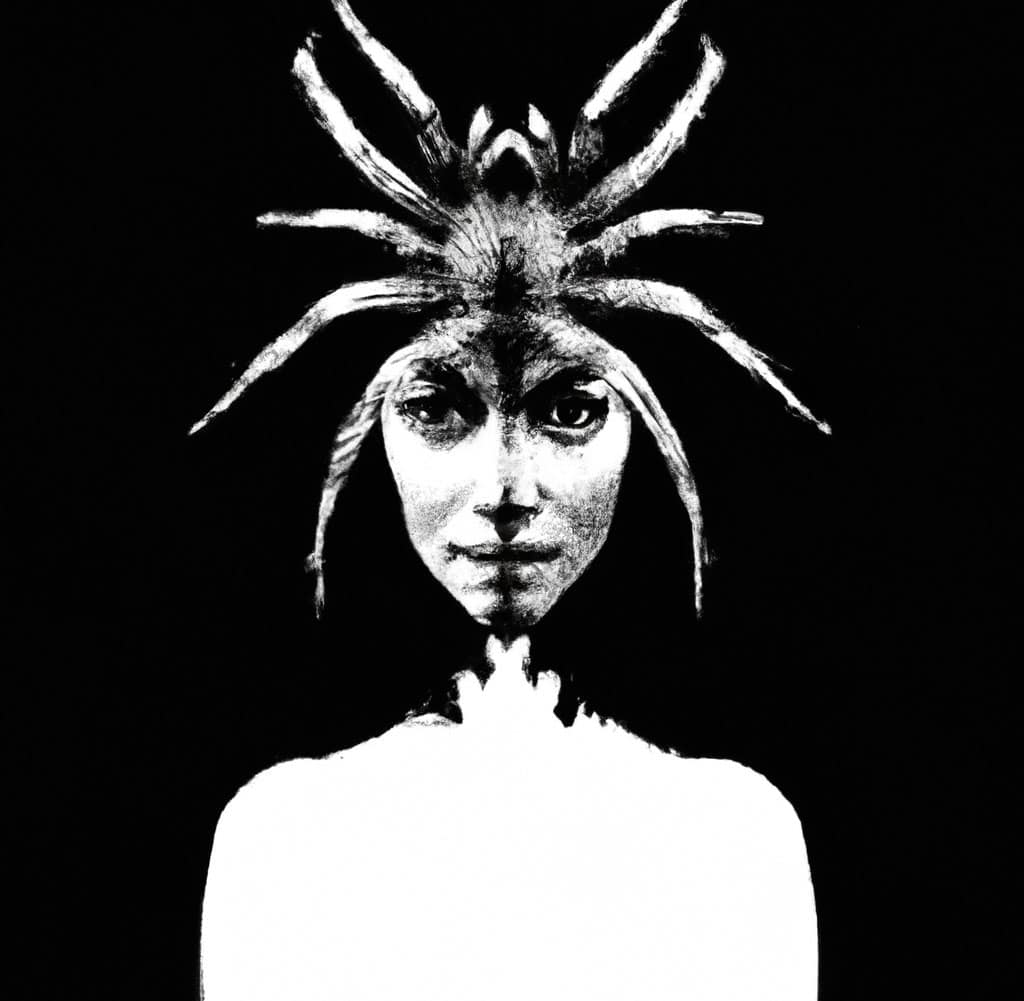
At the most basic level, Jorogumo is a spider yōkai that can take the form of a beautiful woman. In English, she is often described as a “spider woman” or an “entangling bride,” though translations vary because the name carries layers of meaning and older spellings. Across retellings, the core idea is consistent: this is a supernatural spider that uses human appearance, charm, and sometimes emotional manipulation to draw victims into her web.
That core image places Jorogumo in a familiar folkloric pattern found around the world: the fatal seductress who appears at the edge of civilization. But in Japanese tradition, she is distinctly tied to yōkai culture and to spider imagery that is both symbolic and literal. She is not merely spider-like. She is a spider with agency, patience, and cunning, and in many versions she is associated with remote natural places, especially waterfalls, river pools, caves, or wooded areas where human beings are already a little vulnerable.
Jorogumo’s place in Japanese folklore
One of the most important things to understand is that Jorogumo does not come from one single definitive “master text.” Like many folkloric figures, she exists through a mix of oral storytelling, regional legend, illustrated books, later literary treatments, and modern retellings. That is common in yōkai tradition generally. Museums and exhibitions on the subject note that yōkai stories stretch back many centuries, while the Edo period played an especially important role in giving many of these beings their familiar visual forms through scrolls, woodblock prints, and popular illustrated books.
That matters for Jorogumo because the Edo period helped transform supernatural beings from local or loosely defined presences into recognizable characters. Toriyama Sekien, one of the great yōkai illustrators, published One Hundred Monsters Ancient and Modern (Hyakki shūi) in 1781, and his work is widely recognized as foundational in standardizing the imagery of many yōkai for later generations. The Metropolitan Museum of Art dates that book to 1781, and museum and exhibition sources note that Sekien’s illustrated yōkai books were instrumental in fixing these creatures in the public imagination.
Jorogumo also belongs to a broader Japanese tradition of supernatural spider imagery. Scholarly work in Asian Ethnologypoints to older literary and visual traditions in which spiders become supernatural threats, including shape-shifting female figures. That broader context helps explain why Jorogumo feels both highly specific and part of a larger supernatural family. She is not an isolated invention. She emerges from a long tradition in which spiders can signify hidden peril, shape-shifting menace, and uncanny femininity.
The most famous Jorogumo legends
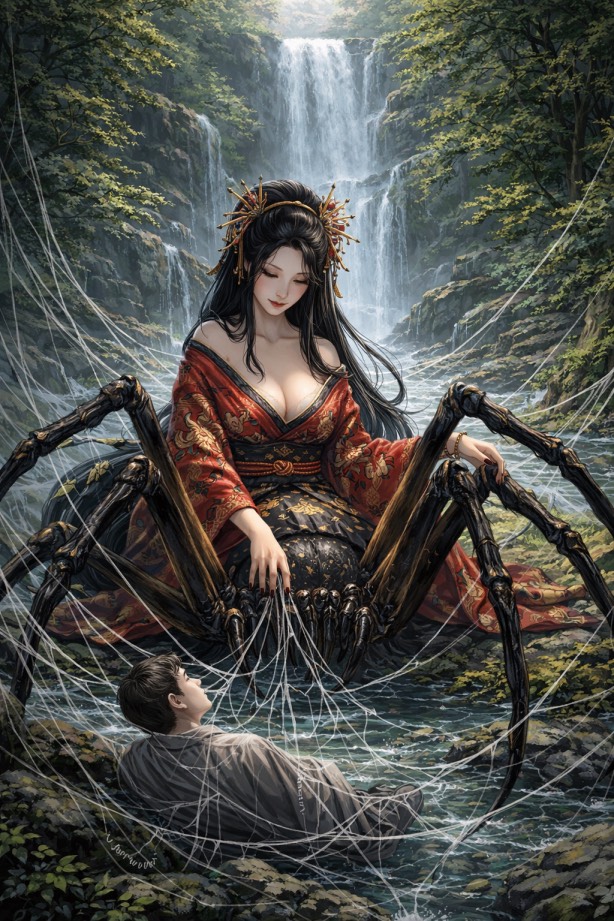
The best-known Jorogumo stories are often linked with water. One of the most famous regional traditions places her at Jōren Falls in Izu, in present-day Shizuoka Prefecture. In that cluster of legends, a man resting near the waterfall becomes entangled in spider silk and barely escapes by tying the web to a stump, which is then dragged into the water instead of him. Other variations tell of a beautiful woman at the falls, a warning never to reveal what was seen there, a secret broken, and a mysterious death that follows. In still other versions, a man falls in love with the woman at the waterfall and wastes away as the supernatural truth closes around him.
These tales work so well because the setting does half the storytelling. Waterfalls are beautiful, loud, disorienting, and dangerous. They hide depth and motion. In folklore, they are natural thresholds, places where a human being might cross from the ordinary into the uncanny without realizing it. Jorogumo is perfectly suited to such a setting because her whole legend depends on a threshold between what seems safe and what is not.
Another important variation comes from Kashikobuchi in Sendai. There, the folklore takes a turn that complicates the usual image of Jorogumo as purely predatory. Retellings associated with that place describe a Jorogumo linked to protection from drowning or water disaster, and the figure is treated more like a local spiritual presence than a straightforward man-eater. That variation matters because it shows how Japanese folklore often resists neat categories. A yōkai can terrify in one place and protect in another.
Why the legend is so unsettling
Jorogumo is frightening for more than one reason. On the surface, she is a monster who traps and devours human beings. But beneath that, she represents anxieties about misrecognition. She is what happens when appearances fail. The victim sees a woman, a lover, a stranger in need, or an enchanting figure in a lonely place. The reality is something patient, hidden, and predatory. Folklore repeatedly returns to that structure because it dramatizes a timeless fear: that what we most desire may also be what destroys us.
The spider itself deepens that symbolism. Webs are one of nature’s most effective metaphors. They suggest craft, architecture, invisibility, patience, entrapment, and inevitability. A web does not usually chase; it waits. That makes Jorogumo more psychologically eerie than many aggressive monsters. She is not terrifying because she is loud. She is terrifying because she is strategic. The victim walks into the danger, often willingly.
There is also a moral dimension in some retellings. Depending on the version, the story can read as a warning about lust, vanity, curiosity, isolation, broken promises, or wandering too far into wild places. Folklore often layers practical caution with supernatural drama, and Jorogumo legends are especially good at doing that. They can warn against dangerous landscapes and against dangerous desires at the same time.
Jorogumo and the real joro spider
One reason Jorogumo has gained fresh attention in English-language discussions is the rise in awareness of the real joro spider, the orb-weaver Trichonephila clavata. Scientific and university sources identify it as a species native to East Asia, and the name “Joro spider” has become familiar in the United States because of its spread in parts of the eastern U.S. The connection in name can make people assume the folklore creature and the real spider are the same thing in a literal sense, but that is too simple. The legend and the living species are related culturally and linguistically, yet one is folklore and the other is zoology.
That distinction is important because the real joro spider is not the nightmare creature of internet headlines. University sources describe the species as shy, reluctant to bite, and generally harmless to people and pets. So while the folklore version is a deadly shapeshifter, the actual spider is an orb-weaver whose reputation has often been exaggerated by sensational coverage. That contrast is part of what makes Jorogumo such an interesting topic today: the same name can point to an eerie legend and an overhyped real-world arachnid.
Why Jorogumo still fascinates people
Jorogumo survives because she fits so many human obsessions at once. She is folklore, horror, seduction, nature, femininity, and metamorphosis wrapped together in one unforgettable figure. She also lives at the intersection of beauty and revulsion, which is always fertile ground for myth. Stories that force us to look twice at what we think we want tend to last. Jorogumo does exactly that.
She also benefits from the lasting power of yōkai culture itself. Exhibition and museum sources note that yōkai have moved from older legends and Edo-period imagery into modern entertainment, including contemporary art, games, anime, and horror media. Even when audiences do not know the older regional stories in detail, the basic Jorogumo image remains instantly effective: a beautiful woman, a hidden spider, a web you do not see until it is too late.
Conclusion
Jorogumo is more than a creepy spider woman from a single old tale. She is a layered folkloric figure shaped by regional storytelling, Edo-period visual culture, and a broader Japanese fascination with yōkai as embodiments of mystery, danger, and wonder. Her legends are about seduction, but they are also about landscape, secrecy, illusion, and the terrible cost of mistaking beauty for safety.
That is why the legend still works. Long after the first listeners heard stories of webs near a waterfall or a woman who was not what she seemed, Jorogumo continues to catch attention in exactly the way a spider should: quietly, elegantly, and all at once.
Sources
https://asianethnology.org/articles/208
Reader sightings
Nobody has reported anything here yet. If you have been, you would be the first.
Leave a Reply