Reviewed by Josh N · Updated March 19, 2026 · How we verify
Remote viewing is one of those paranormal topics that seems to live in two worlds at once. In one world, it is a fringe psychic practice tied to clairvoyance, ESP, and the idea that the human mind can perceive a distant place, object, or event without using the ordinary senses. In the other, it is a documented subject of government-funded research, complete with laboratory protocols, intelligence interest, and a long paper trail that runs through the Cold War.
That unusual mix is exactly why remote viewing continues to fascinate people. It is not just a ghost-story topic or a late-night TV talking point. It is also a real historical research program that was taken seriously enough by parts of the U.S. intelligence community to be studied for years. At the same time, the best-known official review of that work concluded that the evidence did not justify using remote viewing as a reliable intelligence tool.
So what is remote viewing, really? Is it psychic spying, misunderstood intuition, a flawed experimental field, or something stranger? The honest answer is that remote viewing sits at the crossroads of parapsychology, Cold War history, and scientific controversy. To understand it, you have to look at all three.
Remote Viewing Defined
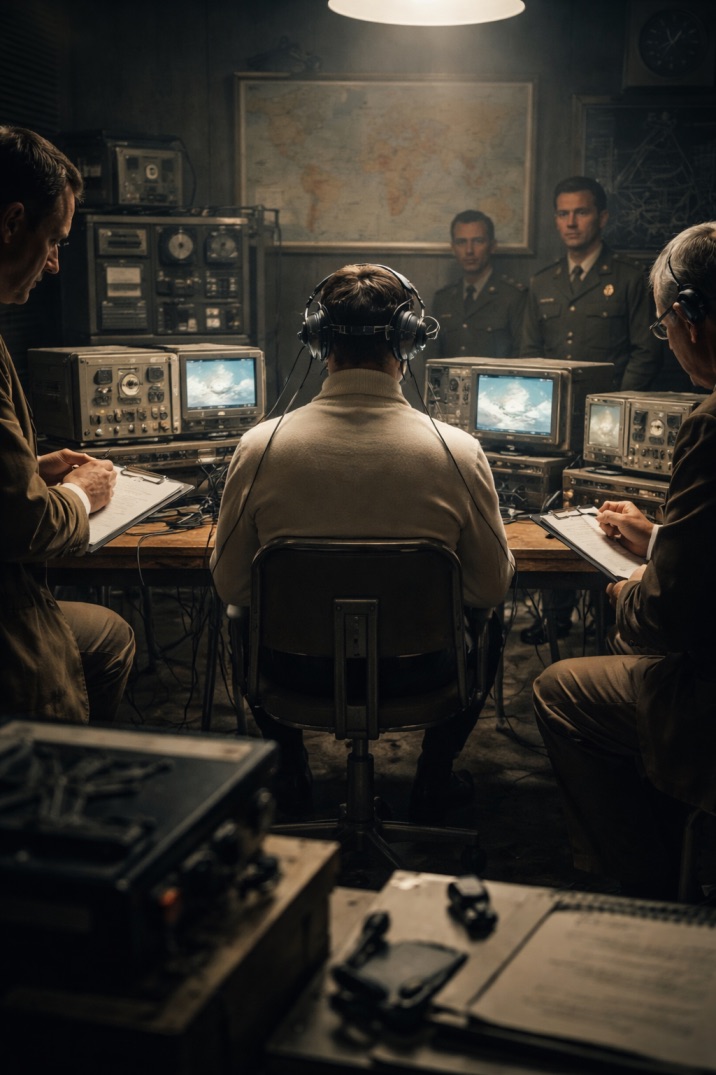
In the context of parapsychology, remote viewing generally refers to an attempt to describe or perceive a hidden, distant, or otherwise inaccessible target without using the known senses. In the classic experimental setup described in the 1995 American Institutes for Research review, one person, sometimes called a “beacon” or “sender,” goes to a remote target location while the “viewer” tries to describe that location from elsewhere. A judge later compares the viewer’s description against possible targets to see whether it matches the correct one better than chance would predict.
That matters because remote viewing is often misunderstood as simply “psychic guessing.” In its research form, it was framed as a testable process. The target was meant to be concealed. The viewer was supposed to work blind. The results were supposed to be judged afterward. That structure was designed to separate the claim from ordinary deduction, prior knowledge, and outright fraud. Whether it succeeded is where the controversy begins.
Where Did Remote Viewing Come From?
Although claims of second sight, clairvoyance, and extrasensory perception are much older, remote viewing as a named research topic took shape in the 1970s. According to the AIR evaluation commissioned by the CIA, studies of remote viewing as a distinct manifestation of psychic functioning began in that decade. UC Davis’s summary of the review likewise notes that the government-sponsored research program traced back to early 1970s work at Stanford Research Institute, now called SRI International, in Menlo Park, California.
Government interest was tied to intelligence concerns. The idea was simple, if extraordinary: if even a small number of people could accurately describe distant targets without physically being there, that ability might have value for espionage, reconnaissance, hostage situations, military planning, or locating hidden facilities. The AIR report explicitly states that this possibility provided the main impetus for government interest, and CIA-linked summaries of the Star Gate effort describe remote viewing as part of a broader attempt to evaluate paranormal methods for intelligence use.
That government connection is one reason remote viewing has never fully faded from public culture. Plenty of paranormal claims survive on anecdote alone. Remote viewing survived because it also accumulated declassified files, internal memoranda, and an official program history.
The CIA, SRI, and the Stargate Connection
When people talk about remote viewing today, they usually end up talking about Stargate. Strictly speaking, Stargate was not the beginning of the research, but it became the umbrella label most closely associated with the government’s long-running interest in psychic functioning and remote viewing for intelligence collection. The AIR report describes Star Gate as a Defense Intelligence Agency program involving paranormal phenomena, primarily remote viewing, for intelligence purposes. The CIA’s own FOIA reading room now maintains a Stargate collection, underscoring that this was a real, documented government effort rather than a myth built from rumor.
The program evolved through multiple phases and code names over the years, but the broad story is consistent across official summaries. Researchers explored whether certain individuals could produce usable information under controlled conditions. Operational personnel also tried to apply those methods to real-world intelligence questions. These efforts continued into 1995, when the program was suspended and formally reviewed.
That last point is crucial. Remote viewing was not abandoned because nobody ever looked into it. It was looked into repeatedly. The real issue was whether the results held up strongly enough, consistently enough, and specifically enough to matter outside the lab.
How a Remote Viewing Session Was Supposed to Work
In its classic form, a remote viewing experiment tried to reduce normal information leakage. A viewer would not be told what the target was. Sometimes the target was a real location visited by a beacon. In later protocols, more controlled target pools such as photographs were used. After the session, judges would compare the viewer’s notes, sketches, or impressions against the actual target and several alternatives. If the correct target ranked unusually high more often than chance allowed, proponents argued that something anomalous might be happening.
The AIR report explains that early remote-viewing research had serious weaknesses. Some studies failed to control properly for cueing and statistical issues. In some cases, ordinary clues could potentially have influenced outcomes, including details tied to the logistics of the target visit itself. More recent research tried to address those flaws with tighter double-blind procedures and more standardized targets, including photograph-based protocols.
This distinction between early weak studies and later improved protocols is important because it shapes the entire debate. Even critics who rejected the strongest paranormal conclusions acknowledged that later experiments were more methodologically careful than the earliest work. The disagreement was not just over whether the protocols improved, but whether the improvements were enough.
Did Remote Viewing Ever Work?
This is the question that keeps the topic alive.
The most careful answer is that some reviewers and later meta-analyses have argued that certain laboratory results were statistically above chance, while official reviewers and many skeptics have argued that this still does not establish a paranormal mechanism or practical reliability. The AIR review says both principal reviewers agreed that a statistically significant effect had appeared in experimental laboratory studies, especially in the later work. But that same report also stresses the need for independent replication, independent judging, and stronger controls before drawing strong conclusions.
That tension has never fully gone away. A 2023 systematic review and meta-analysis in the Journal of Scientific Exploration reported a positive average effect size across 36 studies and 40 effect sizes through December 2022. Supporters cite that as evidence that remote viewing merits continued attention. Critics, however, point out that a statistical signal is not the same as proof of a psychic process, especially in a field where judging methods, target selection, and interpretive flexibility can influence outcomes.
So if you are looking for a clean yes-or-no answer, you will not find one that satisfies everyone. The pro-remote-viewing side often points to repeated above-chance findings. The skeptical side points to methodological fragility, the lack of a plausible mechanism, and the failure to turn suggestive lab results into dependable real-world performance. Both positions are part of the verified record.
Why the U.S. Government Ultimately Rejected It
The 1995 AIR evaluation is still the load-bearing document here. After reviewing both the research and the operational applications, the report concluded that adequate experimental and theoretical evidence for remote viewing as a parapsychological phenomenon had not been provided by the program. It also concluded that remote viewing was of little value for intelligence operations, noting that reports often included large amounts of irrelevant or erroneous information and showed little agreement among viewers.
That is the heart of the matter. Even if a laboratory effect looked intriguing on paper, intelligence agencies do not need something that is merely interesting. They need information that is timely, specific, actionable, and consistently reliable. By the AIR review’s account, remote viewing did not clear that bar. The government program was then suspended and terminated in 1995.
This is also why remote viewing occupies such an odd space in paranormal culture. The government’s involvement makes the topic sound validated. The government’s own final assessment makes the story much less mystical and much more complicated.
Why People Still Believe in Remote Viewing
Remote viewing remains compelling for a few reasons.
First, it offers a structured form of psychic experience. Unlike vague claims of intuition, remote viewing presents itself as a process with targets, protocols, notes, sketches, and scoring. That makes it feel more concrete than many other paranormal claims. The official literature itself reflects this structured approach, describing specific protocols and judging procedures rather than loose storytelling.
Second, it carries the aura of secrecy and intelligence work. Any phenomenon linked to the CIA, Defense Intelligence Agency, and Cold War research is almost guaranteed to attract ongoing fascination. Declassified files tend to fuel that fascination because they prove the subject was taken seriously enough to study, even if they do not prove the underlying claim is true.
Third, remote viewing fits a pattern seen across paranormal belief more broadly: people are strongly drawn to experiences that seem meaningful, uncanny, or personally validating. A partially correct sketch, a striking symbolic impression, or a memorable “hit” can feel far more persuasive than a long run of ambiguous misses. The AIR review explicitly warns against overvaluing prima facie successes and emphasizes how subjective validation can distort judgment.
What Skeptics Say
Skeptics generally do not argue that remote-viewing researchers invented the entire field out of thin air. Instead, their core argument is that extraordinary claims require extraordinary control, and remote-viewing research has struggled to clear that standard convincingly enough.
The AIR review highlights several recurring concerns: cueing, methodological weaknesses, non-independent judging, interpretive flexibility, and the lack of a clear causal mechanism. It also notes that some dramatic cases may have involved more background information than first appeared. From that perspective, the burden of proof remains unmet.
Even the 1995 discussion surrounding the CIA review captured this split. Jessica Utts argued that the findings were more than chance and worth taking seriously, while Ray Hyman argued that inexplicable statistical departures from chance were still far from compelling proof of anomalous cognition. In other words, the disagreement was never just about numbers. It was about what those numbers are allowed to mean.
Remote Viewing in the Paranormal World
In paranormal media, remote viewing is often framed as proof that consciousness can travel beyond the body, beyond distance, or even beyond time. That is why the topic is frequently grouped with astral projection, clairvoyance, psychic spying, precognition, and other claims about nonlocal perception. The research record itself sometimes used terms such as “anomalous cognition” alongside remote viewing, reflecting attempts to place the subject in a broader category of unusual information transfer claims.
But for a serious paranormal article, it is important not to oversell what the historical record supports. Verified history tells us that remote viewing was studied, debated, and in some contexts statistically suggestive to some researchers. Verified history also tells us that the best-known official evaluation did not find it useful enough or proven enough to justify intelligence use. That tension is exactly what makes the subject so enduring.
So, What Is Remote Viewing?
Remote viewing is best described as a paranormal claim and research practice centered on whether people can obtain information about hidden or distant targets without using the ordinary senses. It is not just folklore. It has a documented history in parapsychology and U.S. government research. But it is also not an established scientific fact or a validated intelligence method in any official sense recognized by the 1995 review that ended the government program.
That makes remote viewing less straightforward than many believers or debunkers would like. It is neither a simple fairy tale nor a settled demonstration of psychic functioning. It is a controversial body of claims, experiments, and interpretations, still debated decades after Stargate ended.
FAQ: Remote Viewing
Is remote viewing the same as clairvoyance?
They are closely related, but remote viewing was often presented by researchers as a more structured, testable protocol for describing distant or hidden targets under controlled conditions. The AIR review also notes that remote viewing was referred to as a form of “anomalous cognition.”
Was remote viewing really studied by the CIA?
Yes. Declassified records and the CIA’s Stargate FOIA collection show that U.S. intelligence agencies were involved in sponsoring and reviewing remote-viewing research and applications over many years.
Did the government prove remote viewing was real?
No. The 1995 AIR evaluation said the program had not provided adequate evidence to establish remote viewing as a proven paranormal phenomenon, and it judged the method of little value for intelligence purposes.
Are there studies that support remote viewing?
Yes. Some researchers and later reviews report above-chance statistical effects in laboratory studies, including a 2023 meta-analysis that found a positive average effect size. But those findings remain disputed, and critics argue that statistical anomalies alone do not prove psychic functioning.
Why is remote viewing still popular?
Because it combines three things people rarely ignore: psychic possibility, secret-government history, and unresolved scientific controversy. That combination gives the subject a staying power many paranormal ideas never achieve.
Final Thoughts
Remote viewing endures because it refuses to fit neatly into one box. It has the eerie appeal of the paranormal, the historical intrigue of Cold War intelligence, and just enough disputed research to keep both believers and skeptics talking. For some, it is evidence that consciousness reaches farther than science currently explains. For others, it is a cautionary tale about how easily suggestive data can be mistaken for extraordinary proof.
Either way, remote viewing remains one of the most compelling “what if” subjects in paranormal history, not because the case is closed, but because it never really was.
Sources
- American Institutes for Research, An Evaluation of Remote Viewing: Research and Applications
- CIA Reading Room, STARGATE collection
- CIA Reading Room, An Evaluation of the Remote Viewing Program
- UC Davis, “Psychic Spying” Research Produces Credible Evidence
- Journal of Scientific Exploration, Remote Viewing: A 1974-2022 Systematic Review and Meta-Analysis
Reader sightings
Nobody has reported anything here yet. If you have been, you would be the first.
Leave a Reply