

Reviewed by Josh N · Updated October 21, 2026 · How we verify
Reported Phenomena
- Shadow figures
- Apparitions on grounds
- Disembodied voices
- Unexplained cries
- Oppressive atmosphere
Reported by visitors & local legend. Stories, not verified claims.
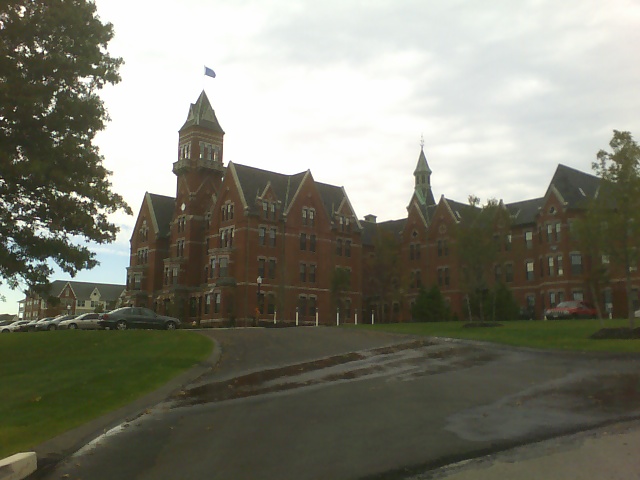
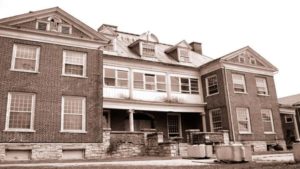
Set on a hill about 18 miles north of Boston, Danvers State Hospital was designed to be the opposite of everything an asylum was supposed to be: light, air, space, and a long symmetrical facade that looked more like a resort than a lock-up. Massachusetts got roughly a century out of it. What the public knows now is mostly the aftermath: a demolished Kirkbride building, a surviving brick shell wrapped around luxury apartments, two cemeteries, and a reputation built as much by horror movies as by anything anyone reported seeing there.
Quick Orientation
- Built: construction began 1874, hospital opened 1878 after four years of work
- Architect: Nathaniel Jeremiah Bradlee of Boston
- Original cost: $1.5 million
- Designed capacity: 500 patients, with attic space for a potential 1,000 more
- Peak population: over 2,000 by the late 1930s and 1940s
- Closed: the entire campus shut on June 24, 1992
- Now: an apartment complex on the 77-acre site, with the Kirkbride’s outer brick shell retained
Bradlee’s Kirkbride Above Danvers
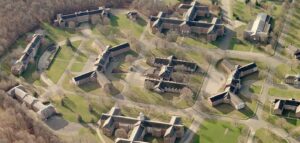
The hospital went up on an isolated rural site and was built to the Kirkbride Plan, the nineteenth century model that put administration at the center and fanned patient wards out to either side so that every room caught daylight. At Danvers that meant two main center buildings for administration with four radiating wings on each side. Men occupied the wings on one side, women on the other, and the outermost wards were reserved for the most hostile patients. Kitchen, laundry, chapel and attendants’ dormitories sat in a connecting building at the rear. Water came from Middleton Pond.
Below ground, the campus was stitched together by a labyrinth of tunnels, a standard feature of Commonwealth institutions of the period so that staff and supplies could move through a New England winter without going outside. Tunnels ran from the steam and power plant at the bottom of the hill up to the hospital, and linked the male and female nurses’ homes, the “Gray Gables,” the Bonner Medical Building, the machine shops and the pump house. That power plant still operates today, serving the Hogan Regional Center.
Five Hundred Beds, Two Thousand Patients
Danvers was not purely a warehouse, and the record is more mixed than the ghost tours suggest. A nurse training program started in 1889 and a pathological research laboratory followed in 1895. In the 1890s the superintendent, Dr. Charles Page, declared mechanical restraint unnecessary and harmful in cases of mental illness. By the 1920s the hospital was running school clinics to assess mental deficiency in children.
The overcrowding is what broke it. A plant designed for 500 was holding more than 2,000 people by the late 1930s and 1940s, with patients housed even in the basements of the Kirkbride. Reports emerged that various inhumane shock therapies, lobotomies, drugs and straitjackets were being used to keep the crowded hospital under control, and the controversy that followed is the origin of most of what gets repeated about Danvers today. Accounts of the era commonly name insulin shock therapy and hydrotherapy among the treatments used. Those are reports and allegations rather than a tidy documented inventory, and they should be read that way.
Closing the Wards, 1969 to 1992
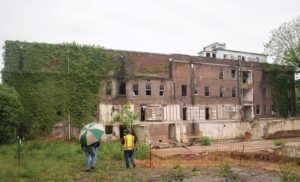
The decline was slow and administrative rather than dramatic. The 1960s brought both massive budget cuts and a genuine shift toward deinstitutionalization and community-based care, and the inpatient population began to fall. Wards and facilities started closing as early as 1969. By 1985, the majority of the original hospital wards were closed or abandoned. The Administration Block inside the Kirkbride closed in 1989 and patients were moved to the Bonner Medical Building across the campus. On June 24, 1992, the entire campus closed and the remaining patients were transferred to the community or to other facilities.
The Kirkbride had been listed on the National Register of Historic Places in 1984. That listing did not save it.
What AvalonBay Tore Down, and What It Kept
In December 2005 the property was sold to AvalonBay Communities, a residential apartment developer. A local preservation fund sued to stop the demolition. The suit failed, and demolition began in January 2006, with the aim of building 497 apartments on the 77-acre site. By June 2006 everything marked for demolition was gone: the unused buildings and old homes on the lower grounds, and all of the buildings on the hill. The work was done by Testa Corp. of Wakefield, Massachusetts.
The historic Kirkbride was demolished too, but not completely erased. The outermost brick shell of the administration area, along with the G and D wards on each side, was propped up during demolition while an entirely new structure was built behind and inside it. A replica of the original tower and steeple was built to duplicate the one removed around 1970 because of structural problems. Much of the wood from the demolition was salvaged and recycled into flooring and millwork.
Richard Trask of the Danvers Archival Center wrote that the failure to protect and adaptively reuse the grand exterior was “a monumental blot in the annals of Massachusetts preservation,” and that what might have been a dignified transformation of a magnificent structure “now is a mere ghost-image of itself.”
The Fire of April 7, 2007
On April 7, 2007, four of the new apartment buildings and four of AvalonBay’s construction trailers burned in a fire large enough to be visible from Boston, nearly 17 miles away. Damage was mostly confined to the buildings then under construction at the eastern end, but the heat was intense enough that the remaining Kirkbride spires caught fire as well. The property changed hands again on June 27, 2014, when AvalonBay sold it to the DSF Group for $108.5 million.
What People Report at the Danvers Cemeteries
No investigation has established anything paranormal here, and the building that generated most of the stories no longer exists in any meaningful sense. What survives are the accounts, which cluster on the ground rather than in any structure.
- Apparitions and shadow figures seen at the edge of vision on the grounds
- Cries, whispers and other voices reported with no source
- Activity concentrated around the two cemeteries, which still remain on the site
- A general atmosphere visitors describe as oppressive and hard to shake
It is worth being honest about how much of the Danvers mythology is borrowed. The hospital is believed by literary historians to have inspired the Arkham sanatorium in H. P. Lovecraft’s “The Thing on the Doorstep,” and Danvers is named outright in “Pickman’s Model” and The Shadow over Innsmouth. Lovecraft’s Arkham in turn gave Batman his Arkham Asylum. The abandoned campus was the setting for the 2001 horror film Session 9, and it had appeared earlier in the 1958 film Home Before Dark. It shaped Parsons State Insane Asylum in Fallout 4, a level in the game Painkiller, a Call of Cthulhu scenario, the novel Project 17, and episode 6 of the podcast Lore. A reader assessing the ghost reports should keep in mind that generations of visitors arrived already primed by all of it.
Visiting the Danvers State Hospital Site
There is no abandoned asylum to explore, and there has not been one since 2006. The hill is now an occupied residential apartment complex, and the preserved brick facade of the Kirkbride administration block is the front of somebody’s home. Treat the whole campus as private property. The tunnel leading up from the power plant still exists but is blocked at the top of the hill, and the other tunnels are sealed.
What genuinely remains from the institution is the brick shell of the administration building and the D and G wings, the historic Danvers reservoir, several blocked tunnels, and the cemeteries. The graves are the reason to come if you come at all: they hold people who died in state custody and were buried with very little ceremony. Visit them as a burial ground, in daylight, and do not go looking for a way into anything.
See Danvers State Hospital for Yourself
Sources
- History of Danvers State Hospital
- Bad News for Danvers State Hospital
- Longleaf Lumber Salvaged Danvers State Hospital Woods
- History: Danvers State Hospital
- "Pickman's Model" by H. P. Lovecraft
- Wikipedia: Danvers State Hospital
Frequently Asked Questions
Where is Danvers State Hospital located?
Danvers State Hospital is located at 450 Maple Street.
Can you visit Danvers State Hospital?
Danvers State Hospital is on private property and best viewed from a distance. Always follow posted rules and respect private property.
Reader sightings
Nobody has reported anything here yet. If you have been, you would be the first.
Report your own visit to Danvers State Hospital: The Kirkbride That Became Apartments
How haunted is this place?
Be the first to rate
Ghost Tours Nearby
 History and Hauntings of Salem Guided Walking Tourfrom $36
 Salem's Best Ghost Tourfrom $24
 The Official "Hocus Pocus" Movie Locations Tour of Salemfrom $50
Affiliate links: BeyondHaunted may earn a commission, at no extra cost to you.
Leave a Reply