
Reviewed by Josh N · Updated August 27, 2026 · How we verify
Reported Phenomena
- Pioneer-era apparitions
- Phantom children crying
- Face in crypt window
- Footsteps that stop
- Photographic orbs
Reported by visitors & local legend. Stories, not verified claims.
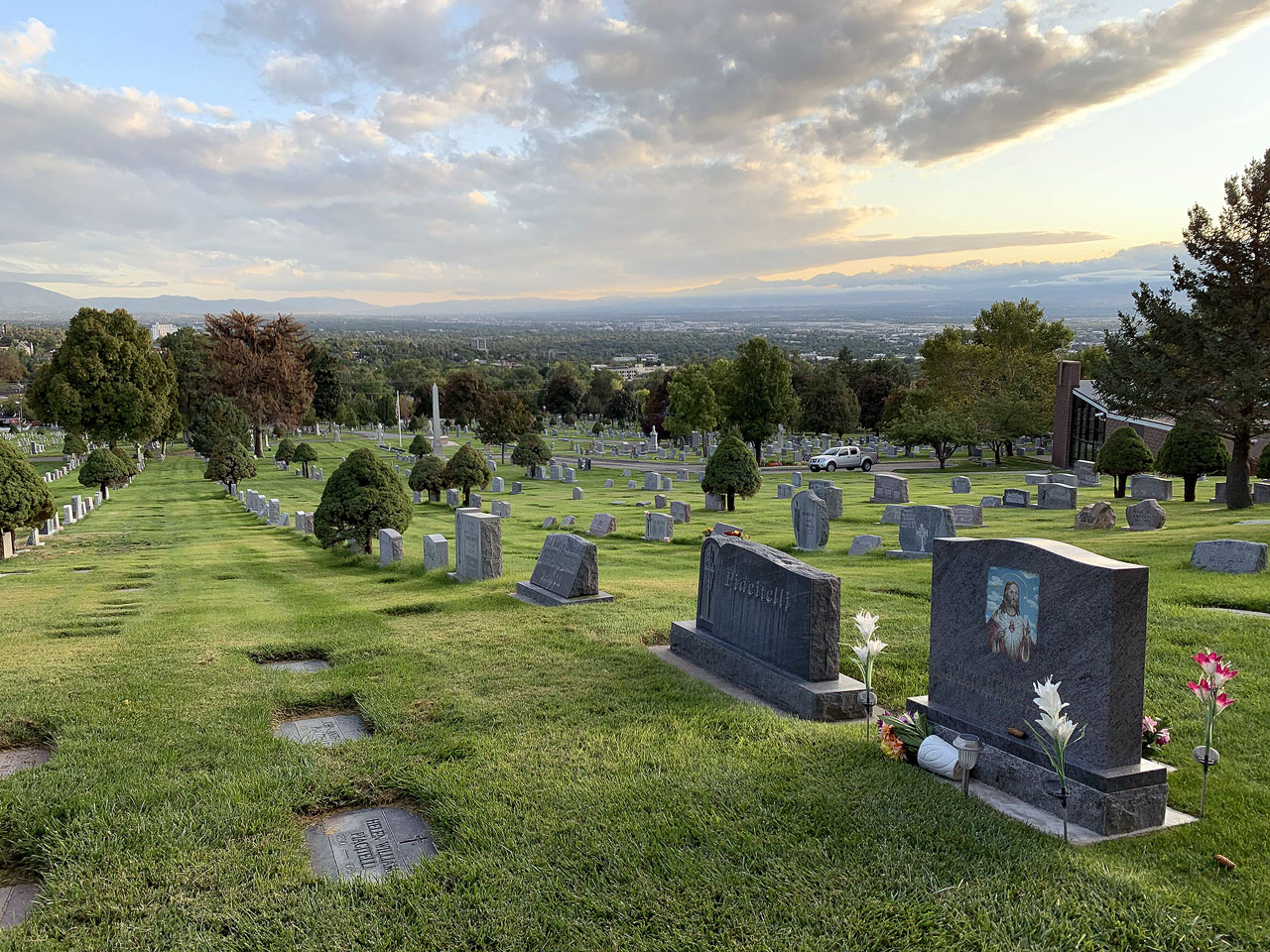
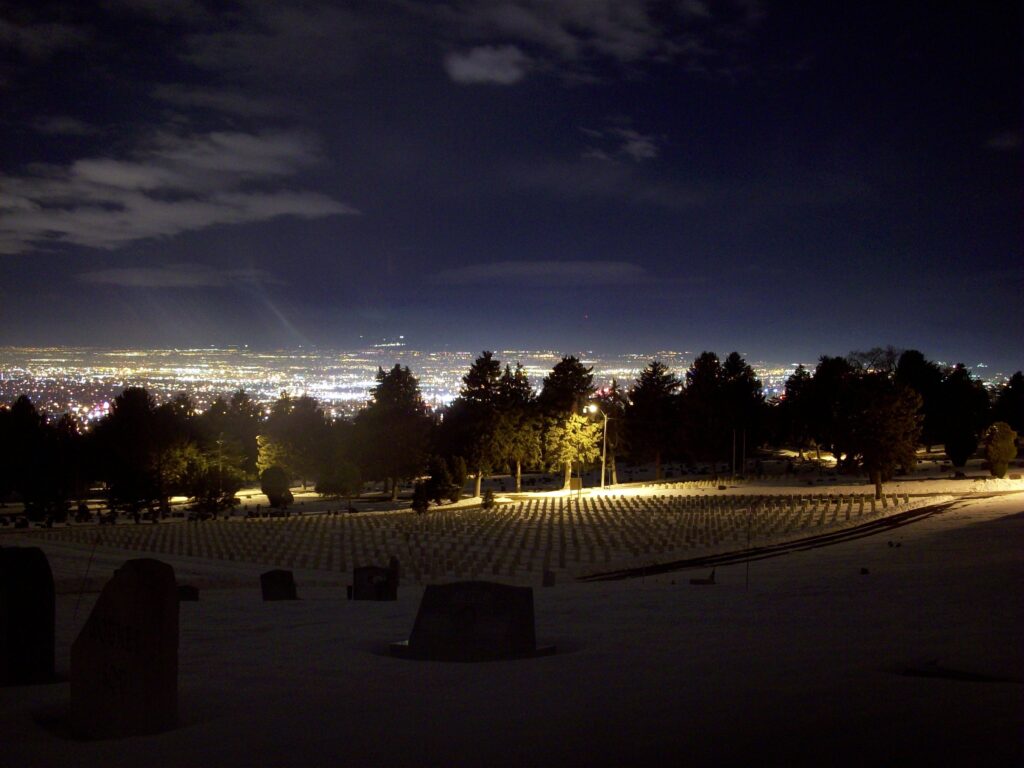
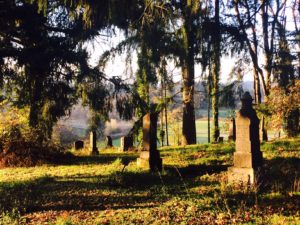
Laid out on a bench of ground above The Avenues, the Salt Lake City Cemetery is both a working municipal burial ground and one of Utah’s most persistent ghost stories. It is one of the largest city-operated cemeteries in the United States, and the sheer scale of it, over 150 acres cut through by nine and a half miles of road, is part of why the place unsettles people after dark. There is always another row, another turning, another stretch of stone you have not walked yet.
Quick facts:
- Located north of 4th Avenue and east of N Street, in the Avenues neighborhood of Salt Lake City.
- First burial: 27 September 1848.
- Approximately 120,000 people are buried here.
- Over 150 acres, with roughly nine and a half miles of internal roads.
- Open grounds, free to enter, no ticket and no guide required.
It Began With a Child Named Mary Wallace
The cemetery did not start as a plan. It started as a grief. On 27 September 1848, George Wallace buried his child, Mary Wallace, on the hillside, and that single grave fixed the location of everything that followed. The next year, in 1849, Wallace returned with Daniel H. Wells and Joseph Heywood and surveyed twenty acres at the same site to serve as the area’s burial ground.
When Salt Lake City was incorporated in 1851, those twenty acres formally became the Salt Lake City Cemetery, and George Wallace, the man who had dug the first grave here, became its first sexton. From that original twenty acres the ground has grown more than sevenfold. The modern boundary encloses over 150 acres, which is why visitors who set out to walk the whole thing on a single afternoon usually do not finish.
Church Leaders, Frontiersmen and a Canadian Soldier
The burial registers read like a shelf of Utah history. Many religious leaders and politicians lie here, including a large number of leaders of the Church of Jesus Christ of Latter-day Saints. Among the more visited graves are those of Orrin Porter Rockwell, the frontiersman and lawman whose name is attached to a great deal of nineteenth century Western legend, and Jane Manning James, an African American pioneer and a significant figure in the early Latter Day Saints movement.
Local guides also point out a grave attributed to Hiram Bebe, identified in Salt Lake tradition as the Sundance Kid. That identification is contested folklore rather than settled record, and it is worth treating as a story the cemetery tells about itself rather than a documented fact.
One marker stands apart from all the pioneer history: the cemetery contains a single British Commonwealth war grave, that of a Canadian Army soldier of the First World War, a long way from home and easy to walk past without noticing.
The Lily E. Gray Headstone and Its Six Words
Of the tens of thousands of stones here, one draws more visitors than any leader or lawman. The headstone of Lily E. Gray, who died in 1958, carries the inscription “Victim of the Beast 666.”
Nobody has produced a documented explanation for the wording. That vacuum has been filled by decades of speculation, ranging from the occult to the political to the simply personal, and none of it is verified. What can be said plainly is that the stone exists, the inscription is real, and the reason for it is not known. The grave has become a pilgrimage stop for visitors who arrive with theories and leave with the same ones.
Circling Emo’s Crypt
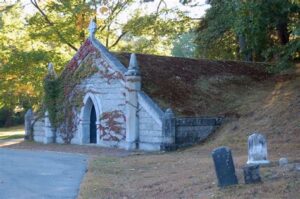
The best known ritual on the grounds belongs to the crypt of Jacob E. Moritz, known to generations of local teenagers simply as Emo. The legend prescribes a method: circle the crypt a set number of times, then look into the window. Those who follow it claim to see a face looking back.
This is folklore in its purest form, a dare passed between school years rather than anything on record, and the crypt’s small dark window is exactly the kind of surface that gives the human eye something to work with. It has nonetheless kept the story alive for decades, and Emo’s crypt remains the single most sought out spot in the cemetery after dark.
What People Report Among the Headstones
Beyond Emo, the reported activity here is consistent in character. Visitors and locals describe figures in pioneer-era clothing seen among the older sections, which fits the cemetery’s origins closely enough to invite suspicion that expectation is doing some of the work.
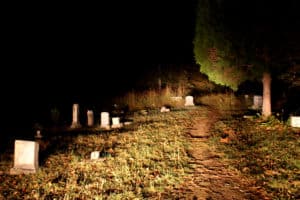
Other accounts include the sound of infants crying or children playing, always somewhere out of sight and always gone by the time anyone reaches the spot. Footsteps that stop the moment a walker turns around are commonly reported, as are unexplained orbs on photographs. None of this is verified, and a hillside of this size at night, with wind moving through mature trees and traffic noise carrying up from the city, offers plenty of ordinary explanations. What the cemetery does reliably deliver is the atmosphere that makes people willing to consider the others.
Visiting the Salt Lake City Cemetery
This is an active municipal cemetery, not an attraction. It is free to enter, the roads are drivable, and the views back over Salt Lake City from the upper sections are genuinely worth the trip on their own. Funerals and family visits happen daily, so quiet behaviour is expected, and the ghost-hunting crowd should be aware that headstone hunting after dark is not what the grounds are maintained for.
Come in daylight if you want the history: the pioneer sections, the LDS leaders, the Gray headstone, the lone Commonwealth war grave. Bring good shoes and a map, because with nine and a half miles of road you will not find anything by wandering. The stories will keep.
See Salt Lake City Cemetery for Yourself
Sources
- SL Cemetery Is Alive with History, The Famous and the Humble Rest in Peace Together
- Headstone at graves of George Wallace children
- Salt Lake City Cemetery: Where Mormon history lives
- Custom 404 – CCE (Utah (official))
- Geographic Names Information System (Nationalmap (official))
- Wikipedia: Salt Lake City Cemetery
Address: 200 N Street
Frequently Asked Questions
Where is Salt Lake City Cemetery located?
Salt Lake City Cemetery is located at 200 N Street.
Can you visit Salt Lake City Cemetery?
Salt Lake City Cemetery is open to the public. Always follow posted rules and respect private property.
Reader sightings
Nobody has reported anything here yet. If you have been, you would be the first.
Report your own visit to Emo’s Crypt and Lily Gray: Salt Lake City Cemetery
How haunted is this place?
Be the first to rate
Ghost Tours Nearby
 Salt Lake Ghost Tour: Salt, Spooks, & Shadowsfrom $26
 Salt Lake City Haunted Old Town Bus Tourfrom $30
 Shadows of Old Salt Lake Walking Tourfrom $20
Affiliate links: BeyondHaunted may earn a commission, at no extra cost to you.
Leave a Reply