

Reviewed by Josh N · Updated September 29, 2026 · How we verify
Reported Phenomena
- White Lady apparition
- Woman in wedding gown
- Phantom black dog
- Male apparition
- Unexplained sounds
Reported by visitors & local legend. Stories, not verified claims.
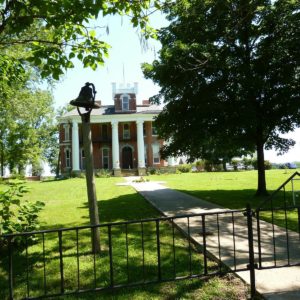
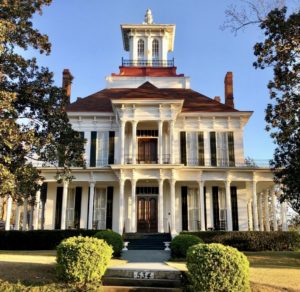
Rotherwood Mansion sits on a bluff above the Holston River outside Kingsport, Tennessee, on Netherland Inn Road, and almost everything told about it arrives in two versions: one from the documentary record and one from a century of local storytelling. The record gives a Presbyterian minister, a pro-slavery author, and a daughter educated in northern boarding schools. The storytelling gives a drowned bridegroom, a woman in white walking toward the water, and a black dog that supposedly came out of a coffin. Both are worth knowing, and it is worth keeping them apart.
Getting Your Bearings on Netherland Inn Road
- Where: Netherland Inn Road, near Kingsport in northeast Tennessee, on high ground overlooking the Holston River.
- Built: The brick mansion was constructed after Frederick Augustus Ross moved to Kingsport in 1818.
- The name: Local accounts credit Sir Walter Scott’s novel Ivanhoe, in which Rotherwood is the home of Cedric the Saxon.
- Access: Private residence. There are no tours and no public interior access.
- The famous ghost: A white-clad figure identified in legend as Rowena Ross.
Frederick Augustus Ross, the Man Who Built It
Rotherwood’s builder was born on December 25, 1796, in Cumberland County, Virginia, the son of David Ross, a wealthy Richmond businessman who had emigrated from Scotland in the middle of the 18th century. The younger Ross was educated at Dickinson College in Carlisle, Pennsylvania, with the class of 1815, though he did not graduate with his classmates.
In 1818 he entered the Presbyterian ministry, emancipated his slaves, and moved to Kingsport, where he had his massive Rotherwood mansion constructed on Netherland Inn Road. That sequence complicates the simplest version of the story. Ross is recorded both as a man who freed the people he held in 1818 and, decades later, as the author of Slavery As Ordained of God, published in 1857 in answer to Harriet Beecher Stowe’s Uncle Tom’s Cabin. Abraham Lincoln read the book and drew on Ross’s reasoning about divine will and slavery in a pointed passage of the 1858 Lincoln-Douglas debates, turning Ross’s argument back on itself by noting how conveniently the arrangement benefited the owner.
Ross became pastor of Old Kingsport Presbyterian Church in 1826 and held the pulpit until 1852, with a brief stint in 1828 as an evangelist in Kentucky and Ohio. When the Old School and New School split tore through the Presbyterian general assembly in 1837 and 1838, he took the New School side. From 1855 he served the First Presbyterian Church in Huntsville, Alabama, until 1875, remaining pastor emeritus until his death on April 13, 1883.
One further link runs out of this house and into American popular music: the singer Diana Ross’s great-grandfather, Frederick Ross, was born on the Rotherwood plantation.
A Preacher Who Went to War Over Ghosts
There is a genuine irony buried in the paper trail of a house now famous for its apparitions. Ross edited The Calvinistic Magazine with James Gallaher and David Nelson from its founding in 1826 through 1832, and revived it in 1845. In its pages he declared war on Methodism, calling the church despotic, likening it to a great iron wheel that would crush American liberty, claiming most Methodists descended from Revolutionary War Loyalists, and accusing John Wesley of believing in ghosts and witches.
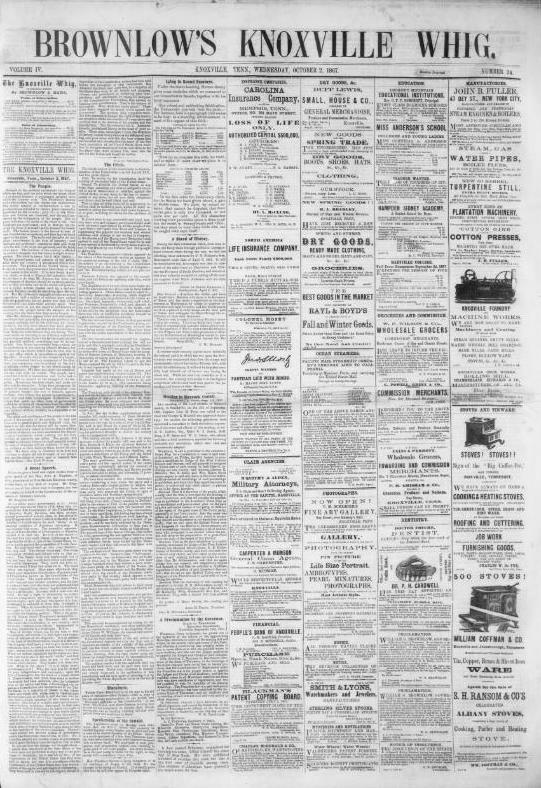
The Methodist minister and newspaper publisher William Gannaway Brownlow answered him with a running column, then in 1847 with an entire paper, the Jonesborough Quarterly Review, devoted to refuting Ross, plus a speaking tour that summer. Brownlow’s counterpunch on the ghost question was that belief in spirits was ordinary in Wesley’s day and that plenty of Presbyterian ministers still held to it. The feud ran to insults of a far uglier kind on both sides, and only subsided when Brownlow moved his paper to Knoxville in 1849. The master of the house that would become East Tennessee’s best-known haunted address spent years in print mocking a rival for taking ghosts seriously.
Rowena Ross and the Wedding on the Holston
Ross had his daughter, Rowena, educated at boarding schools in the northern United States. That is the documented part. The rest belongs to legend, and it is the legend that fills the mansion.
As locally told, Rowena’s fiance drowned in the Holston River on the day they were to marry. The shock is said to have broken her, and the story has her withdrawing into the upper floor of the house for years afterward. From that account grows the figure known as the White Lady: a woman in a wedding gown seen on the grounds or moving down the slope toward the river. No contemporary record of the drowning is presented in the popular retellings, and readers should treat the whole episode as folklore rather than history.
Joshua Phipps and the Blackest Chapter in the Legend
Local accounts hold that financial ruin forced Ross to sell Rotherwood in 1847 to Joshua Phipps, remembered in the same tradition for extreme cruelty toward the people he enslaved, including iron-barred cells and a whipping post on the property. His reported death in 1861 is where the story leaves the realm of the plausible entirely: he is said to have suffocated beneath a swarm of flies, and a phantom black dog is said to have burst from his coffin during a storm-lashed funeral and vanished into the trees. Stories also describe his grave being desecrated after his death.
None of the supernatural elements here are verifiable, and the flies and the dog have the shape of punishment folklore, the kind of tale communities attach to men they had reason to hate. What the story does preserve, accurately enough, is the memory of slavery on this ground.
What People Say They See at Rotherwood
Reports gathered from residents, workers, and passing drivers over the years cluster around a few repeating images. They are claims, not evidence.
- A woman in white, identified as Rowena, on the lawn or heading toward the Holston.
- A male apparition associated with Phipps, sometimes accompanied by a large black dog.
- Unexplained sounds and disturbances reported by people living or working in the house.
- Heavy river mist off the Holston, which does as much for the mansion’s reputation as any of the above.
Seeing Rotherwood Mansion Without Trespassing
Rotherwood is a private residence and is closed to the public. There are no tours, no open houses, and no legitimate way inside. The house can be seen from Netherland Inn Road, which is the beginning and the end of what any visitor should attempt. Do not walk the grounds, do not knock, and do not park where you block a driveway. People live here, and the fastest way to kill a location’s story is for its owners to lose patience with the people chasing it.
See Rotherwood Mansion for Yourself
Sources
- Loc (official)
- Yale (official site)
- VIAF
- Full text of "What Lincoln read"
- Wikipedia: Frederick Augustus Ross
Frequently Asked Questions
Can you visit Rotherwood Mansion?
Rotherwood Mansion is on private property and best viewed from a distance. Always follow posted rules and respect private property.
Reader sightings
Nobody has reported anything here yet. If you have been, you would be the first.
Report your own visit to Rowena and the Black Dog: Rotherwood Mansion, Kingsport
How haunted is this place?
Be the first to rate
Leave a Reply