Reviewed by Josh N · Updated March 17, 2026 · How we verify
Every October, the idea comes back around. Candles are lit, scary movies are queued up, the decorations go darker, and sooner or later someone asks the question: should you use a Ouija board on Halloween?
It is easy to see why the pairing feels natural. Halloween is culturally tied to ghosts, spirits, death lore, and the supernatural, with roots in Samhain and the traditions that fed into All Hallows’ Eve. The Ouija board, meanwhile, grew out of 19th century American Spiritualism and was patented in 1891 as a “toy or game,” even while it traded heavily on the promise of mysterious answers. In other words, Halloween gives the board atmosphere, and the board gives Halloween drama.
But atmosphere is not the same thing as evidence.
If you want the most honest answer, it is this: you probably should not use a Ouija board on Halloween if anyone involved is anxious, suggestible, grieving, intoxicated, or genuinely expecting spirit contact. If everyone sees it as theatrical entertainment and keeps clear boundaries, that is a different situation. Halloween does not make a Ouija board more scientifically credible or more supernaturally “open.” What it does do, very effectively, is amplify mood, expectation, and interpretation.
Why Ouija boards and Halloween feel like a perfect match
Halloween has long been treated as the time of year when the boundary between the ordinary and the uncanny feels thinner. Historically, the holiday absorbed older harvest and spirit traditions, plus later Christian observances around All Saints Day. That cultural layering is a big reason modern Halloween still revolves around ghosts, omens, costumes, the dead, and ritualized fear.
A Ouija board slips neatly into that atmosphere because it was never just sold as a flat board with letters. From the beginning, it was wrapped in mystery. Smithsonian’s history of the board notes that it emerged from the American Spiritualist movement, when interest in séances, automatic writing, and contacting the dead had become widespread. Its creators also understood the commercial appeal of the uncanny. That mixture of parlor-game fun and otherworldly possibility is exactly why the board still shows up in Halloween conversations more than a century later.
That also explains why so many people feel conflicted about it. A Ouija board occupies a strange place in culture. It is spooky enough to frighten people, ordinary enough to be mass marketed, and psychologically persuasive enough to create experiences that feel deeply real in the moment. Hasbro still presents it as a game product, complete with instructions and included components.
What a Ouija board actually is
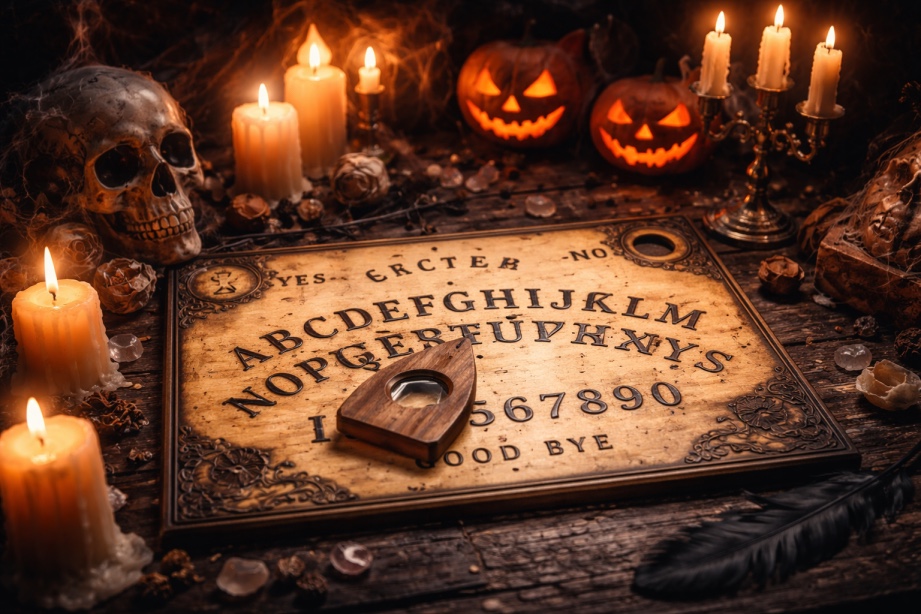
At the most basic level, a Ouija board is a talking board marked with letters, numbers, and simple responses such as “yes,” “no,” and “goodbye,” used with a movable pointer called a planchette. The 1891 patent describes it explicitly as a game or toy designed so people could ask questions and receive answers indicated by letters on the board. That framing matters because it shows the board was commercialized from the start, not discovered as some ancient proven spirit technology.
That does not mean people did not use talking boards spiritually. They absolutely did. The board’s popularity rose during an era when many Americans believed the dead could communicate with the living, especially in the wake of enormous personal loss and uncertainty. That historical context helps explain why the Ouija board has always carried more emotional weight than an ordinary board game. It was sold into a culture already primed to search for signs, messages, and comfort from beyond.
What science says about how Ouija boards “work”
The most widely accepted explanation is the ideomotor effect. Britannica describes this as involuntary muscular movement influenced by expectation, belief, or mental focus. In the case of a Ouija board, participants often feel as though the planchette is moving on its own, but the movement is actually being produced by tiny, unconscious motions of their own hands.
That explanation does not make the experience feel any less eerie. In fact, part of what makes the Ouija board so unsettling is that people are not usually aware they are causing the motion. A 2012 study indexed by PubMed found that when participants believed they were only guessing, ordinary verbal answers were at chance, but Ouija-style ideomotor responses were significantly more accurate, suggesting that unconscious knowledge can surface through these subtle movements. That result does not show spirit communication. It suggests the board can act as a channel for information participants already hold below full conscious awareness.
A later open-access field study on Ouija sessions found that participants in actual sessions had a lower sense of agency, meaning they felt less like they were controlling the movement themselves. The study also found that meaningful responses can emerge at the pair level over time, as interacting participants increasingly impose structure on what may begin as random motion. In plain English, the board can feel autonomous because joint attention, expectation, and unconscious coordination make it seem that way.
So, if you are asking whether science supports the claim that Halloween night makes the board a better device for contacting spirits, the answer is no. There is no verified evidence that Halloween changes the mechanism. The better-supported explanation is still psychology, expectation, unconscious movement, and the way humans generate meaning in emotionally charged settings.
Why Halloween can make the experience feel more intense
Even if Halloween does not make the board “stronger,” it absolutely can make the experience feel stronger.
That is because Halloween is already full of cues that shape expectation: darkness, costumes, candles, ghost stories, graveyard imagery, and a shared agreement that this is the season of the uncanny. Once people enter that frame of mind, ordinary events can feel loaded with special meaning. A pause can feel ominous. A small movement can feel deliberate. A vague answer can feel personal.
This is where a lot of Halloween Ouija stories come from. The setting does not have to produce paranormal activity to produce a powerful memory. The more charged the atmosphere, the easier it is for participants to remember the session as extraordinary, frightening, or spiritually significant. That is one reason Ouija boards remain culturally potent even though the strongest evidence points away from supernatural causation.
When using a Ouija board on Halloween is a bad idea
There are situations where the answer should be a clear no.
If someone in the room is already frightened, prone to panic, recently bereaved, or likely to dwell on the session afterward, the board can stop being harmless fun very quickly. The same goes for groups mixing it with alcohol, dares, or pressure. A Halloween setting can intensify emotional reactions, and once someone interprets the session as real contact, that fear can linger well beyond the party. Smithsonian’s discussion of Ouija boards specifically connects their cultural power to psychology, grief, and uncertainty, which is part of why the experience can hit some people much harder than others.
It is also a bad idea if the group cannot agree on what the board is. If one person thinks it is a joke, another thinks it is a doorway to spirits, and a third is already terrified, the session is almost guaranteed to become uncomfortable. The board works best, if you can call it that, when participants share expectations. Ironically, that same shared expectation is part of what can make the experience feel convincing.
If you still want to use one, treat it like theater, not revelation
If you are still planning to use a Ouija board on Halloween, the smartest approach is to treat it as a spooky party experience, not as a serious method for receiving truth from the dead.
Set the tone ahead of time. Make sure everyone is willing. Do not use it to ask about someone’s deceased loved one. Do not use it to target the most nervous person in the room. Do not use it as a dare. And do not keep going once someone becomes distressed. If the point is seasonal fun, then protect the fun. The minute the room shifts from playful to genuinely shaken, you have your answer and it is time to stop.
That may sound practical rather than mystical, but practical is the better lens here. The verified history and research do not support the idea that Halloween unlocks a hidden spiritual function in the board. They do support the idea that belief, context, and unconscious action can create something that feels intensely real.
Better Halloween alternatives if you want the same vibe
If what you really want is tension, mystery, and a memorable October-night activity, there are better options.
Try a ghost-story circle, a Victorian-style séance game without claims of spirit contact, a horror movie marathon, a haunted history discussion, a candlelit trivia night about urban legends, or a visit to a haunted attraction. Those activities preserve the mood people want from a Halloween Ouija session without inviting the emotional fallout that sometimes follows one.
That distinction matters. Most people are not looking for laboratory-grade truth on Halloween. They are looking for a thrilling experience. You can get that experience without handing the night over to a tool that some guests may take far more seriously than others.
Final verdict: should you use a Ouija board on Halloween?
For most people, the best answer is probably no, unless everyone involved understands exactly what it is and what it is not.
Use one only if the group is comfortable, sober, and treating it as spooky entertainment. Do not use one if anybody is emotionally vulnerable, deeply fearful, or expecting genuine supernatural contact. Halloween may make the session feel richer, darker, and more dramatic, but verified evidence does not show that the date gives the board extra power. What Halloween reliably adds is atmosphere, symbolism, and a stronger chance that normal unconscious movement will be interpreted as something beyond it.
In other words, if your goal is fun, there are safer ways to get chills. If your goal is certainty about the afterlife, a Ouija board on Halloween is still not the tool that will give it to you.
Sources
Reader sightings
Nobody has reported anything here yet. If you have been, you would be the first.
Leave a Reply