Reviewed by Josh N · Updated August 29, 2026 · How we verify
Reported Phenomena
- Red Lady apparition
- Ghosts of two girls
- Elemental spirit
- Séance phenomena
Reported by visitors & local legend. Stories, not verified claims.
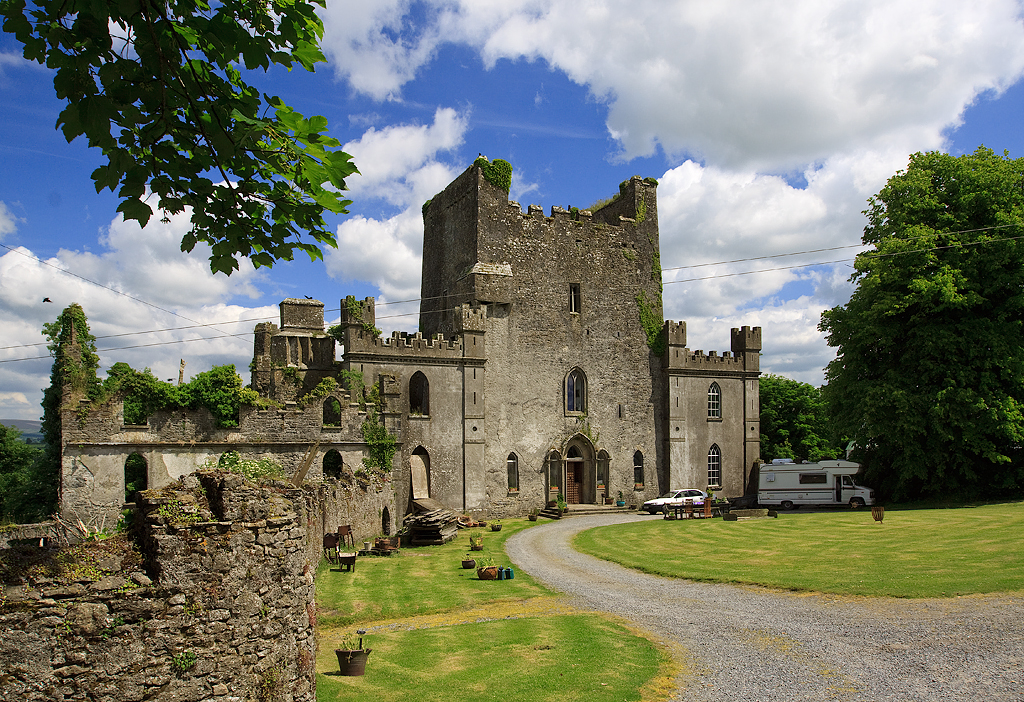
Ask anyone in the midlands to name a haunted Leap Castle rival and you will get a long pause. The tower stands on the R421 in County Offaly, about 6 kilometres (3.7 mi) north of Roscrea and 10 kilometres (6.2 mi) south of Kinnitty, and it markets itself, without much modesty, as “the world’s most haunted castle”. Behind the slogan is a genuinely knotted history: a keep of disputed age, a killing at an altar, a Gothic novelist holding séances in the drawing room, and a burning during the Civil War that left the place a ruin for half a century.
Who Built the Léim Uí Bhánáin Keep, and When
The honest answer to the date question is that nobody agrees. Accounts of the main tower’s construction range anywhere from the 13th century to the late 15th century, with most opinion settling around 1250 AD. It was raised by the O’Bannon clan and originally called “Léim Uí Bhanáin”, the Leap of the O’Bannons, a name that covered the fertile land around the castle as well as the building. The O’Bannons were secondary chieftains in the territory, subject to the ruling O’Carroll clan.
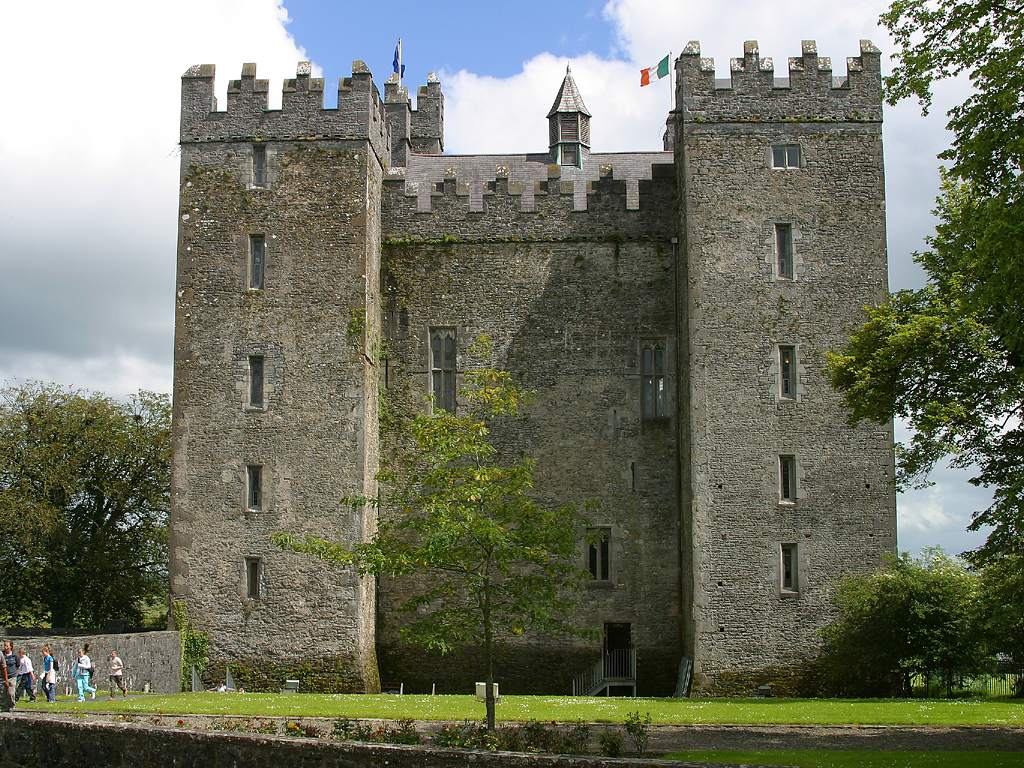
There is evidence that the keep went up on the site of an earlier stone structure, possibly ceremonial, and that the ground has been occupied consistently since at least the Iron Age and perhaps since Neolithic times. That deep occupation is the sort of detail ghost tours enjoy, but it is also ordinary archaeology: good high ground stays in use.
Sieges, Succession and the Killing in the Chapel
The Annals of the Four Masters record that Gerald FitzGerald, Earl of Kildare, tried and failed to seize the castle in 1513. He came back in 1516 and managed to partially demolish sections of it. By 1557 the O’Carrolls had regained possession.
The story the castle is best known for belongs to the generation after Mulrooney O’Carroll’s death in 1532, when family struggles plagued the clan and a fierce rivalry for leadership turned brother against brother. One brother was a priest. As he held mass for a group of his family in what is now called the Bloody Chapel, his rival brother burst in and ran him through with a sword. The priest fell across the altar and died in front of his family. This is the traditional account carried in the record of the castle rather than a coroner’s finding, and it should be read as such, but it is the origin of the chapel’s name and of most of what is said about the upper floors.
The Darbys, and Mildred Darby’s Séances
In 1642 the castle passed by marriage to the Darby family, whose notable members included Vice-Admiral George Darby, Admiral Sir Henry D’Esterre Darby and the preacher John Nelson Darby. The paranormal reputation as we now have it is largely the work of one of them by marriage. During the tenure of Jonathan Charles Darby, his wife Mildred Darby, a writer of Gothic novels, held séances in the castle. The publicity that followed did more for the castle’s ghosts than four centuries of clan warfare had managed.
Mildred Darby’s interest is worth keeping in view when you read modern accounts. A novelist working in the Gothic mode, holding sittings in her own ancient house and then writing about them, is not a neutral witness. Nearly every later claim traces back through her.
Twenty Minutes and a Can of Petrol: the 1922 Burning
The central keep was later expanded with significant extensions. Paying for them meant raising rents and selling off much of the land that went with the castle, and that resentment is one theorised motivation for the burning of Leap Castle during the Irish Civil War in 1922. Raiders arrived and stated that they intended to burn the castle. Dawkins asked for time to remove his wife and child and was granted twenty minutes. When the twenty minutes were up, the raiders went in, distributed petrol through the rooms and set the structure alight.
In September 1922, after the destruction, Mr Darby obtained a reinstatement estimate from Beckett & Medcalf, surveyors in Dublin. The document confusingly gives the address as Leap Castle, Roscrea, County Tipperary. The net amount of claim came to £22,684.19.1, equivalent to roughly €1m in 2018 terms. It was settled for a lesser amount.
Peter Bartlett, Sean Ryan and Fifty Years of Rebuilding
The ruin sat until 1974, when it was bought by the Australian historian Peter Bartlett, whose mother had been a Banon: the family name of the original builders, come back around. Bartlett and the builder Joe Sullivan carried out extensive restoration work up to Bartlett’s death in 1989. Since 1991 the castle has been privately owned by the musician Sean Ryan and his wife Anne, who continue the work. Leap is therefore not a state property and not in the care of the Office of Public Works. It is somebody’s home and somebody’s ongoing building project.
The Red Lady, the Two Girls and the Elemental
Claims of paranormal activity at Leap centre on three recurring figures: a Red Lady, the ghosts of two girls, and an “elemental spirit” associated with Mildred Darby. None of these is a documented event. They are reported experiences and inherited stories, passed on by owners, guests and television crews, and the elemental in particular is inseparable from the séances that produced it.
The castle’s oubliette has become the other fixed point of the legend. Aaron Mahnke devoted a chapter of “The World of Lore: Dreadful Places” to Leap, titled The Tainted Well in reference to it, and returned to the subject in episode 68 of his podcast Lore.
Leap Castle on Television
Few Irish buildings have been filmed by more ghost-hunting crews. Investigators from ABC Family’s Scariest Places on Earth and from the first season of Living TV’s Most Haunted have both been through the place, as has The Atlantic Paranormal Society for Syfy’s Ghost Hunters. In August 2014 the Travel Channel’s Ghost Adventures shot their tenth season Halloween special at the castle, and more recently the YouTube channel Sam and Colby filmed there. In 1996 the castle’s history and hauntings were examined in Castle Ghosts of Ireland, presented by Robert Hardy. The castle also appeared on the cover of several editions of Tim Winton’s novel The Riders.
Seeing Leap Castle for Yourself
Leap is private property, lived in and still under restoration, and the sources here do not set out any public opening arrangement. Treat it as a place to view from the public road rather than one to wander into. The R421 between Roscrea and Kinnitty gives you the setting: rolling Offaly farmland, the Slieve Blooms behind, and a squat grey keep that has been fought over, partly demolished, burned out and rebuilt by two owners in living memory. Anyone hoping to get inside should be asking the owners first, not the gate.
Address: Leap Castle, Roscrea, County Offaly, Ireland
See Leap Castle for Yourself
Sources
- Darby
- Biographical cuttings on Peter Bartlett, writer, historian and owner of Leap Castle built around 1380, containing one or more cuttings from newspapers or journals
- Lockdown Your October with Ghost Adventures
- Hit American show Ghost Adventures filming in Ireland
- 6 tales of terror: 1 Leap Castle
- Wikipedia: Leap Castle
Frequently Asked Questions
Where is Leap Castle Bloody Chapel located?
Leap Castle Bloody Chapel is located at Leap Castle, Roscrea, County Offaly, Ireland.
Can you visit Leap Castle Bloody Chapel?
Leap Castle Bloody Chapel is on private property and best viewed from a distance. Always follow posted rules and respect private property.
Reader sightings
Nobody has reported anything here yet. If you have been, you would be the first.
Report your own visit to Haunted Leap Castle: The Bloody Chapel of County Offaly
How haunted is this place?
Be the first to rate
Leave a Reply