

Reviewed by Josh N · Updated September 15, 2026 · How we verify
Reported Phenomena
- Objects moving unaided
- Unexplained noises
- Shadowy figures at windows
- Apparitions in the woods
Reported by visitors & local legend. Stories, not verified claims.
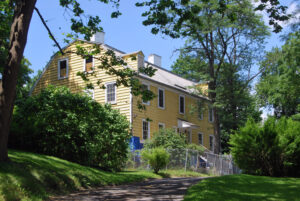
Set among the hills of Cavendish, Vermont, the Wheelock farmhouse is one of those places where the documented record and the ghost stories run on separate tracks. The record belongs to Deacon Jonathan Wheelock, a Revolutionary War Minuteman who raised the house in 1789 and spent his last decade parceling out farmland to his children. The stories belong to everyone since: visitors and paranormal enthusiasts who describe objects moving on their own, noises in empty rooms, and shapes at the windows. Only the first of those two accounts can be traced to paper.
The Wheelock Farmhouse at a Glance
- Where: Cavendish, Vermont
- Built: 1789, by Deacon Jonathan Wheelock
- Builder’s dates: born September 18, 1727 in Shrewsbury, Massachusetts; died October 21, 1798
- Land: more than 1,000 acres acquired and farmed
- Buried: Old Revolutionary War Cemetery, Windsor County
- Reputation: moving objects, unexplained sounds, shadowy figures at the windows
From Shrewsbury to Cavendish: Who Deacon Wheelock Was
Jonathan Wheelock was born on September 18, 1727 in Shrewsbury, Massachusetts, which means he was already a man in his late forties when the Revolution began. He served as a Minuteman, one of the militiamen expected to turn out at short notice, and he carried a second kind of standing in his community as well: he is credited with establishing Cavendish’s first Episcopalian church. The title of deacon stuck to his name and still does.
He came north to Cavendish in 1789 with his wife, Anna Drury Wheelock, and the farmhouse dates from that same year. It was not a retirement. Wheelock acquired and worked more than a thousand acres of Vermont land, a holding large enough to support a family of nine and then to be broken up for them.
A Thousand Acres, Divided Within Sight of the House
The detail that says the most about the man is how he handed on the land. As his children came of age, Wheelock divided his acreage among them, and he did it so that every parcel lay within view of his own farmstead. Whether that was affection, practicality, supervision, or all three is a matter of interpretation, but the arrangement put the whole family inside one sightline from the front of the house.
Jonathan and Anna had seven children: Jonathan, Zeruiah, Ebenezer, Jotham, Joseph, John, and Anna. The deacon died on October 21, 1798, only nine years after arriving in Cavendish, leaving a settled family landscape behind him. His life is set out in Gertrude Bernadette Wilgus’s book Sketch of the Life of Deacon Jonathan Wheelock of Cavendish, Vermont, which remains the standard account of him and the reason so much biographical detail survives for a farmer who never held national office.
What People Say Happens at the Wheelock Farmhouse
The haunting attached to the property is described in fairly familiar terms. Reported experiences include:
- Objects seen moving without anyone touching them
- Unexplained noises carrying through empty rooms
- Shadowy figures said to appear behind the farmhouse windows
Nobody claims to know who the figures are. The accounts leave open whether they are meant to be the deacon himself or one of the family members who lived and farmed within sight of the house. That vagueness is worth noticing. When a legend cannot name its ghost, it is usually the building’s history supplying the identity rather than any witness.
None of this is documented in the way Wheelock’s birth, marriage, land and death are documented. There are no named witnesses in the tradition, no dated incidents, and no verified event on the property that the reports point back to. What exists is a reputation, repeated by people who have visited or gone looking. A house standing since 1789 will also move, settle, and make noise in ways that surprise anyone alone in it, and old glass in old frames does strange things with reflected light. That does not disprove anything. It does mean the stories should be read as folklore rather than record.
Cavendish, the Woods, and a Village That Keeps Its Ghosts
The farmhouse does not carry the town’s reputation on its own. Cavendish has ghost stories attached to the dense woods around it and to the village itself, and the Wheelock property sits inside that larger local tradition rather than standing apart from it. In a place where the eighteenth century is still visible on the ground, the past tends to get credited with anything unexplained.
Visiting Cavendish and Wheelock’s Grave
Nothing in the available accounts suggests the farmhouse operates as an attraction, so treat it as a private home unless you have been told otherwise. Look from the public road, do not walk the property, and do not knock. A ghost story is not an invitation.
The one site connected to Wheelock that genuinely welcomes visitors is his grave in the Old Revolutionary War Cemetery in Windsor County, where history-minded travelers and ghost hunters both turn up. Usual cemetery manners apply: daylight hours, stay on the paths, leave the stones alone. Between the burial ground, the surrounding countryside, and Wilgus’s biography, there is more than enough of the real Deacon Wheelock to occupy a day in Vermont without ever setting foot on his doorstep.
Frequently Asked Questions
Can you visit Wheelocks Haunted Farmhouse?
Wheelocks Haunted Farmhouse is on private property and best viewed from a distance. Always follow posted rules and respect private property.
Reader sightings
Nobody has reported anything here yet. If you have been, you would be the first.
Report your own visit to The Deacon’s 1,000 Acres: Wheelock Farmhouse, Cavendish VT
How haunted is this place?
Be the first to rate


Leave a Reply