
Reviewed by Josh N · Updated November 22, 2026 · How we verify
Reported Phenomena
- Spectral figures
Reported by visitors & local legend. Stories, not verified claims.
Ask about the haunted Saltair pavilion and you will get a picture in return before you get a story: a pale domed hall standing alone on a salt flat, water gone, paint gone, doors open to the wind. That image is real, it was filmed, and it is most of the reason the place carries a spectral reputation at all. What sits on the southern shore of the Great Salt Lake in Utah, roughly 15 miles west of Salt Lake City in what is now the city of Magna, is not one building but the successive remains of three resorts that each failed in their own way.
Three Resorts, One Name
The first Saltair was completed in 1893, jointly owned by a corporation associated with The Church of Jesus Christ of Latter-day Saints and the Salt Lake & Los Angeles Railway, a line built for the express purpose of serving the resort. It was designed by the Utah architect Richard K.A. Kletting as an example of early twentieth century Moorish Revival architecture, and it rested on more than 2,000 posts and pilings. The church sold the resort in 1906.
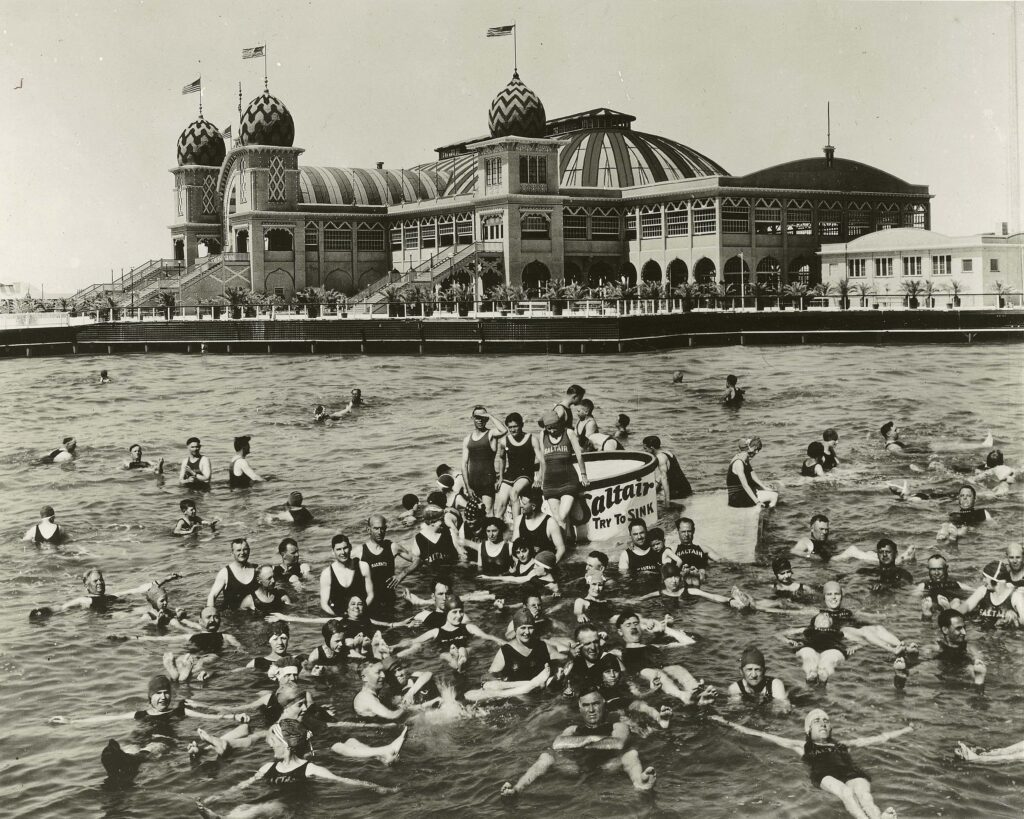
Saltair was intended from the beginning as a western counterpart to Coney Island, and for a time it was the most popular family destination west of New York. It was not the first resort on the lake. It was the most successful one ever built there.
The second Saltair rose on the same spot after the first burned, and it never matched its predecessor. Motion pictures, radio and the Great Depression kept people closer to home. The replacement pavilion had the largest dance floor in the world at the time, and Saltair became known less as an amusement park than as a dance palace hosting traveling bands such as Glenn Miller.
Four Fires and a Lake That Walked Away
The dates are worth laying out in order, because Saltair’s reputation for doom is one of the few things about it that the record supports outright.
The first pavilion and several other buildings were destroyed by fire on April 22, 1925. In 1931 another fire caused over $100,000 in damage to the second resort. In 1933 the lake itself retreated, leaving the pavilion high and dry and forcing the operators to build a miniature railway to carry swimmers out to the water. Fuel rationing and the loss of customers and staff during World War II closed the resort entirely. It reopened, struggled against closer competition, and shut for good in 1958, which ended passenger operations on the railroad at the same time.
Then came the arson. A fire set in September 1967 destroyed the concourse, the entry gate, the concession stands and other support structures, but spared the main building. In November 1970 a second arson fire, set in the center of the wooden dance floor, destroyed the main pavilion.
The Hangar That Became Saltair III
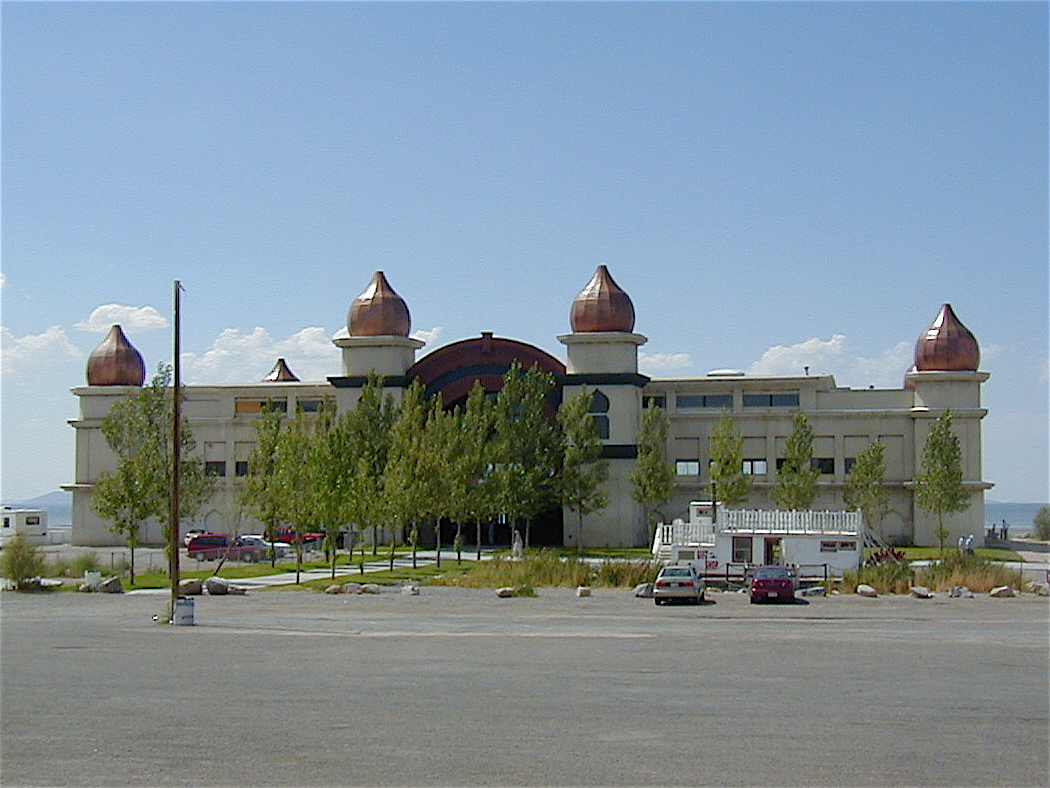
A third Saltair was built in 1981, roughly a mile west of the original, prompted by proximity to Interstate 80 and by population growth in the Tooele Valley and western Salt Lake Valley. The new pavilion was not purpose built: it was constructed out of a salvaged aircraft hangar from Hill Air Force Base.
The lake punished this one too. Flooding reached the resort only months after it opened. The water receded over several years, investors restored and repaired, and then the shoreline kept retreating until the building was stranded again. By the end of the 1990s Saltair was all but abandoned. In 2005 several investors from the music industry pooled together to buy the building, and concerts have run there since.
Why People Think Saltair Is Haunted
Key scenes of the 1962 horror film Carnival of Souls were shot in Saltair II. The film is about a woman drawn repeatedly to an abandoned lakeside pavilion populated by the dead, and it used the real thing: the real dance floor, the real emptiness, the real salt flat. For a great many people that film is the only image of Saltair they have ever seen, and it is an image of a haunted building.
The resort has kept turning up in popular culture since. The 1993 film Josh and S.A.M. shows the dilapidated Saltair III inside and out. A Beach Boys photo session was held there in 1968 with poses around Saltair II. The Pixies song “Palace of the Brine,” released in 1991, is a reference to Saltair.
It is worth being plain about what that adds up to. The documented history of Saltair contains fires, bankruptcies, arson and a lake that would not stay put. It does not contain a recorded death toll, a named ghost, or a body of witness accounts. The reputation is cinematic and atmospheric rather than evidential, and visitors looking for a specific apparition with a backstory will not find one in the record.
Pilings, Car 502 and the Rest of the Wreckage
Relics of the lake’s resort era remain visible from the highway. Rows of pilings snake outward toward the water, all that is left of the railway trestle and pier that once carried visitors to the earlier resort. Many of the original 2,000-plus posts survive after more than a century.
The most conspicuous relic for years was the skeleton of car 502, one of the Salt Lake, Garfield & Western interurban rail cars, sitting beside the ruins of an old powerhouse that once fed the lights and roller coasters at the entrance to the first Saltair. The property owner removed the rail car on February 18, 2012, citing safety concerns. The railroad itself still exists as a shortline common carrier doing switching work around Salt Lake City, but the tracks no longer reach the resort.
Saltair’s neighbor, Lake Park, had a better ending. Its surviving buildings were moved thirty miles away, and the Lagoon Amusement Park grew up around them.
Going Out to Saltair Now
The building standing today is Saltair III, the converted hangar, and it operates as a concert venue under the ownership group that bought it in 2005. Check the official website for the current event schedule, since access depends entirely on whether something is booked.
The surroundings are the draw for anyone interested in the older resorts. The pilings, the powerhouse ruins and the flats are near the highway and visible from it. Bear in mind that what you are standing in front of is not the pavilion from the film: the building that Carnival of Souls made famous burned in November 1970, and the one before that burned in 1925. Saltair is a place where the ghost is the architecture, and the architecture has been gone for over fifty years.
Address: Southern shore of the Great Salt Lake near Magna, Utah, about 15 miles west of Salt Lake City
See Saltair for Yourself
Sources
- Saltair: A Photographic Exhibit (Utah (official))
- Saltair
- Fire destroys historic Saltair resort
- Full Steam Ahead For Saltair Rec Area
- So long, Saltair Train: Iconic rail car makes final departure from Saltair
- Wikipedia: Saltair (Utah)
Frequently Asked Questions
Where is Saltair Pavilion Great Salt Lake located?
Saltair Pavilion Great Salt Lake is located at Southern shore of the Great Salt Lake near Magna, Utah, about 15 miles west of Salt Lake City.
Can you visit Saltair Pavilion Great Salt Lake?
Saltair Pavilion Great Salt Lake is open to the public. Always follow posted rules and respect private property.
Reader sightings
Nobody has reported anything here yet. If you have been, you would be the first.
Report your own visit to Carnival of Souls and the Haunted Saltair Pavilion
How haunted is this place?
Be the first to rate
Ghost Tours Nearby
 Salt Lake Ghost Tour: Salt, Spooks, & Shadowsfrom $26
 Salt Lake City Haunted Old Town Bus Tourfrom $30
 Shadows of Old Salt Lake Walking Tourfrom $20
Affiliate links: BeyondHaunted may earn a commission, at no extra cost to you.
Leave a Reply