

Reviewed by Josh N · Updated October 8, 2026 · How we verify
Reported Phenomena
- Apparition sightings
- Sounds of distress
- Overwhelming sadness
- Unexplained noises
Reported by visitors & local legend. Stories, not verified claims.
A broad grassy valley in the southwestern corner of Utah carries one of the heaviest reputations in the American West. The Mountain Meadows Massacre took place here in September 1857, when an emigrant wagon train bound for California was destroyed by men who had just promised its members safe passage out. The killing itself is documented history, not folklore. The ghost stories that have attached themselves to the meadow are a separate matter, and it is worth knowing which is which before you drive out there.
Quick Orientation to Mountain Meadows
- Where: Mountain Meadows, in southern Utah.
- When: September 1857, during the Utah War.
- Who died: the Baker-Fancher party, a wagon train of roughly 120 emigrants traveling from Arkansas to California.
- Who survived: only children under seven, spared on the reasoning that they were too young to testify about what they had seen.
- Who carried it out: local commanders and members of the Iron County contingent of the Utah Territorial Militia, with Paiute participants; militiamen involved in the attack were disguised as Native Americans.
- Status today: a memorial landscape and burial ground rather than a tourist attraction.
War Hysteria in the Utah Territory, 1857
The massacre did not come out of nowhere. The territory was effectively on a war footing. The Utah Territorial Militia, better known as the Nauvoo Legion, had been reformed out of the remnants of the earlier Illinois organization by Brigham Young in 1847 and organized into sub-units for each Utah county. It had already seen combat against Native peoples, including the Walker War of 1853 to 1854 against forces led by Chief Walkara, in which twenty Mormon militiamen and many Native Americans died.
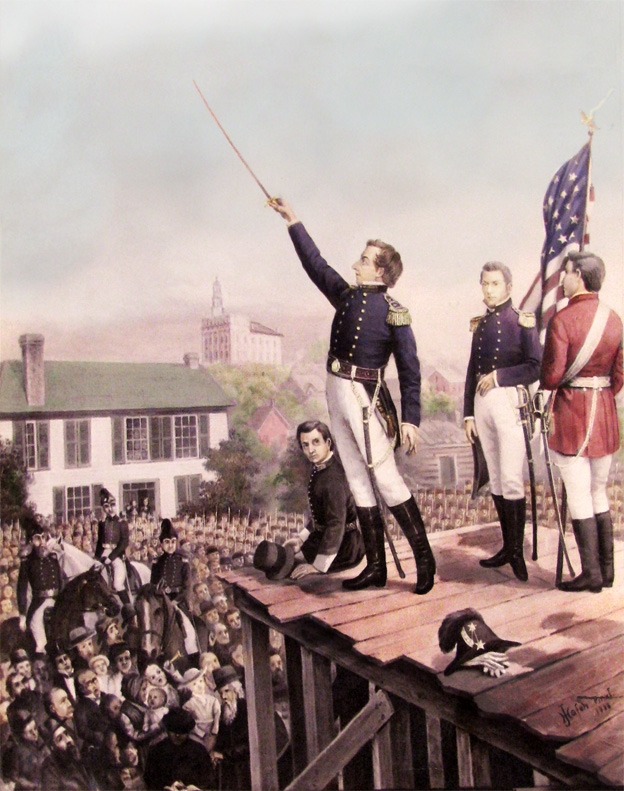
In 1857 the Legion was called up again, this time against the United States Army. President James Buchanan had dispatched Albert Sidney Johnston’s column, the so-called Utah Expedition, to put down what the federal government regarded as a rebellion. The militia, with a strength of around 6,000 personnel, mobilized segments of its northern contingent to slow Johnston’s advance. Rather than meeting the army in the open, it relied on destroying supplies and avoiding direct engagement. It was also under the auspices of the militia that men were organized and instructed to burn Salt Lake City and other parts of northern Utah to the ground if the invading army attempted to take up residence there.
That is the atmosphere in which a wagon train from Arkansas crossed southern Utah: an armed population convinced an army was coming to destroy it. Daniel H. Wells was the chief military commander of the militia at the time. The massacre has been attributed to local commanders and members of the Iron County militia who were, in the standard description, overcome with suspicion and war hysteria.
The Flag of Truce and the Baker-Fancher Party
The emigrants were besieged in the meadow and held out for several days. What ended the siege was not a storming of their position but a negotiation. The party was approached under a white flag of truce, persuaded to give up its defensive wagon circle, and then killed. Only the youngest children, those under seven, were left alive.
The aftermath compounded the crime. The emigrants’ property was sold off. Their bodies lay where they fell and were later buried by the U.S. Army. The Utah War itself ended without a pitched battle: both sides stood down after an agreement permitted the army to pass through Salt Lake City and establish itself at Camp Floyd. The militia survived the war, outlasted the Civil War years, and was finally disbanded for good by the Edmunds-Tucker Act of 1887, with the non-sectarian Utah National Guard organized in 1894 in anticipation of statehood. The massacre, meanwhile, has never stopped being a sensitive and contested subject.
What People Say They Experience in the Meadow
There is no scientific evidence of paranormal activity at Mountain Meadows, and nobody claiming otherwise has produced any. What exists is a long, consistent body of anecdote from people who have stood in the valley.
Visitors describe spectral figures seen across the open ground, sounds of distress with no apparent source, and most commonly an overwhelming heaviness or sadness that settles on them well before they have read the monuments. Those reports are personal experiences rather than verified events, and the setting does a great deal of the work: a remote, quiet, treeless basin where something genuinely terrible happened, visited mostly by people who already know the story in detail. Suggestion and atmosphere are not trivial forces.
It is also worth noting what the reports are not. There is no named resident ghost here, no identified apparition with a biography attached, no signature incident retold with fixed details. The haunting of Mountain Meadows is diffuse, which is unusual and, in its way, more honest. People say the place feels wrong. They rarely say more than that.
Visiting Mountain Meadows with Some Sense
Treat this as a grave site, because that is what it is. The meadow is a place of reflection, marked by memorials, and it draws descendants of both the victims and the participants. It is not a ghost hunting location, and behaving as though it were will go badly with anyone else present.
Go in daylight if you want to understand the ground, which is the real reason to make the trip. Standing in the basin and seeing how exposed it is, how far from help the Baker-Fancher party was, explains more about what happened in September 1857 than any amount of equipment would. Read the memorials. Keep your voice down. Leave everything where it is.
Why the Story Will Not Settle
Mountain Meadows endures as a haunted place for reasons that have little to do with the supernatural. It is the rare American atrocity committed by a community against travelers passing through it, carried out under a promise of protection, and then argued over for generations. The alleged hauntings offer a kind of narrative closure to a chapter of history that has never actually been closed. Whether anything walks the meadow is unprovable. That the ground deserves the weight people feel there is not in question at all.
Sources
- Utah Wars and Conflicts (Utah (official))
- A History of the Nauvoo Legion in Illinois (Byu (official site))
- History
- The Mormons Sit Out the Civil War
- The Utah Black Hawk War: Synopsis by Historian Phillip B Gottfredson
- Wikipedia: Utah Territorial Militia
Frequently Asked Questions
Can you visit Mountain Meadows Massacre?
Mountain Meadows Massacre is open to the public. Always follow posted rules and respect private property.
Reader sightings
Nobody has reported anything here yet. If you have been, you would be the first.
Report your own visit to Under a Flag of Truce: The Mountain Meadows Massacre, Utah
How haunted is this place?
Be the first to rate
Leave a Reply