
Reviewed by Josh N · Updated July 28, 2026 · How we verify
Reported Phenomena
- Room 1102 activity
- Faucets turning on
- Phantom touches
- Disembodied whispers
- Apparition sightings
- Elevators moving alone
Reported by visitors & local legend. Stories, not verified claims.
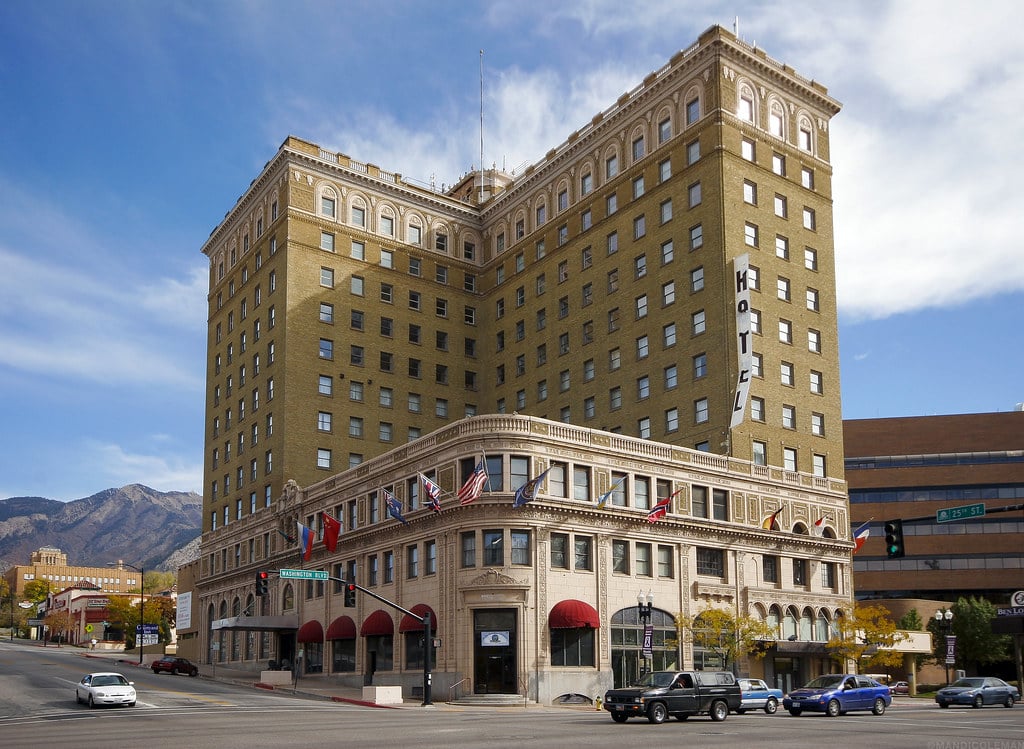
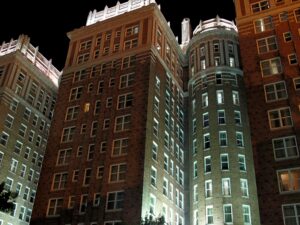
The Ben Lomond Hotel is the name most people in Ogden, Utah still use for the eleven story landmark at 2510 Washington Boulevard, even though the building opened in 1927 as the Bigelow Hotel, carried the Ben Lomond name from 1933 to 2017, and has been an apartment complex since 2019. It is the largest hotel ever built in Ogden, one of Utah’s three so-called grand hotels, and the setting for a set of ghost stories centred on a single room on the eleventh floor. The architecture and the political history are documented. The hauntings are reported experiences passed along by guests and staff, and the deaths described in the legend do not appear in the building’s recorded history.
Quick Facts
- Location: 2510 Washington Blvd, Ogden, Utah
- Opened: 1927, as the Bigelow Hotel
- Named for: local banker Archie P. Bigelow
- Architects: Hodgson & McClenahan, also responsible for Peery’s Egyptian Theatre and Ogden High School
- Style: Italian Renaissance Revival, with a heavily ornamented terra cotta exterior
- Construction cost: stated at $1,250,000 in 1927
- Renamed: Ben Lomond Hotel in 1933 by Marriner S. Eccles, back to Bigelow in 2017
- Listed: National Register of Historic Places, 1990
- Status: Converted to The Bigelow Apartments in 2019. No longer a hotel
The History of the Building
A five story hotel called the Reed Hotel stood on the site from 1891. Local businessman A. Peery decided to replace it with something modern, and a corporation of 300 shareholders was organised to fund and manage the project. The result opened in 1927 and was named for local banker Archie P. Bigelow.
The architectural firm of Hodgson & McClenahan drew the plans. The same firm shaped much of the city’s public face in this period, including Peery’s Egyptian Theatre, Ogden High School, the Ogden/Weber Municipal Building, the Regional Forest Service Building, the Stock Exchange Building and several Prairie School houses in the Eccles Avenue Historic District. The Bigelow cost a stated $1,250,000 to build, a figure that says a great deal about how confident Ogden felt in the 1920s.
The style is Italian Renaissance Revival, common enough nationally in that decade but unusual in Utah. The exterior was finished in ornamented terra cotta, most elaborately on the elevations facing 25th Street and Washington Boulevard. Inside, the designers worked their way through a catalogue of themes: an Arabic style coffee shop, a Florentine Palace ballroom, a businessmen’s club room done in a touch of old Spain, an English Room panelled in old wood influenced by a room at Bromley Palace, and a Georgian Room in Adamesque style. The showpiece was the Shakespeare Room, with murals by the Utah artist LeConte Stewart.
The 1928 Convention
The hotel drew national attention almost immediately. In 1928 it hosted the Western Democrats convention, and the Western States “Smith for President” campaign that came out of it signalled to Democratic leaders that Alfred E. Smith would be a serious force in the 1928 presidential election. Time covered the gathering in its issue of October 3, 1927.
From Ben Lomond to Apartments
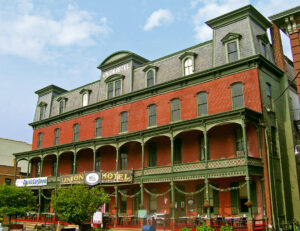
Marriner S. Eccles acquired the Bigelow in 1933 and renamed it the Ben Lomond Hotel, the name that stuck for the next eight decades and the one attached to nearly every ghost story told about the place. It operated as a working hotel for more than 40 years under that name. Later owners, Weber County among them, put parts of the building to other uses including offices. Radisson bought and refurbished the hotel in the 1980s.
The original name returned in 2017. Two years later, in 2019, the building was converted into The Bigelow Apartments, which made it the last of Utah’s three grand hotels to stop functioning as a hotel. The other two were the former Hotel Utah and the Newhouse Hotel, which has been demolished. The Bigelow was added to the National Register of Historic Places in 1990.
Reported Phenomena
The stories below are reported experiences described by guests, staff and later visitors during the building’s long run as a hotel. None of the deaths in the legend appear in the documented record of the building, and the account of how they happened has been told in several slightly different versions over the years.
The best known story concerns room 1102 on the eleventh floor and involves a woman and her adult son. In the version most often repeated, the woman drowned in the bathtub of that room while on her honeymoon, and her son later took his own life in the same room after coming to collect her belongings. Treat this as folklore rather than history: it is the sort of tidy, symmetrical tragedy that legends produce, and no supporting record is offered for it.
Phenomena attached to the building include:
- Faucets in room 1102 said to turn themselves on
- The sensation of being touched by unseen hands in the same room
- Reported sightings of figures, sometimes accompanied by whispering
- Elevators said to travel between floors with nobody aboard and no call button pressed
Elevator behaviour is worth a note of caution. An eleven story building with equipment installed in 1927 and modified repeatedly across nearly a century of changing ownership has plenty of mundane reasons for a car to move on its own. The room 1102 accounts are harder to test in either direction, because they rest entirely on what individual guests reported feeling and hearing.
Visiting
You cannot book a night here. The conversion to The Bigelow Apartments in 2019 ended the building’s life as a hotel, and the upper floors, including the eleventh, are private residences. Anyone hoping to sleep in room 1102 has arrived several years too late.
What remains freely available is the exterior, and it is the reason the building is on the National Register. Stand at the corner of Washington Boulevard and 25th Street and read the terra cotta ornament, which is concentrated on exactly those two elevations because they were the faces the hotel presented to Ogden. The scale is the other thing to take in: eleven storeys is still the tallest statement on this stretch of Washington Boulevard, and it was built by a corporation of 300 local shareholders betting on their own city.
Historic 25th Street runs west from the corner and gives useful context for the hotel’s heyday, when Ogden was a railroad town and the Bigelow was where visiting politicians and conventions stayed. Photographs of the original hotel bar are held in the University of Utah’s J. Willard Marriott Library Digital Collections for anyone who wants to see the interiors as they were.
See Ben Lomond Hotel for Yourself
Sources
Frequently Asked Questions
Where is Ben Lomond Hotel located?
Ben Lomond Hotel is located at 2510 Washington Boulevard.
Can you visit Ben Lomond Hotel?
Ben Lomond Hotel is on private property and best viewed from a distance. Always follow posted rules and respect private property.
Reader sightings
Nobody has reported anything here yet. If you have been, you would be the first.
Report your own visit to Ben Lomond Hotel Ogden: History and Reported Hauntings
How haunted is this place?
Be the first to rate
Leave a Reply