
Reviewed by Josh N · Updated August 9, 2026 · How we verify
Reported Phenomena
- Disembodied screams
- Footsteps in empty corridors
- Papers moving unaided
- Sudden temperature drops
- Objects displaced in offices
- Feeling of being watched
- Shadow figures glimpsed
Reported by visitors & local legend. Stories, not verified claims.
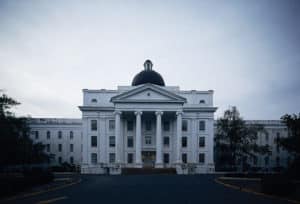
Eight years of stalled bills, postponed resolutions and one inconclusive statewide vote stood between a governor’s plea and the opening of the New Hampshire State Hospital, the brick institution that rose in Concord, New Hampshire, in 1842. It was the seventeenth mental institution built in the country and the seventh in New England. It ran for almost a century and a half, closed in 1989, and left behind a campus where some buildings now hold state offices and others hold nothing at all. It is the empty ones that people talk about.
Quick Orientation: What the Concord Campus Actually Is
- Chartered: 1838, as the New Hampshire Asylum for the Insane. Renamed the New Hampshire State Hospital later.
- Built: 1842, in Concord.
- Closed: 1989, when services moved to the newly built New Hampshire Hospital on the same property.
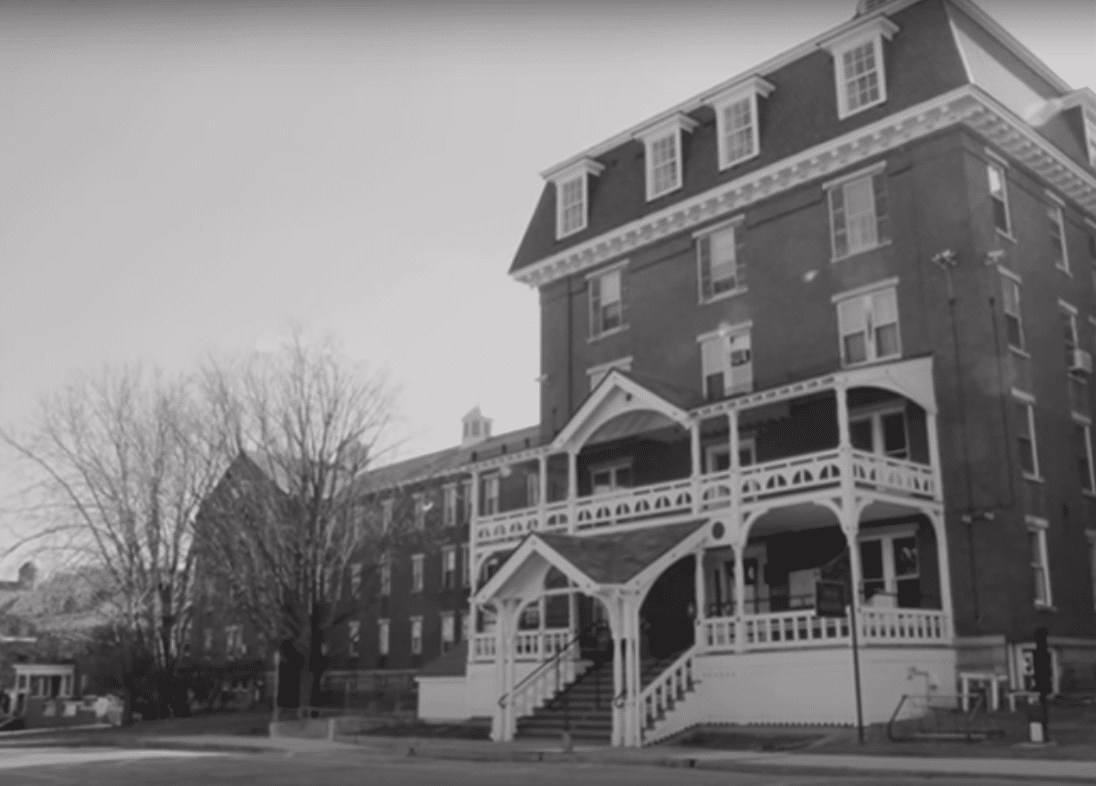
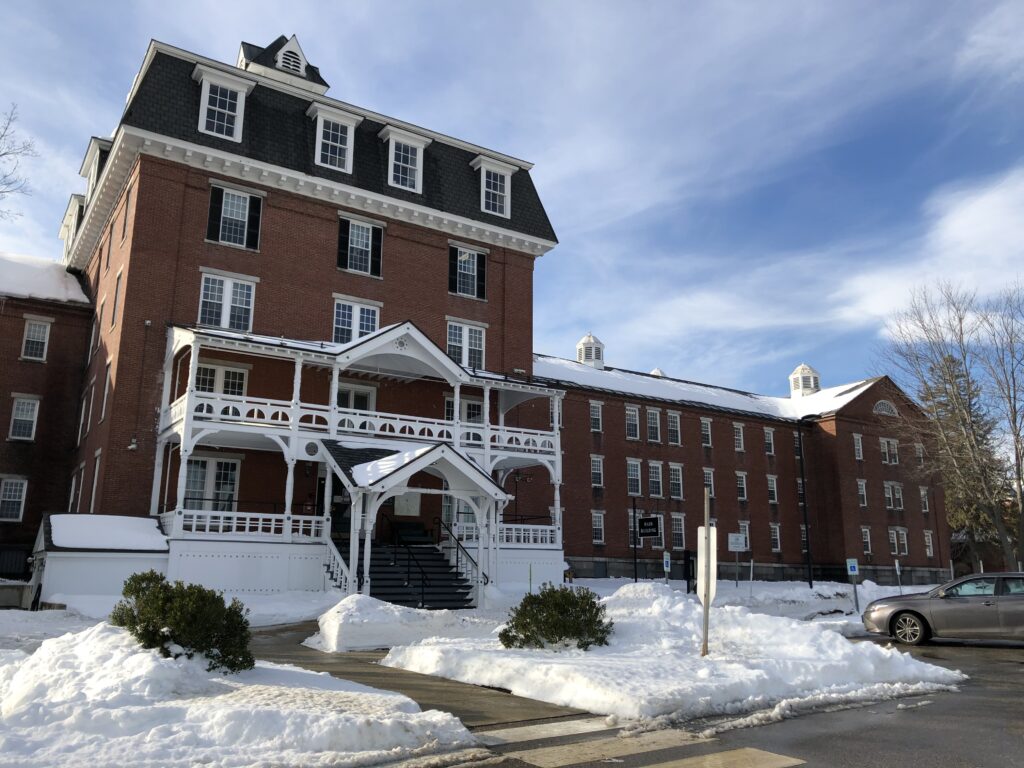
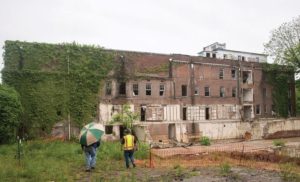
- Now: Mostly state offices. The Bancroft Building, the Kent Annex and the Peaslee Annex remain abandoned.
Governor Dinsmore’s Argument, and Six Years of No
Local and state officials decided in 1830 that New Hampshire should take some initiative in caring for the insane, and in June 1832 Governor Samuel Dinsmore put the case to the Legislature bluntly. “I feel no apology need be made, in an age so distinguished for its public and private charities, for calling your attention to a subject which has so much reason and humanity on its side,” he said, adding that the Legislature “has never yet recognized these unfortunate beings as entitled to any special favor from the government.”
The Legislature was unmoved. A bill for the establishment of the asylum was indefinitely postponed in December 1832 by a vote of 139 to 78. Dinsmore raised it again in 1833, saying he had “never lost the hope” of cooperation between the government and “the friends of suffering humanity.” A resolution to appoint an agent to inspect other asylums and report a plan passed the House, then stalled in the Senate. In 1834, under Governor William Badger, a resolution appropriating $812,500 for an asylum was postponed once more, though lawmakers did order towns to report the number and condition of the insane in their districts. An 1835 attempt to fund the building with 25 bank shares was defeated.
In 1836 the question went to the voters: “Is it expedient for the state to grant an appropriation to build an insane hospital?” Fewer than half the qualified voters bothered to answer, and the returns showed no decided majority either way. The issue was dropped for a year. The charter finally came in 1838, and the building followed in 1842.
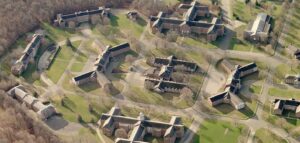
How a Two-Wing Building Became a City
The hospital opened as a main administration building with two symmetrical wings, the female ward to the left and the male ward to the right. Everything else accumulated around it over the next ninety years.
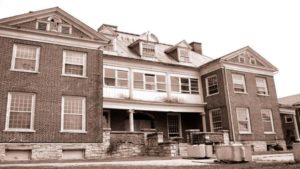
In 1892 Dr. Charles Bancroft had the Bancroft Building put up as a residential dormitory for female patients, built in a European style meant to feel more like a home than a ward. The Twitchell House followed in 1894 with the same idea, for men. A nurses’ annex arrived in 1899; before that, nurses had lived on the patient wards between shifts. The new nurses’ home was linked to the Bancroft Building and the main administration building by long tunnel-like hallways.
The Thayer Building went up beside the main administration building in 1907 as a medical surgical facility. It handled routine surgeries and also sterilisations, which the record describes as commonplace during New Hampshire’s eugenics movement. That single line accounts for much of the campus’s reputation.
As the patient population spiked, compact institutional housing followed: the Walker Building between 1913 and 1917, the Brown Building in 1924 for women, the Tobey Building in 1930 for men. Brown held patients right up to 1989. A geriatric facility, the Dolloff Building, was built in 1941 and named for Dr. Charles Dolloff, and the Thayer Building was converted to geriatric housing in the 1950s as the elderly population grew. In 1960 the Philbrook Center opened, named for Dr. Anna L. Philbrook, who pioneered adolescent psychiatry in the state and pushed for a separate facility for disturbed youths.
Local accounts also describe a burial ground beside the hospital for patients whose families declined to claim them or arrange funerals. That is a persistent part of the story told about the site rather than a documented part of the construction record above, and it is worth treating as such.
Screams, Paper and Cold Air: What People Report Here
None of the following is verified. It is what visitors, investigators and people who work on the campus say they have experienced, and it clusters in the parts of the complex that were never reused.
The most commonly repeated reports are disembodied screams, footsteps moving along corridors with nobody in them, and sudden drops in temperature. Several accounts describe loose papers stirring and sliding to the floor as though pushed by a hand. Employees in the converted office sections, not just trespassers in the derelict wings, report objects moved from where they were left, a persistent sense of being watched, and occasional glimpses of figures crossing a room or a doorway.
The abandoned wings, the Bancroft Building above all, have drawn paranormal investigation groups hoping to record something. Nothing produced there amounts to proof, and a vast institution with a century of psychiatric care, surgical sterilisations and unclaimed dead behind it generates stories whether or not anything walks its halls.
The 2023 Shooting at New Hampshire Hospital
Anyone reading about this place will run into a recent and entirely non-supernatural tragedy. On 17 November 2023, a shooting at the hospital killed a security guard and the shooter. Police identified the gunman the following day as 33-year-old John Madore of Concord, who had previously lived at a Seacoast Region hotel and was homeless. He parked a U-Haul truck, entered the lobby with a 9-mm pistol, and at 3:40pm shot 63-year-old security guard Bradley Haas of Franklin. Haas received CPR at the scene and was pronounced dead after transfer to Concord Hospital. Governor Chris Sununu said Haas “will be remembered for his heroism and decades of public service.”
Madore was shot and killed by Trooper Nathan Sleight, who was working an overtime shift at the hospital. Troopers were not routinely assigned there; the state office complex police were facing critical staffing problems tied to low pay and poor benefits. A suspicious vehicle nearby was cleared by the bomb squad, and officers found an assault-style rifle, body armour and further ammunition in the rented truck. This is a recent crime with living relatives, not folklore, and it should not be folded into ghost stories about the older buildings.
Visiting the Old State Hospital Grounds in Concord
This is not a museum and there are no ghost tours. The former hospital buildings function as a state office campus with a large number of organisations working out of them, so the areas you can legitimately see are lobbies, car parks and exteriors during business hours. The Bancroft Building, the Kent Annex and the Peaslee Annex are abandoned and closed; entering them is trespassing on state property, and derelict institutional buildings carry the usual hazards of collapsing floors and asbestos.
The active New Hampshire Hospital, built on the same property and receiving patients since 1989, is a working psychiatric facility. It is not a stop on any itinerary. Photograph the old brickwork from the public roads and drives, read the building names, and leave the rest alone.
See New Hampshire State Hospital for Yourself
Sources
- History of NHH – New Hampshire Hospital – NH Department of Health and Human Services (Nh (official))
- The institutional care of the insane in the United States and Canada
- Concord State Hospital – Asylum Projects
- New Hampshire Eugenics (Uvm (official site))
- Dr. Anna L. Philbrook (The New York Times)
- Wikipedia: New Hampshire State Hospital
Frequently Asked Questions
Where is New Hampshire State Hospital located?
New Hampshire State Hospital is located at 1941 and named for Dr.
Can you visit New Hampshire State Hospital?
New Hampshire State Hospital is on private property and best viewed from a distance. Always follow posted rules and respect private property.
Reader sightings
Nobody has reported anything here yet. If you have been, you would be the first.
Report your own visit to The Bancroft Building Stands Empty: New Hampshire State Hospital
How haunted is this place?
Be the first to rate
Nearby Haunted Locations
- 1Balcony Ghost and Acoustic GuitarNew Hampshire0.0mi
- 2The Town That Walked AwayNew Hampshire10mi
- 3Fire on the HillNew Hampshire11mi
- 4The Chairs Outside the Courtroom at Alton Town HallNew Hampshire22mi
- 5The Night Express Went DownVermont42mi
- 6Princess Carolyn and Room 314 at the Mount Washington HotelNew Hampshire43mi
Leave a Reply