
Reviewed by Josh N · Updated August 26, 2026 · How we verify
Reported Phenomena
- Sudden cold spots
- Figures along the railing
- Cries from the arroyo
- Sense of being watched
Reported by visitors & local legend. Stories, not verified claims.
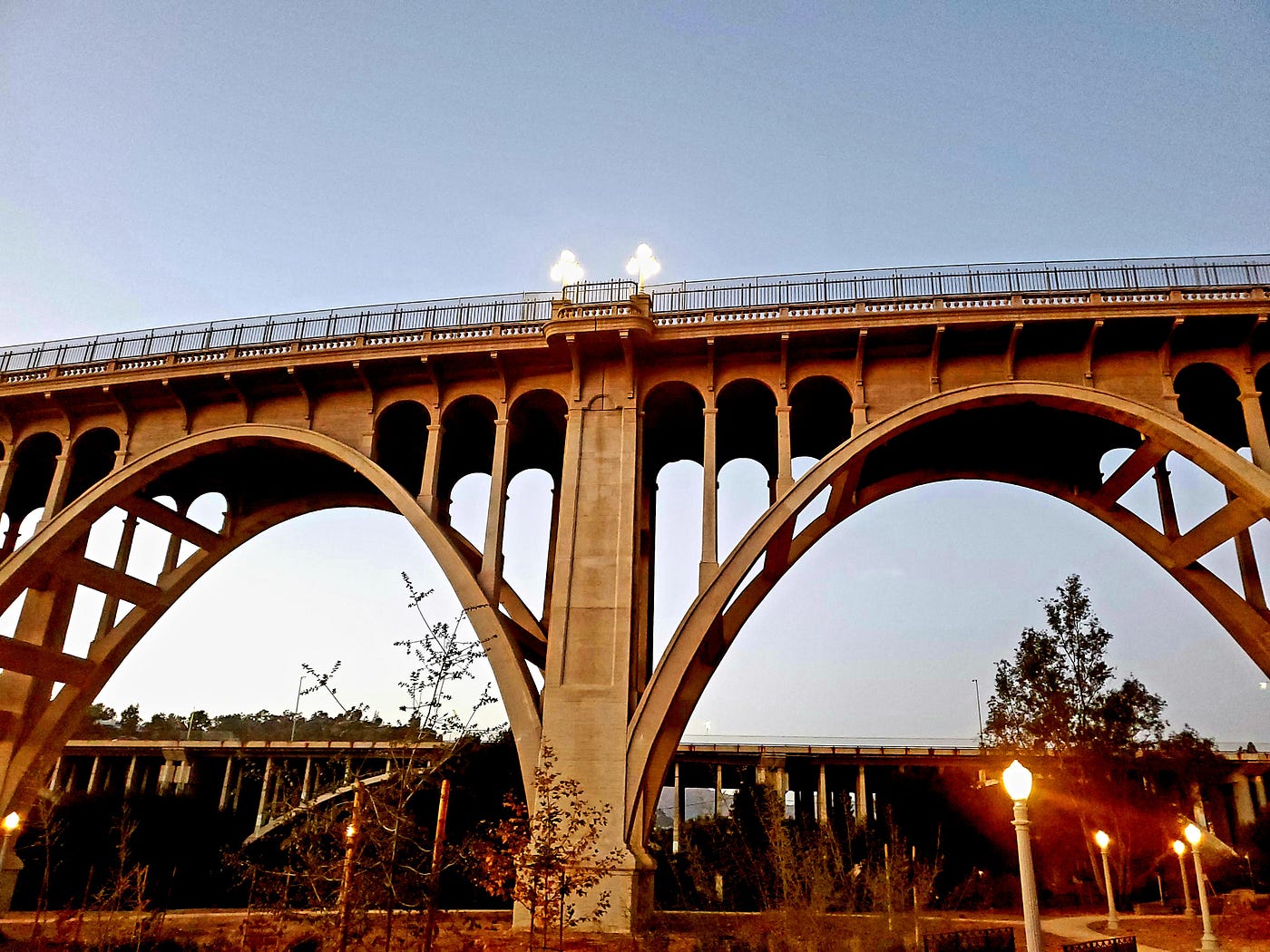
Two names attach to the same span of concrete over the Arroyo Seco. To Pasadena Heritage and the National Register it is the Colorado Street Bridge, a Beaux Arts landmark that has carried traffic west out of Pasadena, California since before the First World War. To generations of locals it is simply Suicide Bridge, a nickname earned by the dozens of people who used it to end their lives in the early twentieth century. Almost every ghost story told about the place grows out of that second name.
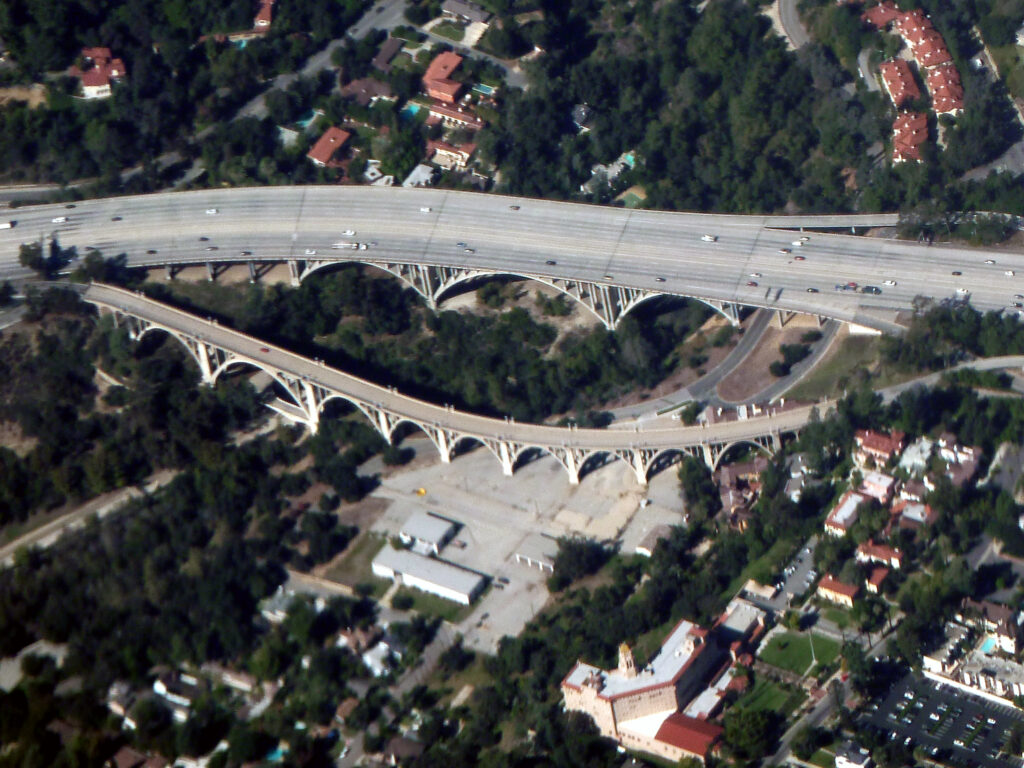
Quick orientation for anyone planning a look: the bridge carries Colorado Boulevard across the Arroyo Seco, linking Pasadena with Eagle Rock and Glendale to the west. It runs 1,468 feet and stands 150 feet above the arroyo floor at its highest point. It is listed on the National Register of Historic Places and designated a California Historic Civil Engineering Landmark. There is a sidewalk, and it is free to walk.
Why the Bridge Bends: Waddell & Harrington’s 1913 Crossing
The engineering firm Waddell & Harrington designed the bridge, which was built for $191,000 in 1912. It opened on 13 December 1913, replacing the smaller Scoville Bridge that had sat near the bottom of the arroyo. The curve that gives the structure so much of its character was not decoration: the bridge follows a curved path so that its footings could sit on more solid ground than a straight alignment would have offered.
The detailing is pure Beaux Arts, with arches, ornamental light standards and railings that photograph beautifully at dusk, which is part of the reason film crews have never left it alone. For roughly four years, from about 1936 to about 1940, it carried U.S. Route 66. After the Loma Prieta earthquake in 1989 the bridge was closed for renovation, reopening in 1993.
Eighty-Seven by 1937: How Colorado Street Became Suicide Bridge
The nickname is not folklore. It is arithmetic. Colorado Street Bridge became known locally as Suicide Bridge after dozens of people used it to take their own lives in the early twentieth century, and by 1937 the count of those who had jumped to their deaths from it stood at 87. That figure, more than any ghost story, is what gave the bridge its reputation and its second name.
Efforts to stop the deaths have been incremental and public. An 8-foot-high barrier was added during the renovation that ran from 1989 to the reopening in December 1993. Even so, on 27 October 2015 the British-American model and reality television personality Sam Sarpong used the bridge to leap to his death. In 2016 a 10-foot-high temporary chain link fence was installed along the sidewalk, blocking the seating alcoves that were believed to be the primary route taken by jumpers. Nine deaths occurred at the bridge in 2017, and four more between January and September 2018, after which the temporary fencing was extended across the entire structure. The city has said it plans to replace that fencing with permanent barriers at least 7.5 feet high.
This is the uncomfortable part of visiting. The bridge is a genuine landmark and a genuinely active site of loss, and the two are not separable. Anyone treating the walk as a thrill should know that the fencing overhead is there for a reason.
The Worker in the Concrete, and Other Arroyo Seco Legends
The most durable story told about the bridge concerns its construction. According to the myth, a worker was caught in a concrete mixer while the bridge was going up and was poured into one of its supports, his body never recovered. It is worth being clear about the status of that tale: it is repeated as myth rather than documented as fact, and no verified account of such a death forms part of the bridge’s engineering record. His restless spirit, in the telling, has never left the pier that holds him.
A second legend, widely retold in Pasadena but likewise undocumented, describes a mother during the bridge’s worst years who threw her infant over the rail before jumping herself, the child surviving after landing in the dense brush below. The story is repeated so often that it functions as local lore in its own right, but it belongs firmly in the legend column rather than the record.
What People Report Above the Arroyo
Visitors and ghost hunters describe a fairly consistent set of experiences on the span after dark: abrupt drops in temperature, figures glimpsed along the railing that are not there on a second look, and sounds carried on the canyon wind that listeners interpret as crying or calling from below. Some report the sense of being watched while walking the sidewalk, and others attribute the cries to the mother of the legend above.
None of this is verified, and the arroyo supplies plenty of ordinary explanations: a deep canyon funnels wind and noise, temperatures fall sharply once the sun leaves the gorge, and a 150-foot drop concentrates the mind. What the bridge undeniably has is a documented history of death, and that history colours everything anyone experiences standing on it.
Walking the Colorado Street Bridge, and Seeing It on Screen
The bridge is a public road crossing with a pedestrian sidewalk, so there is no admission and no gate. Fencing now runs the length of the walkway, which changes the view but not the scale of the thing. The best single day to go is in summer, when the bridge is closed to traffic for the Celebration on the Colorado Street Bridge festival hosted by the preservation group Pasadena Heritage, and the roadway belongs to pedestrians.
Film and music have kept the span in the public eye for more than a century. Mack Sennett’s 1915 short Love, Speed, and Thrills sent a car chase across it. Charlie Chaplin’s The Kid, released in 1921, shows a character contemplating a jump from the bridge before Chaplin’s character intervenes. It appears in Yes Man in 2008 as a bungee jumping location and in La La Land in 2016 as an evening stroll. Television has borrowed it repeatedly, standing in for San Francisco in the Full House episode “Leap of Faith” and for San Diego in the ER episode “Fathers and Sons”. Eric Caboor and David Kauffman named their 1984 album Songs from Suicide Bridge after it and photographed themselves standing on it for the cover, and part of the video for Lana Del Rey’s “Summertime Sadness” was filmed there in 2012.
Sources
- The Complicated Case of the Colorado Street Bridge
- Pasadena's Colorado Street Bridge Celebrates 100th Anniversary
- The Bridge Is Back: Landmarks: Pasadena celebrates the reopening of the 80-year-old Colorado Street span. After nearly four years of renovation, it is declared stronger than ever.
- Bridge Lures 19th Victim To His Death
- Hurls Her Child Off 150-Foot Span; Young Mother, in Ill Health, Then Leaps to Death From Pasadena Bridge; Girl Hits Tree, May Live; Passers-By Witness Tragedy, Suicide Is 87th Committed From Structure (The New York Times)
- Wikipedia: Colorado Street Bridge (Pasadena, California)
Address: Colorado Boulevard at the Arroyo Seco
Frequently Asked Questions
Where is Colorado Street Bridge located?
Colorado Street Bridge is located at Colorado Boulevard at the Arroyo Seco.
Can you visit Colorado Street Bridge?
Colorado Street Bridge is open to the public. Always follow posted rules and respect private property.
Reader sightings
Nobody has reported anything here yet. If you have been, you would be the first.
Report your own visit to Eighty-Seven by 1937: Pasadena’s Colorado Street Bridge
How haunted is this place?
Be the first to rate
Ghost Tours Nearby
 Sunset Strip True Crime and Ghost Stories Tourfrom $39
 Los Angeles Ghost Tours: Terrors of Tinseltownfrom $26
 Pasadena Ghost Tour: Purgatory Phantomsfrom $26
Affiliate links: BeyondHaunted may earn a commission, at no extra cost to you.
Nearby Haunted Locations
- 1Bloody Christmas 1951 and the Empty Lincoln Heights JailCalifornia6.5mi
- 2Pio Pico’s Grand HotelCalifornia7.9mi
- 3Is the Hollywood Sign Haunted? The True Story Behind the LegendCalifornia9.2mi
- 4Jingling Keys in the LobbyCalifornia13mi
- 5The Girl in the Blue DressCalifornia20mi
- 6Notoriety on Main StreetCalifornia21mi
Leave a Reply