Reviewed by Josh N · Updated February 23, 2026 · How we verify
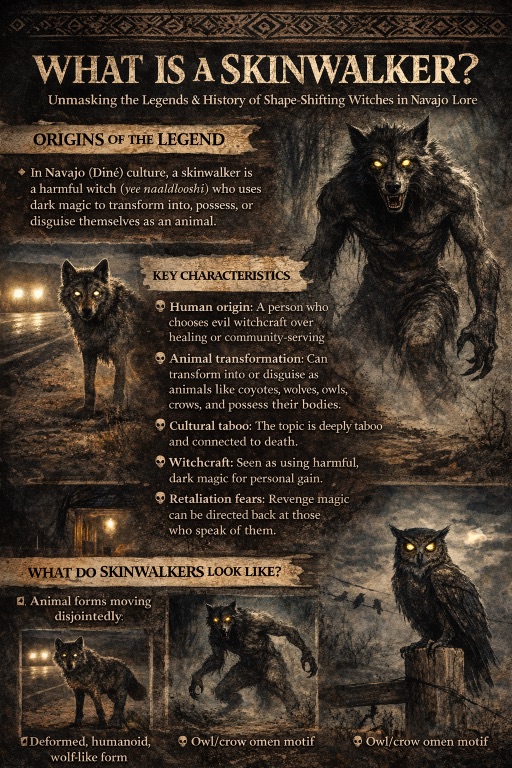
In the way the term is used inside Diné (Navajo) tradition, a “skinwalker” isn’t a monster species or a cryptid. It’s a human being associated with harmful witchcraft, described as able to take an animal form, possess an animal, or disguise themselves as one.
Because the topic is tied to death, taboo, and community harm, many Diné people consider it inappropriate or dangerous to discuss casually, especially with outsiders or in entertainment first ways.
What follows is an “outside-facing” explanation: historically grounded, culturally cautious, and clear about where tradition ends and modern pop culture begins.
Names, language, and what “yee naaldlooshii” implies
A common Diné term connected to the English “skinwalker” is yee naaldlooshii. Linguistically, it’s often glossed as “by means of it, it goes on all fours,” with yee (“by means of it”) and naaldlooshii linked to “quadruped / something that goes on four legs.”
That literal sense matters: it frames the idea as a person moving into a four-legged mode of being, rather than “a random forest creature with antlers.” A lot of modern internet imagery (skulls, antlers, “deer-headed humanoids”) is actually a mash-up of multiple horror aesthetics and sometimes gets tangled with wendigo imagery, which originates in Algonquian-speaking traditions and is a different being with different meanings.
The cultural skinwalker backdrop: balance, “walking in beauty,” and why witchcraft stories hit so hard
Diné philosophy is often described through Hózhó (commonly rendered as a state of beauty, balance, harmony, order, and well-being). Scholarly writing on Diné wellness describes Hózhó as an all-encompassing “good” condition and a pathway people try to live within.
Traditional ceremonial frameworks are frequently discussed in terms of keeping or restoring that balance. For example, the Blessingway (Hózhójí) is described as a major ceremony used to enhance blessings and preserve a state of hozho, and broader ceremonial systems include ways of addressing “ugly conditions” and disruptive forces.
Within that worldview, witchcraft isn’t “spooky fun.” It’s a category of social and spiritual rupture: fear, jealousy, death-related pollution, and the deliberate misuse of power. That’s one reason the topic can be taboo, and why discussion can be treated as risk-bearing rather than harmless storytelling.
So what is a skinwalker in traditional terms?
Across many retellings (including skeptical summaries that still respect the cultural framing), the through-line is:
- Human origin: a person who chooses harmful witchcraft rather than community-serving ceremonial roles.
- Animal transformation / disguise / possession: not just “turning into a wolf,” but an ability to appear as an animal or to move through an animal form.
- Not a healer archetype: sources repeatedly distinguish this from medicine people and healing work.
- Taboo and fear: discussion is avoided because it’s linked to death concepts and retaliation fears.
One important nuance: even “skinwalker” can be an English umbrella label. In older ethnographic and anthropological discussions of Diné witchcraft, there are categories and subtypes (often presented as “witchery, sorcery, wizardry, frenzy,” etc.). Modern summaries note that popular culture tends to flatten those distinctions into one cinematic creature-type.
Commonly described forms and behaviors
Descriptions vary by community, family story, and who is willing to talk. But recurring motifs (especially in modern public-facing retellings) include:
Animal forms most often mentioned
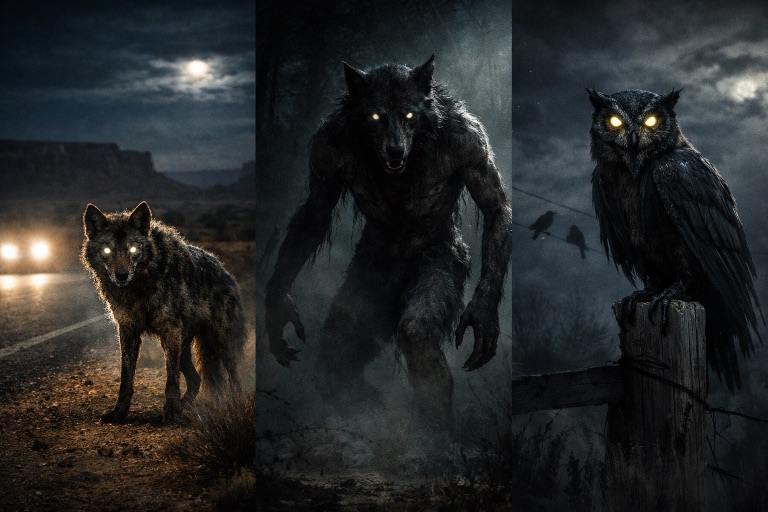
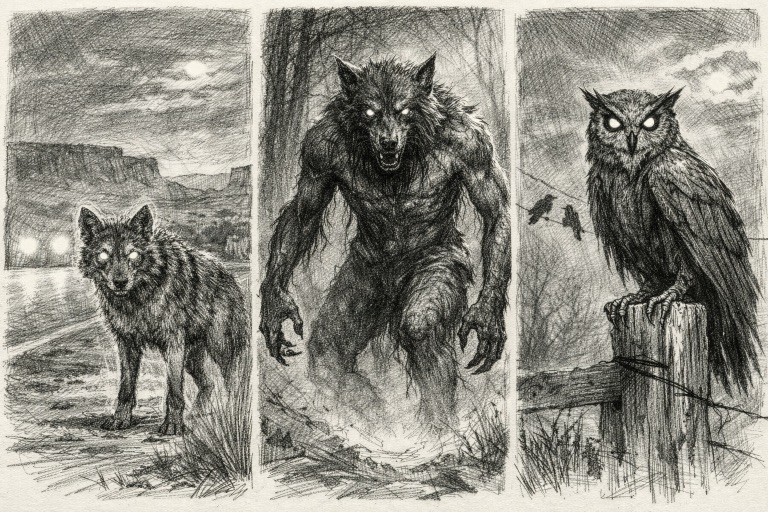
A skeptical overview of contemporary descriptions notes skinwalkers are often reported in the forms of a handful of carnivorous or ominous animals: coyote, wolf, fox, and sometimes owl or crow.
Why these animals?
- Coyote is widely present in Southwest Indigenous storytelling and is frequently entangled with themes of trickery, boundary-crossing, and danger. (This doesn’t mean “coyote = evil”; it means coyote is symbolically loaded.)
- Owls/crows/ravens in many cultures carry “night-sign” symbolism, which can slot into fear narratives.
Encounter structure
Traditional “encounter stories” are often told as warning stories: a brush with something dangerous and manipulative, not a “boss fight.” Public summaries describe them as incidents on roads, near homes, or at liminal places where a person is temporarily vulnerable.
Haunting-adjacent elements
Even though a skinwalker is not a ghost in the strict sense, public explanations of Diné ceremonial thinking describe illness or disruption as sometimes associated with contact with “ugly conditions,” which can include ghosts and witch-related forces.
That overlap helps explain why skinwalker stories can feel like hauntings: people report dread, stalking, uncanny sounds, and the sense of a presence that contaminates a space.
A quick history of documentation (and why it’s patchy)
A recurring problem with “skinwalker research” is that the most respectful stance inside Diné culture often involves not turning it into public exposition. So the written record is uneven: there are ethnographic snapshots, later anthropological syntheses, and then a huge wave of modern, non-Indigenous retellings.
One widely cited early recorder of Navajo traditions was Washington Matthews, a U.S. Army surgeon and ethnographer who documented Navajo stories in the late 1800s. A skeptical summary points to Matthews as an early English-language source where “witchcraft” concepts appear in recorded emergence-story material.
That same overview also mentions the Navajo “witch purge” of 1878 in the context of historical trauma and colonial pressure, noting that witchcraft accusations can surge in times of social stress and upheaval.
This is worth sitting with: sometimes the scariest part of “skinwalker history” is not the creature-description, but what witchcraft fear does to communities under strain.
The modern explosion: why “Skinwalker” became a global horror keyword
1) Internet folklore turned it into a catch-all
Online, “skinwalker” often becomes shorthand for:
- “anything in the desert acting wrong”
- uncanny animals
- voice-mimic entities
- deer-skull humanoids (often not Diné-rooted imagery)
The result is a blended creepypasta creature that can drift far from Diné meanings and taboos. This is also where “skinwalker vs wendigo” confusion spikes; they originate in different cultures and carry different themes.
2) Pop culture controversy and appropriation
When major franchises pull “skinwalker” into fantasy settings, Indigenous critics often point out that these beliefs are living, contextual, and not raw material for worldbuilding. Coverage of the backlash around J.K. Rowling’s “History of Magic in North America” writings documents these concerns and quotes Indigenous critics emphasizing that these are real traditions with roots and consequences.
3) “Skinwalker Ranch” turbocharged the term
This is the biggest accelerant.
Skinwalker Ranch (Utah) is a property associated with reports of UFOs, cattle mutilations, strange lights, and bizarre creatures. Media coverage describes how the Sherman family reported frightening events in the mid-1990s, and how the ranch was purchased by Robert Bigelow (a UFO/paranormal enthusiast) who funded investigations through NIDS (National Institute for Discovery Science).
Important caveat: even sources sympathetic to the mystery note that investigators struggled to capture meaningful physical evidence matching the extraordinary stories.
Also, the ranch’s name borrows from Navajo legend, but the ranch is not on Navajo land; it sits near the Uintah and Ouray Reservation (Ute territory). History.com’s coverage explicitly flags that “skinwalkers don’t feature in Ute religion” in the same way and discusses how the label gets applied anyway because it’s culturally available as a spooky explanation.
What do skinwalkers look like?
Because the original concept is about a person taking an animal form, descriptions tend to be less like “one definitive monster design” and more like unsettling variations. The most repeated motifs in popular accounts include:
- A normal-looking animal that moves wrong (too human, too intelligent, too steady)
- A too-large canid (coyote/wolf-like) with uncanny eyes
- A human silhouette with animal traits (ears, muzzle, elongated limbs)
- Owl/crow imagery in night encounters
The deer-skull/antler “skinwalker” design is widely popular online, but it’s also one of the places where modern horror aesthetics often drift away from Diné specificity and blend with other legends.
Skeptical and psychological lenses (why people still swear it happened)
Even without assuming “it’s all fake,” there are grounded reasons people report skinwalker-like encounters:
- Misidentification in low light: coyotes, foxes, large dogs, owls, and deer can look profoundly uncanny at night.
- Fear contagion: once a community story takes hold, ordinary anomalies can be interpreted through that frame (especially in places already shaped by trauma or conflict).
- Sleep disruption & stress: fatigue can amplify threat perception and pattern-finding.
- Story drift: as stories move through retellings, details converge toward the most vivid motifs.
Meanwhile, for believers within cultural contexts, the point is not “proving it in a lab,” but explaining why certain harms, misfortunes, or uncanny patterns cluster around suspected witchcraft. Those are different questions, and they produce different kinds of “evidence.”
Sources
https://skepticalinquirer.org/newsletter/skinwalkers/
https://en.wiktionary.org/wiki/yee_naaldlooshii
https://www.britannica.com/topic/wendigo
https://pmc.ncbi.nlm.nih.gov/articles/PMC4424938/
Reader sightings
Nobody has reported anything here yet. If you have been, you would be the first.
Leave a Reply