Reviewed by Josh N · Updated February 23, 2026 · How we verify
Reported Phenomena
- Disembodied voices
- Slamming doors
- Phantom smells
- Unexplained sounds
Reported by visitors & local legend. Stories, not verified claims.
Address: 2300 17th Street, Tuscaloosa, AL 35401
Phone: (205) 356-8194
Website: The Historic Drish House
Hours/Access: Access is by appointment only (it operates as a privately run event venue).
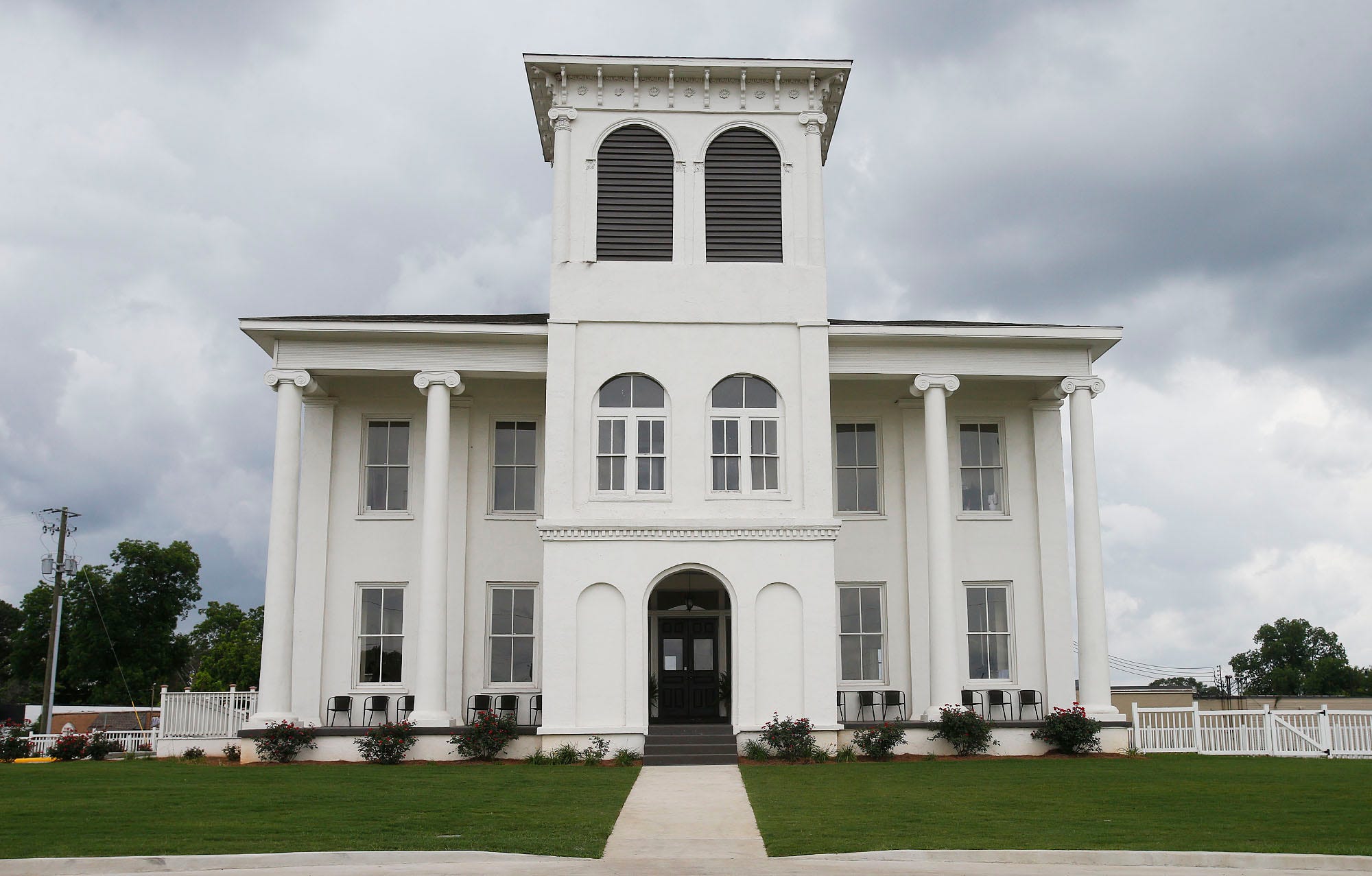
Few places in Alabama have a reputation quite like the Drish House. It is a striking historic landmark, a survivor of near-demolition and decades of changing use, and a magnet for one specific story that refuses to fade: a mysterious glow in the tower windows, often described as candlelight or even flames, with no fire to be found.
Quick Drish House facts that matter if you want to visit
The Drish House sits at 2300 17th Street, famously positioned in the middle of a traffic circle, so the building is easy to spot but not something you casually wander onto. Today, it is promoted as The Historic Drish House and is run as an event venue, with visits handled through inquiries and appointments rather than open public hours.
For history-focused visitors, it is also helpful to know the property is officially recognized:
- Listed in the Alabama Register of Landmarks and Heritage (listing includes “Drish House, 2300 17th Street, Tuscaloosa,” dated July 31, 1975).
- Listed in the National Register of Historic Places as Jemison School-Drish House (NRIS ID 14000357; listed March 17, 2015).
A short history of the Drish House
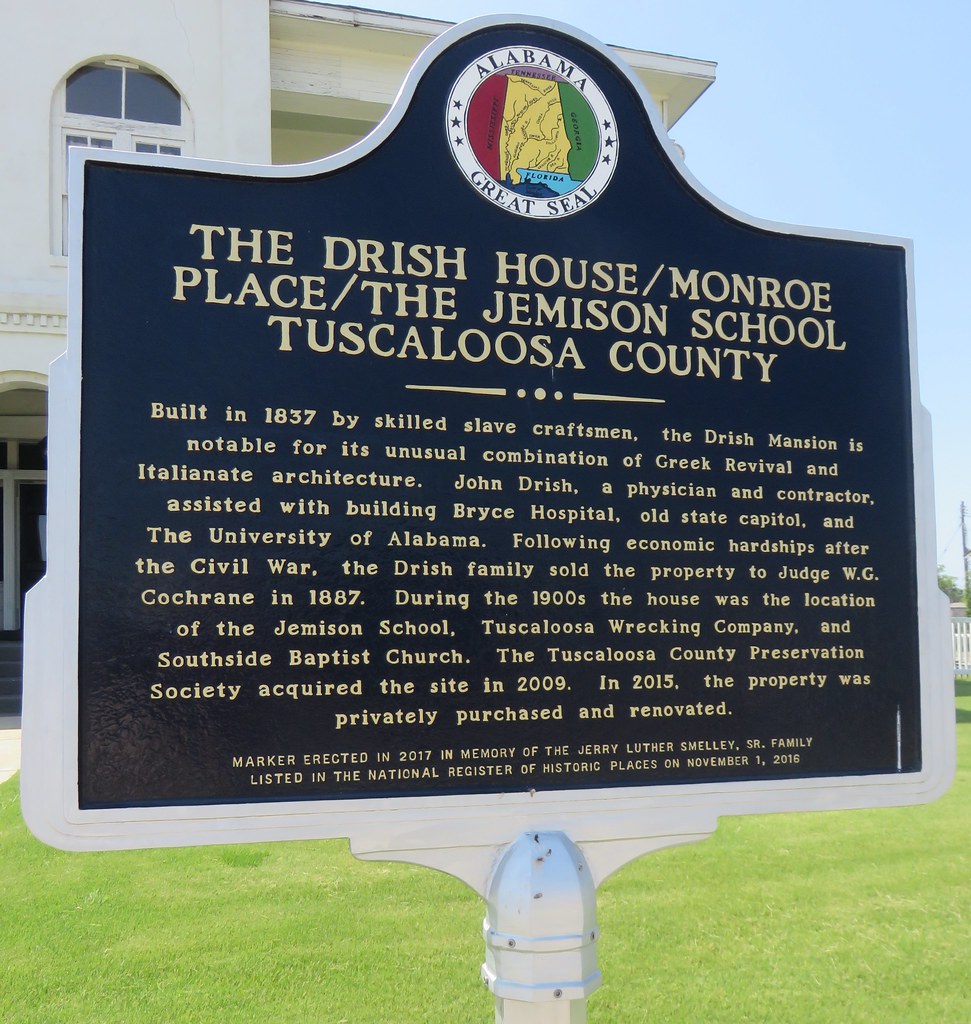
The home is most commonly associated with Dr. John R. Drish and his wife Sarah, and multiple reputable history sources emphasize an essential truth about its creation: the house was constructed with the skilled labor of enslaved craftsmen, whose work shaped early Tuscaloosa’s built environment.
The Library of Congress documentation (Historic American Buildings Survey) highlights the building’s significance and ties the craftsmanship directly to enslaved labor connected to Drish’s building activities. That federal documentation also reflects the house’s architectural importance as a notable blend of styles and its status as a subject of preservation interest long before it became a popular “haunted” headline.
Architecture: why it looks like nothing else in town
One reason the Drish House sticks in your memory is that it does not read like a single-style mansion. Preservation writing has repeatedly pointed to its uncommon combination of Greek Revival and Italianate/Italian Villa features.
In broad terms, Greek Revival cues show up in the classical massing and temple-like presence, while later Italianate touches are often associated with decorative changes and the addition of the iconic tower that dominates the structure’s silhouette.
From private mansion to school, church, and comeback story
The Drish House has had several distinct lives, and that shifting identity is part of what fuels its mystique.
- Jemison School (1906): The Tuscaloosa Board of Education opened the Jemison School in the building in 1906, an important chapter that helps explain its National Register name.
- Wrecking company / auto parts era: The building later served as an auto parts warehouse connected to the Tuscaloosa Wrecking Company, a period that appears in local historical summaries and preservation narratives.
- Southside Baptist Church (around the 1940s): The house was purchased by Southside Baptist Church around 1940, with major additions built alongside the mansion.
- Places in Peril and stabilization: By 2006, the property’s condition was serious enough that it appeared on Alabama preservation “in peril” reporting, and by 2007 it was connected to local preservation efforts that stabilized the structure and later removed major church-era additions.
- Private renovation and modern use: The property later returned to private hands and has been operated as a for-profit events venue.
That restoration arc matters for haunting claims, too, because it puts a lot of modern reports in context: many experiences people describe today come from staff, vendors, and guests during events, not from abandoned-building exploration.
The hauntings: What people actually report
The Drish House’s signature paranormal claim is the tower phenomenon often called the “death lights”: a fire-like glow or candlelit flicker seen from outside, with responders finding no active fire. This story shows up across Tuscaloosa lore and has been repeated in local reporting for decades.
A big reason the legend spread beyond Tuscaloosa is that it appears in Kathryn Tucker Windham’s classic Alabama folklore collection, 13 Alabama Ghosts and Jeffrey, in the story commonly referenced as “Death Lights in the Tower.”
It is important to separate three layers of “truth” here:
1) The documented history
The building’s architectural and community history is well documented through preservation sources, federal surveys, and registry records.
2) The consistent local legend
Multiple sources agree on the recurring theme: mysterious light in the tower, sometimes interpreted as candles, sometimes as flames, sometimes described as causing alarm calls.
3) The “origin story” people tell to explain it
One of the most repeated explanations is tied to funeral candles connected to Sarah Drish: a claim that certain candles were meant to be used again later and were lost, and that the lights are Sarah “doing it herself.” Modern local reporting has repeated this narrative directly from people associated with the venue.
Other dramatic details (including some versions of Sarah’s death) vary depending on who is telling the story. When you see those versions, treat them as folklore retellings unless they are backed by primary records. Even tourism pieces that cover the hauntings tend to present these elements as legend rather than settled biography.
Recent “real-life” encounters people say they’ve had
Modern accounts often come from staff and guests during events.
A 2025 WVTM report describes visitors and workers attributing experiences to Sarah Drish’s presence, including:
- Strange noises and slamming doors
- The sound of young girls giggling when someone believes they are alone
- An unexplained scent of roses, described as linked to Sarah Drish in the story-world surrounding the property
- Continued claims of candlelight in windows with no confirmed fire when checked
Ghost tours and the Drish House
Tuscaloosa has organized ghost-tour operators that use the Drish House as a featured location in their storytelling route. Some tour descriptions specifically reference it as a key stop or starting point, but routes and access can change, so it is always best to verify directly with the tour company before assuming you will enter the building.
Why the tower legend sticks
Even among haunted-location regulars, the Drish House myth is unusually “sticky” because it is visual. You are not relying on a shaky EVP clip or a story that requires you to be alone in a basement at 2 a.m. The claim is something neighbors can supposedly see from the street: light where light should not be.
Add in an instantly recognizable building, a history that includes a school and church, and a preservation saga that kept the mansion in local headlines, and you get the perfect conditions for a legend to travel across generations.
If you go: the responsible way to experience the Drish House
Because the Drish House is a privately operated venue with access by appointment, the best approach is simple:
- Treat it as private property unless you have confirmed access.
- If you want the haunted angle, book with a reputable local tour operator or attend a scheduled public event rather than trying to “peek around.”
- If your goal is history and architecture, start with the preservation documentation and registry records, then plan a visit through official channels.
Never trespass on property that is not yours without permission, and remember that ghost hunting can be dangerous, so always use caution.
Sources
Frequently Asked Questions
Where is Drish House located?
Drish House is located at 2300 17th Street, Tuscaloosa, AL 35401 .
Can you visit Drish House?
Drish House is open to the public. Always follow posted rules and respect private property.
Reader sightings
Nobody has reported anything here yet. If you have been, you would be the first.
Report your own visit to The Drish House in Tuscaloosa: History, Hauntings, and the Famous Tower Lights
How haunted is this place?
Be the first to rate
Ghost Tours Nearby
 Banshees of Birmingham Ghost Tour: The Furnace of the Forgottenfrom $25
 The Birmingham Downtown Ghost Self-Guided Walking Tourfrom $10
 The Birmingham Ghost Walk – Hotels Churches and Riots Tourfrom $59
Affiliate links: BeyondHaunted may earn a commission, at no extra cost to you.
Leave a Reply