

Reviewed by Josh N · Updated January 4, 2026 · How we verify
Across the United States, people report meeting a pale woman in white, on lonely roads, by rivers and bridges, inside old hotels and lighthouses, and in forgotten cemetery lanes. Sometimes she mourns a lost child. Sometimes she warns of danger. Sometimes she simply vanishes as headlights pass through her. The “Lady in White” isn’t one ghost, it’s a family of closely related legends with deep European roots, American twists, and an uncanny way of resurfacing wherever tragedy, liminality, and memory overlap.
Why white?
- Visibility at night: In folklore, white is the easiest color to visualize in darkness, think headlights, moonlight, or lantern light.
- Ritual & rite of passage: White gowns suggest weddings, christenings, funerals, threshold moments between roles and worlds.
- Purity and mourning: In Victorian and Edwardian imagery (which shaped American ghost lore), white simultaneously signals innocence, bereavement, and the otherworldly.
Deep roots: from Old World to New
The Lady in White predates America. Europe is dense with “White Lady” traditions, German Weiße Frau, Portuguese Dama Branca, Irish and Scottish mourning apparitions, and Mediterranean “river mothers”, spirits who appear in pale garments near water, ruins, or ancestral estates. Immigrants carried those story bones to North America, where they fused with Indigenous place spirits, frontier tragedies, and modern hazards like automobiles and rail lines. The result: American variants that feel local but speak a global language of grief, warning, and unfinished business.
What makes a Lady in White story?
Most cases combine several of these motifs:
- Site of threshold: Bridges, bends in roads, cemetery gates, shorelines, lighthouses—places that mark crossings.
- A tragic hinge: Death tied to love, betrayal, accident, childbirth, or drowning.
- Repetition: Recurring seasonal dates or weather conditions (fog, first snow, spring thaw).
- Witness pattern: Solitary travelers, late-night drivers, security guards, or fishermen—people who pass liminal spaces at odd hours.
- Physical effects: Headlights pass through a figure; cold spots; radios fuzz; cars stall; dogs react; speedometers spike.
- Moral or protective role (sometimes): She warns of icy bridges, stops children from the water’s edge, or appears before accidents.
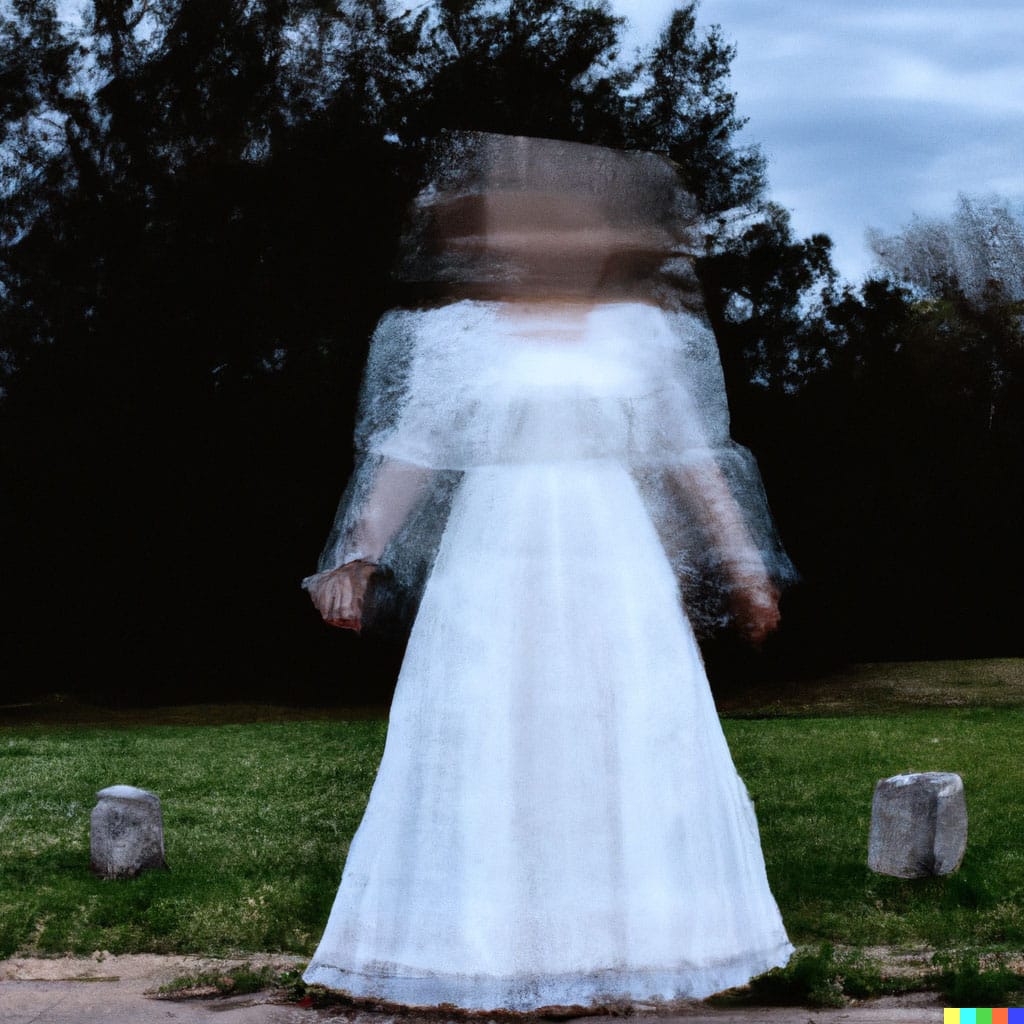
The big American archetypes
- The Roadside Bride: A spectral hitchhiker in a white dress (often “on her way to a dance” or “home from a ballroom”) who accepts a ride, shares an address, and vanishes, later confirmed as a deceased local woman.
- The River Mother: A grieving figure near creeks and rivers, searching for a child (echoes of La Llorona but with the white-gown aesthetic rather than a shawl).
- The Cemetery Madonna: A white-clad woman seen near infant graves sometimes cradling a phantom baby, linked to 19th-century burials.
- The House/Lighthouse Widow: A keeper’s wife or resident in white who tidies rooms, slams windows in storms, or walks galleries overlooking dangerous water.
- The Warning Wraith: Appears before crashes or disasters as a harbinger (not necessarily causing them).
U.S. hotspots & signature cases (by region)
Northeast
- Union Cemetery “White Lady” (Easton, Connecticut)
Perhaps New England’s best-known white-gowned apparition. Often described in a long white nightgown or bridal dress, seen along Stepney/Union Cemetery roads and near cemetery gates, sometimes photographed or filmed, often tied (in lore) to a 19th–20th-century tragedy. Night drivers report braking for a woman who vanishes on impact. - Durand-Eastman Park “White Lady” (Rochester, New York)
A lakeside guardian searching for a lost (or murdered) daughter. Stories say two large white dogs accompany her; teens once dared each other to call her from the bluffs or the ruins of an old lakeside structure. - “Lydia’s Bridge” (Jamestown/Greensboro, North Carolina—often grouped with the East Coast)
Classic vanishing-hitchhiker script: A young woman in a pale or white dress asks for a ride near a bridge on US-70, disappears when the car passes the span, and per countless retellings, local addresses confirm she died decades earlier. - The “Aroostook/Haynesville Road Hitchhiker” (Northern Maine)
Often reported as a pale, distressed young woman in light/white clothing appearing on Route 2A in harsh weather, asking for help, then gone. Variants reference fatal winter crashes and a recurring warning function.
Mid-Atlantic
- Raven Rock / Catoctin Mountain “White Lady” (near Thurmont, Maryland)
A translucent woman in a white dress is said to haunt Raven Rock (and nearby Devil’s Racecourse). Hikers report a figure watching from ledges, then gone. - NJ “Clinton Road” & “Shades of Death Road” (New Jersey)
A blur of white forms and single-sighting tales—more urban-legend ecology than a single ghost. Useful case studies in how road legends accrete details over time.
Midwest
- “Resurrection Mary” (Archer Avenue, Chicago, Illinois)
America’s definitive white-dress hitchhiker. Since the 1930s, drivers pick up a quiet blonde in a white dress near dance halls along Archer Ave. She asks to be let out by the gates of Resurrection Cemetery, then vanishes. Numerous independent driver reports, taxi lore, and ballroom staff anecdotes make this a cornerstone case. - Bachelor’s Grove “Madonna” (Bremen Township, Illinois)
A luminous woman in white, sometimes with a baby, photographed or seen near an old cemetery fence and headstones; sightings spike around full moons and humid summer nights.
South
- The “White Lady of Rio Frio” (Texas Hill Country)
A benevolent river guardian said to watch over children along the Frio. One popular tale casts her as a jilted bride who redirected her grief into protection; another folds her into the broader La Llorona stream but in a gentler key.
West & Pacific
- Heceta Head Lighthouse “Keeper’s Lady” (Oregon Coast)
A maternal figure, sometimes perceived as gray, sometimes white, associated with the keeper’s house. Reports include neatly folded linens, items moved, and gentle presences on storm nights. - Resort & Mission corridors (California)
Multiple sites (coastal missions, canyon roads, historic hotels) have local “white lady” variants, often a bride or a bereaved mother tied to cliffs, balconies, or river crossings.
Psychology & culture: why the White Lady endures
- Liminal fear made visible: She concentrates anxieties about thresholds, marriage, motherhood, migration, modern travel, into a single, legible figure.
- Collective grief processing: Communities without a clear memorial for certain deaths often produce a protective or warning apparition.
- Cognitive template: Once a culture teaches “women in white appear on dangerous roads,” ambiguous stimuli (mist, reflectors, billowing plastic) fit the template.
- Media feedback loop: Each TV special or YouTube retelling seeds fresh witnesses and keeps the legend “warm.”
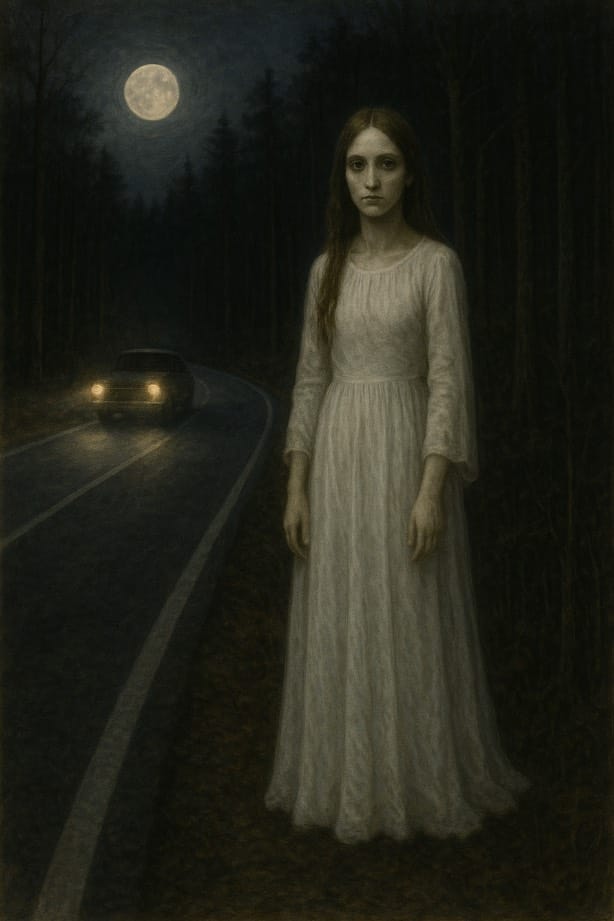
How to research a White Lady case (responsibly)
- Pin the place: Exact bridge name, mile marker, cemetery gate, lighthouse gallery, GPS if possible.
- Timeline sweep: Build a chronology from earliest mention to latest. Look for clumps: first retellings, press spikes, paranormal-team visits.
- Local records:
- County deaths/inquests (accidents, drownings, childbirth complications).
- Old newspapers (library microfilm, state archives, Chronicling America, Newspapers.com).
- Church registers (marriage/infant burials).
- Interview layers:
- Original-source witnesses (drivers, rangers, caretakers).
- Secondary narrators (a friend of a friend).
- Law enforcement for accident logs (FOIA, where applicable).
- Site conditions: Note lighting, sightlines, reflective signage, fog corridors, animal crossings, and how modern headlights interact with road camber and guardrails.
- Data discipline: Record date, time, weather, direction of travel, vehicle speed, companions, and immediate emotional state.
- Compare variants: Is this a unique case or a local copy of Archer Avenue/Jamestown scripts?
- Ethics: No trespassing. Respect private property, cemeteries, and living relatives tied to tragedies.
Field notes: what witnesses report
- A woman in a long, flowing white dress (sometimes clearly a bride; sometimes a nightgown).
- Bare feet on cold pavement; wet hem near riverbanks.
- Hair color inconsistent (blonde, black, indistinct), but pallor and stillness emphasized.
- Sudden appearance in the lane, then disappearance through the hood or windshield without impact.
- Rear-seat vanishing: she accepts a ride, falls silent, then isn’t there at the next turn.
- After-effects: temperature drop, nausea, radios detuning, GPS glitching for seconds.
Debunking avenues (and why they don’t end the stories)
- Visual misreads: Night glare on reflective posts, fog banks, mylar balloons, wedding-dress mannequins in roadside dumps (yes, really), billowing geotextile from construction sites.
- Memory shaping: If a driver already knows the legend, their brain fills gaps during stress and fatigue.
- Hoaxes & dares: Teen pranks with thrift-store dresses.
Still, even thorough prosaic explanations rarely extinguish a durable Lady in White. Communities keep telling the story because it does cultural work, warning, remembering, belonging.
Frequently asked questions
Is every “Lady in White” the same ghost?
No. It’s a type. Different places, different backstories, similar appearance and behavior.
Why do so many appear near water or bridges?
Water is a classic boundary (life/death, town/wilderness). Bridges concentrate accidents and emotion, and folklore clusters at such thresholds.
Do they hurt people?
The vast majority of stories are startling, not harmful. Some frame her as a protector or warning presence.
Can photographs capture her?
Claims exist (especially at cemeteries and lighthouses), but most can be explained by long exposures, pareidolia, or artifacting. Treat images as narrative evidence, not scientific proof.
If you plan a visit (safety & ethics)
- Get permission where needed; many sites are patrolled.
- Go with a partner; tell someone your itinerary.
- Bring a red-light headlamp (protects night vision), a dashcam, and a voice recorder if you document interviews.
- Never stage pranks or trespass for clicks, real families and first-responders live with these roads.
Closing: what the Lady in White tells us about us
Strip away the shock, and the Lady in White reads like a country’s dream journal. White dresses are memory made visible: warnings at bad curves, grief that needed a face, the echo of immigrants’ old stories re-speaking in new landscapes. Whether you take her as a spirit, a sign, or a story with a job to do, she endures because she’s doing that job, helping us mark dangerous places, honor broken lives, and keep watch at the edge of night.
Reader sightings
One reader has told us what happened to them here.
- 1 saw a figure
- Anonymous
Was driving past an old cemetery and seen a woman in white running one minute, the next she was gone. Then the next day I seen her again, running through my backyard. It happened in a second. I don't know what to think. Haven't seen her again.
Would go back.

Leave a Reply