
Reviewed by Josh N · Updated August 25, 2026 · How we verify
Reported Phenomena
- Objects moved or tidied
- Misplaced household items
- Poltergeist-style disturbances
- Spirit laid to rest
Reported by visitors & local legend. Stories, not verified claims.
Ask anyone in Sunderland about the ghost of Hylton Castle and you will be told about the Cauld Lad of Hylton, a murdered stable boy whose name has been attached to this stone gatehouse for generations. The castle itself sits in the North Hylton area of the city, in the North East of England, and it has a documented history considerably longer and better recorded than its ghost story. It is a Grade I listed building and a scheduled monument, owned by English Heritage, with the surrounding parkland looked after by a community organisation.
Timber on the Wear: the First Hylton Castle
The Hylton family arrived with the Conquest. Lancelot de Hilton and his two sons joined William’s forces, and after Lancelot was killed at Faversham during the advance on London, the king granted the eldest son, Henry, a large tract of land on the banks of the River Wear. The first castle on that land was built by Henry de Hilton in about 1072 and was likely to have been built of wood.
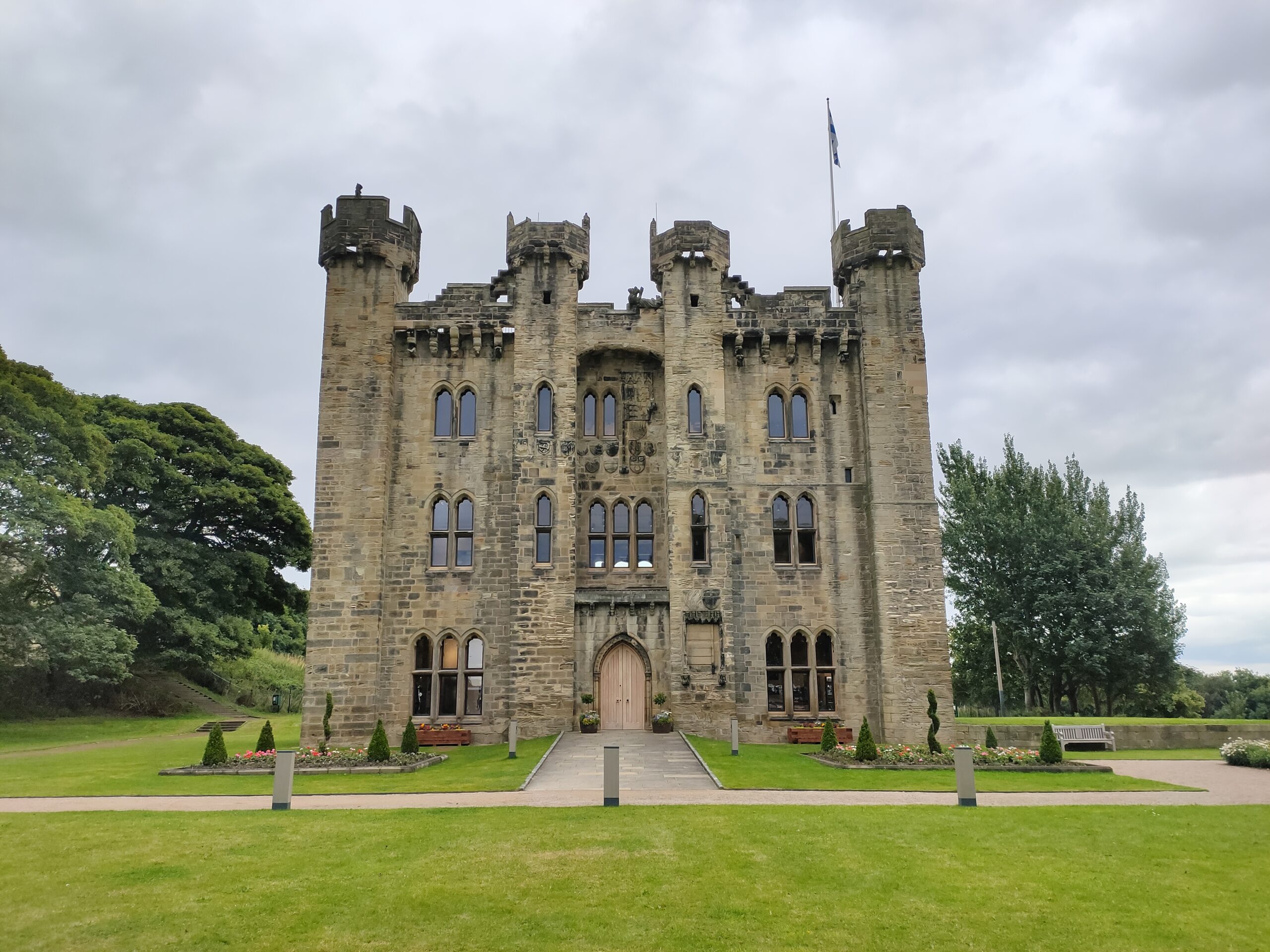
The stone building that survives came much later. It was rebuilt in stone by Sir William Hylton as a four-storey, gatehouse-style fortified manor house, similar in design to Lumley and Raby. The castle is first mentioned in a household inventory taken in 1448, described there as “a gatehouse constructed of stone”. The inventory taken on Sir William’s death in 1435 lists, alongside the castle, a hall, four chambers, two barns, a kitchen and the chapel, so the site was busier than the single surviving block suggests. Apart from the castle and chapel, those other buildings were probably all of timber.
Dating the Gatehouse by Its Twenty Shields
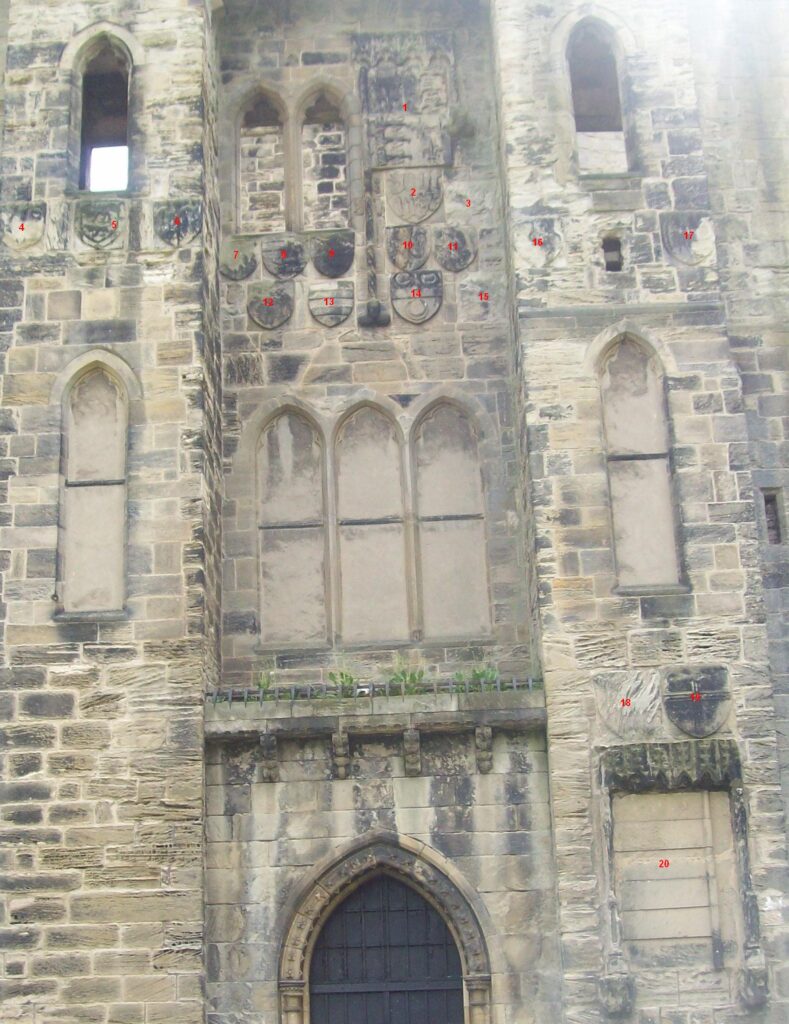
Above the main entrance on the west facade are twenty shields of arms, believed to show the political alliances of the early Hyltons. They are the reason the reconstruction can be dated at all, since no construction details survive. The arms shown of Henry IV are those he adopted around 1400, after he simplified the French quarters, and Sir Henry “Hotspur” Percy did not quarter his own arms with those of Lucy until he inherited the Honour of Cockermouth in 1398. Together the shields give a date for construction and completion of between 1390 and the early 15th century.
The roof is worth craning your neck at. Stone warriors and other figures adorn it, similar to those at Raby and Alnwick, and of the four originally set on each corner turret and bartizan only five survive in total. Between the central towers there once stood a sculpture of a knight in combat with a serpent, now reduced to fragments, believed to pertain to the tale of the Lambton Worm. The battlements also carried shallow stone troughs that fed scalding oil or water into the machicolations as a means of defence, with a brazier kept burning in a small chamber in each turret to bring the liquids up to temperature.
Georgian Sashes and a Victorian Idea of the Middle Ages
Hylton remained the family’s principal seat until the death of the last Baron in 1746, and by then the interior had already been transformed. Early in the 18th century John Hylton, who died in 1712, gutted the interior to form a three-storeyed block of one room per floor, inserted large alternating pedimented sash windows in the Italianate style, and added a north wing. His son later added a matching south wing, crenellations to both, and removed the portcullis from the west entrance.
When the eighteenth and last “baron” died without male heirs in 1746 the estate went to a nephew and was sold under a private act of Parliament in 1749. A Mr Wogan returned from the East Indies intending to buy it for the enormous sum of 30,550 pounds, but that sale never went through, and it was bought instead by Lady Bowes, widow of Sir George Bowes of Streatlam and Gibside.
The version of the castle that ruins today is largely the work of William Briggs, a local timber merchant and ship builder who bought it in 1862 and set about making it what he believed to be more authentically medieval. He demolished the north and south wings, gutted the interior, raised the whole ground floor by three and a half feet and inserted cusp-headed windows. To rework the west front he moved the stone-carved Hylton banner from above the west entrance to the front left-flanking tower, and in doing so is believed to have re-arranged the shields and disrupted their original hierarchical order.
Boarding School, Fire and the Coal Board
Between grand owners, the building had a thoroughly unglamorous 19th century. Simon Temple, a local businessman, leased it in 1812 and made it habitable, re-roofing the chapel so that it could be used for public worship again, but his failed business ventures stopped the work. In 1840 the Revd John Wood advertised “Hylton Castle Boarding School” in the Newcastle Courant, and the 1841 census records him, his family, pupils and staff living on the estate. It cannot have lasted long. Writing in 1842, William Howitt found “a scene of great desolation”, with the windows along the front boarded up and the house empty. By 1844 the chapel was in use as a carpenter’s workshop, and according to the Durham Chronicle in January 1856 the castle caught fire while occupied by a farmer, Mr Maclaren.
After Colonel Briggs died in 1900 the castle passed to the Wearmouth Coal Company about 1908 and then to the National Coal Board. Sunderland’s expansion in the 1940s wrapped it in housing estates, it was vandalised, and the lead was stolen from its roof. In 1950, under local pressure and the threat of demolition, the castle and chapel were taken into the care of the Ministry of Works, which stripped out the decayed internal partitions, consolidated the shell to expose the medieval masonry, appointed a full-time custodian and made the building watertight with roofing felt. In 1994 Channel 4’s Time Team excavated the Eastern Terrace and found evidence of a medieval hall east of the castle.
Robert Skelton and the Cauld Lad Legend
The haunting is local tradition rather than documented event, and the sources are honest about that. The tradition holds that the castle is haunted by the spirit of Robert Skelton, known as the Cauld Lad of Hylton, cauld being the local pronunciation of cold. Various versions of his death circulate. The most popular is that he was decapitated by Sir Robert Hylton, later de jure 13th Baron Hylton, after falling asleep and failing to have his master’s horse ready on time.
What the story attributes to Skelton is domestic rather than terrifying. His spirit was said to move objects about, sometimes misplacing them and sometimes tidying up, behaviour that sits closer to a household brownie than a vengeful revenant. The tradition also supplies its own ending: the spirit was said to have been finally laid to rest when the castle servants put a cloak out for him. No record of a Robert Skelton, or of the killing, appears in the documentary history of the castle. Anyone hoping for a catalogue of recent sightings should be warned that the story is passed down as folklore, not logged as a series of witness accounts.
Seeing Hylton Castle and Hylton Dene
The castle and chapel have been Grade I listed since 1949 and form a scheduled ancient monument in the care of English Heritage, which took over the site in 1984, although Sunderland City Council own the land. The Friends of Hylton Dene was formed in 1999 by residents of the surrounding estates to involve the local community in the upkeep of Hylton Dene and the castle, and in December 2007 the group won 50,000 pounds from the Heritage Lottery Fund for a survey of the site’s future.
Access has been in flux for years, so check with English Heritage before travelling. In February 2016 plans were announced to turn the castle into a community facility and visitor attraction, with the Heritage Lottery Fund awarding 2.9 million pounds and Sunderland Council 1.5 million pounds towards classrooms, a cafe and rooms for exhibitions, meetings and events. The chapel, dedicated to St Catherine of Alexandria and known to have existed on the site since 1157, stands on a small embankment to the north east of the castle. Look for the flagpole too: on 4 July 2004 around fifty American descendants of the Hylton family visited to present a flag featuring the Hylton blazon, which now flies from a pole provided by English Heritage.
Address: North Hylton, Sunderland
See Hylton Castle for Yourself
Sources
- The History of the Castle and the Hyltons
- Sunderland wins £5.4million to bring Old Fire Station and Hylton Castle back to life
- Hylton Castle & Dene
- Surtees's History of Durham Vol. II
- Doorway of the Golden Lion, South Hylton
- Wikipedia: Hylton Castle
Frequently Asked Questions
Where is Hylton Castle Cauld Lad located?
Hylton Castle Cauld Lad is located at North Hylton, Sunderland.
Can you visit Hylton Castle Cauld Lad?
Hylton Castle Cauld Lad is open to the public. Always follow posted rules and respect private property.
Reader sightings
Nobody has reported anything here yet. If you have been, you would be the first.
Report your own visit to The Cauld Lad of Hylton: Sunderland’s Stone Gatehouse
How haunted is this place?
Be the first to rate
Leave a Reply