
Reviewed by Josh N · Updated August 11, 2026 · How we verify
Reported Phenomena
- Ghost dog sightings
- Headless figure
- Soldier apparitions
- Lantern-carrying spectre
- Lady on the towpath
- Uneasy mules
Reported by visitors & local legend. Stories, not verified claims.
Boat crews on the Grand Old Ditch kept careful track of tolls, waybills and fines, and they also kept a mental map of places they would not tie up after dark. The C&O Canal ghosts that survive in the record are unusually specific for canal folklore: they belong to named locks, numbered levels and one long brick tunnel, strung along 184.5 miles of towpath between Washington, D.C., and Cumberland, Maryland. Wikipedia’s account of the canal notes plainly that many legends were documented along the canal during its operating days, which is a different thing from saying anything supernatural happened. These are stories boatmen told each other, written down while the boats were still running.
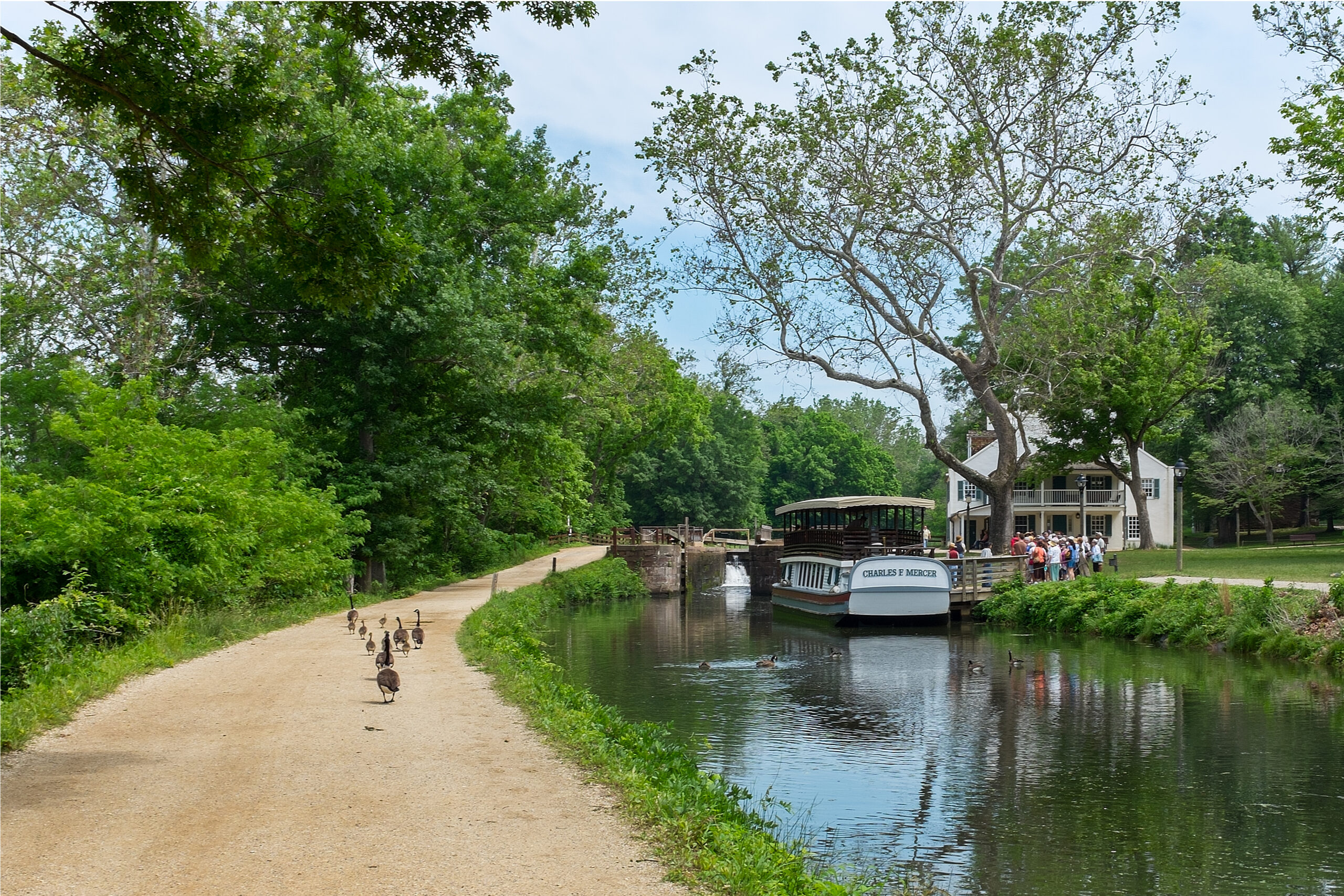
Orientation, before the ghosts. The canal operated from 1831 until 1924 along the Potomac River. Its principal cargo was coal from the Allegheny Mountains. It is now maintained as the Chesapeake and Ohio Canal National Historical Park, with a trail that follows the old towpath, so nearly every location in the folklore can be walked to.
A 184 Mile Ditch That Coal Built
Construction began in 1828 and ended in 1850 with the completion of a 50 mile stretch to Cumberland. The groundbreaking ceremony was held on July 4, 1828, attended by U.S. president John Quincy Adams. The elevation change required 74 canal locks, 11 aqueducts to cross major streams, more than 240 culverts to cross smaller streams, and the 3,118 foot Paw Paw Tunnel.
The building of it was brutal work. In August or September 1832, an epidemic of cholera swept through the construction camps, killing many workers and leading others to throw down their tools and flee. When the canal finally opened for trade to Cumberland on Thursday, October 10, 1850, the victory was hollow: the B&O Railroad had already been operating in Cumberland for eight years, and the canal suffered financially from the start. Following the disastrous flood of 1889 the company entered receivership with court-appointed trustees. The last known boat to carry coal was Pat Boyer’s Boat #5, which returned to Cumberland on November 27, 1923. The boating season lasted only three months in 1924, and after the flood of that year, navigation ceased. In 1938 the abandoned canal was obtained from the bondholders by the United States in exchange for a loan from the federal Reconstruction Finance Corporation.
Haunted House Bend and the Ball’s Bluff Boat
The best documented of the canal’s ghost stories sits on the stretch canallers called the nine mile level. During the American Civil War some boats were used to transport soldiers to the Battle of Ball’s Bluff. One of the boats sank, and it was said that departed ghosts of the soldiers haunted the area. Canallers would avoid tying up at night in that area.
Two details give the story its texture. It was also said that the mules would sense it and would hurry through the area, which is how the stretch picked up the name Haunted House Bend, and there were tales of a ghost dog there. Dogs were genuinely useful on a canal boat, driving mules and swimming the towline across to hitch them, so a spectral one belongs in the landscape rather than sitting oddly on top of it.
The Headless Man of the Paw Paw Tunnel
A headless man was reported to haunt the Paw Paw Tunnel. Nothing in the record names him or explains him, and the tunnel does not need much help. Built to save six miles of construction around the obstacle, it used over six million bricks and took almost twelve years to build, and in the end was only wide enough for single lane traffic. The initial cost estimate of $33,500 proved far too low; the tunnel was completed for $616,478.65.
That single lane produced the tunnel’s most famous non-ghost story. Two captains once refused to budge for several days, until a company official threw green cornstalks onto a roaring fire at the upwind portion of the tunnel, smoking the offenders out. Walk the tunnel today with a torch and the folklore explains itself: 3,118 feet of dripping brick, no daylight in the middle, and a narrow towpath ledge with the water alongside.
The Lantern on the Monocacy Aqueduct
Somewhere between Nolands Ferry and the Monocacy river, canal lore placed buried treasure. It could be found, the story went, by anyone who followed the ghost of a robber, allegedly seen from time to time on moonless nights crossing the Monocacy Aqueduct carrying a lantern. It is a classic treasure legend rather than a haunting, and it has the usual structure: the reward is real, the guide is dead, and nobody who tried it ever reported back.
Two More Ghosts the Canallers Named
A lady ghost was reported on the two mile level at Catoctin, between locks 28 and 29, which would walk over the waste weir, down the towpath and to the river. The ghost of an Indian chief was reported on the 14 mile level around Big Pool. Near Lock 69, known as Twigg’s lock, a Romeo and Juliet like story was documented. None of the three comes with a name, a date or an incident attached in the record, which is worth stating outright.
Why Boat Families Told These Stories
The canal was not a picturesque place to live. Fifteen hours a day was the minimum and 18 hours were the most frequently reported, according to the U.S. Department of Labor. Children generally did the mule driving, except perhaps at night when the captain might do so. The typical boating season ran from April until late November or December, when the canal froze over.
Real deaths sit alongside the folklore. On 1 May 1903 the towline to Boat No. 6 broke at Little Slackwater, with Captain Keim, Mrs. Keim, their two daughters and Harry Newkirk aboard. One daughter drowned, another suffered a broken leg, and the captain died later of injuries. That is the documented record, and it is a harder read than any of the ghost stories.
Walking the Towpath Between Georgetown and Cumberland
The park is public and the towpath is a continuous trail, which makes this one of the few haunted locations you can visit by simply walking to the correct mile marker. Lock 28 and Lock 29 at Catoctin, Big Pool, the Monocacy Aqueduct and the Paw Paw Tunnel are all on the route, and the tunnel in particular is worth the trip on engineering grounds alone. The canal became a magnificent wreck after the 1936 flood and the inattention of the B&O Railroad, so expect ruins rather than a working waterway: dry prisms, composite locks, culverts choked with tree roots, lockhouses in varying states of repair. Bring a light for the tunnel and check National Park Service notices, since sections of towpath close for flood repair.
One more piece of history that beats the folklore. After a major flood in 1877 the company built a communications line along the canal, and by the summer of 1879 it stretched over 180 miles from Georgetown to Cumberland, using forty-eight Edison Universal Telephones stationed at intervals. It was considered a pioneering achievement, the world’s first long distance telephone service, running past every one of the places where the boatmen said they saw ghosts.
Address: Along the Potomac River between Washington, D.C., and Cumberland, Maryland
See Chesapeake and Ohio Canal for Yourself
Sources
- Early Development of Chesapeake and Ohio Canal Project
- Historical Structure Report, The Canal Prism, Including Towpath with Canal Berm and River Revetments Historical Data (National Park Service)
- "The Canal Connection" marker
- Washington City Canal: Plaque beside the Lockkeeper's House marking the former location of in Washington, D.C.
- Local Financial News
- Wikipedia: Chesapeake and Ohio Canal
Frequently Asked Questions
Where is Chesapeake Ohio Canal Ghost Stories located?
Chesapeake Ohio Canal Ghost Stories is located at Along the Potomac River between Washington, D.C., and Cumberland, Maryland.
Can you visit Chesapeake Ohio Canal Ghost Stories?
Chesapeake Ohio Canal Ghost Stories is open to the public. Always follow posted rules and respect private property.
Reader sightings
Nobody has reported anything here yet. If you have been, you would be the first.
Report your own visit to C&O Canal Ghosts: Haunted House Bend to Paw Paw Tunnel
How haunted is this place?
Be the first to rate




Leave a Reply