

Reviewed by Josh N · Updated September 10, 2026 · How we verify
Reported Phenomena
- Phantom figures on trails
- Unexplained lights
- Whispers at dusk
- Vanished prospector lore
Reported by visitors & local legend. Stories, not verified claims.
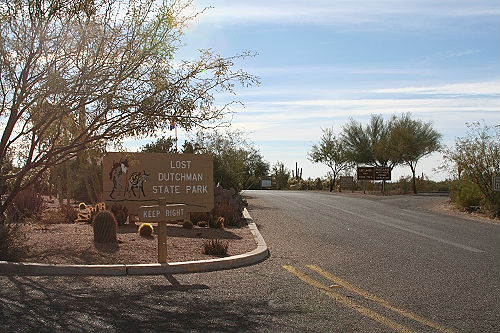
The trailheads at Lost Dutchman State Park point directly into the Superstition Mountains, and that is the entire reason people come here with something other than hiking on their minds. The park sits east of Phoenix in Arizona, on ground that borders the Tonto National Forest, and it takes its name from the most famous lost mine in American history. The gold has never been found. A long line of the people who went looking for it has never come back either, and that record, rather than any documented haunting, is what feeds the ghost stories told around the campground.
Quick Facts for Lost Dutchman State Park
- Where: at the foot of the Superstition Mountains near Apache Junction, about 40 miles east of Phoenix by way of U.S. Highway 60, the Superstition Freeway
- Established: 292 acres set aside in 1977, expanded to 320 acres in 1983
- Named for: Jacob Waltz, the German prospector known as the Lost Dutchman
- What to do: hiking and camping, with several paths through the brush and cacti and a short interpretive route called the Discovery Trail
- Reported activity: phantom figures, unexplained lights and voices at dusk. Anecdotal, with no documented incident inside the park behind any of it.
Jacob Waltz Was German, Not Dutch, and He Died in Phoenix
The mine is named for Jacob Waltz, a German immigrant born around 1810 who was said to have found a rich gold vein in the Superstitions in the 19th century and kept its location to himself. “Dutchman” was simply the common American term for a German at the time, drawn from Deutsch, and had nothing to do with the Netherlands.
What is documented is thinner than the legend. Waltz reached the U.S. from Germany and appears in an 1848 affidavit describing himself as “about 38 years old.” He relocated to Arizona in the 1860s, prospected and mined without obvious success, and by 1870 held a homestead of about 160 acres near Phoenix where he farmed. A catastrophic flood hit Phoenix in 1891 and wrecked his farm. He fell ill afterward, rumored to have contracted pneumonia during the flooding, and died on October 25, 1891, nursed at the end by an acquaintance named Julia Thomas. He is buried in Phoenix in what is now the Pioneer and Military Memorial Park.
The hunt began almost immediately. As early as September 1, 1892, the Arizona Enterprise was reporting on the efforts of Thomas and several others to find the mine whose location Waltz had described to her. When they failed, Thomas and her partners were reported to be selling maps to it at $7 each. People have been searching ever since, and by one estimate 9,000 of them make some attempt each year. Former Arizona Attorney General Robert K. Corbin is among those who have gone looking.
It is worth saying plainly that serious researchers doubt the mine exists at all. Place-name expert Byrd Granger counted 62 variants of the story by 1977, some of them so different they cast the tale in an entirely new light. John D. Wilburn argued in Dutchman’s Lost Ledge of Gold that the Bulldog Gold Mine near Goldfield fits Waltz’s description of his location, and that the geology rules out the Superstitions themselves, which are igneous in origin.
Adolph Ruth’s Skull and the Two Holes in It
Without one death in 1931, the Lost Dutchman would likely have stayed a footnote among hundreds of rumored lost mines in the West. Adolph Ruth was a 66-year-old amateur explorer with a long-standing interest in lost mines and a leg full of metal pins from a fall he had taken while searching for the Pegleg mine in California. He walked with a cane. In June 1931 he came to Arizona with maps his son had been given years earlier, and outfitted his expedition at the ranch of Tex Barkely, who repeatedly urged him to give it up because the terrain was treacherous even for experienced outdoorsmen, let alone for a man of Ruth’s age in the summer heat.
Ruth went anyway, planning two weeks. He did not come back. In December 1931 the Arizona Republic reported the discovery of a human skull in the Superstitions. The anthropologist Aleš Hrdlička, given photographs and dental records, positively identified it as Ruth’s and concluded from the two holes in it that a shotgun or high-powered rifle had been fired through the head at almost point-blank range.
In January 1932 the rest of the remains turned up about three-quarters of a mile away, scattered by scavengers but identifiable by his personal effects, including his pistol, which was not missing any shells, and the pins from his mended bones. The map was gone. His checkbook was not: it held a note in which Ruth claimed to have found the mine, gave detailed directions, and signed off with “Veni, vidi, vici.” Arizona authorities convened no criminal inquest and suggested thirst or heart disease. Many people, Ruth’s family among them, never accepted it. The wire services carried the story nationally, and the legend has run on that fuel ever since.
The Names the Superstitions Kept
The park sits at the doorstep of a wilderness with a genuinely grim casualty list, and this, not folklore, is the sober part of the story. On November 9, 1949, copper prospector James Kidd went to work in the Superstition Mountains and never returned. He has never been found. The skeleton of Charles Massey, who had become separated from a hunting party, was found on February 24, 1955, shot between the eyes. On March 21, 1961, the body of Walter J. Mowry of Denver was recovered near Weaver’s Needle, and a coroner’s jury ruled he died of a gunshot wound inflicted by a person or persons unknown. In June 1961 Jay Clapp, a recluse who lived in a cave in the range, disappeared; his headless skeleton was found about three years later, cause of death still unknown. Unidentified skeletal remains, catalogued as Apache Junction John Doe, were found on November 23, 1969, with a gunshot wound to the temple.
The list did not close with the last century. Jesse Capen, 35, of Denver, went in during December 2009 to look for the mine; his abandoned Jeep and then his camp were found, with his wallet, cash, food and water still in the tent, and his body was not recovered until 2012. On July 11, 2010, three Utah men, Curtis Merworth, Ardean Charles and Malcolm Meeks, went missing looking for the mine and are presumed to have died in the summer heat, with three sets of remains recovered in January 2011. Khayman Welch, a 25-year-old local artist, was last seen on August 12, 2020, walking southeast from the Weaver’s Needle Vista Viewpoint after telling his uncle he wanted a better view of the sunset. He has not been found.
Phantom Figures and Lights: What Visitors Report
No death, disaster or documented tragedy is attached to the 320 acres of the state park itself. The stories that circulate here are informal ones, traded between campers, hikers and locals, and they should be read as anecdote rather than record.
Visitors describe figures glimpsed at a distance on the slopes and along the trails that resolve into nothing when approached. Others report strange lights moving on the horizon after dark, and voices or whispers heard at dusk, which the tellers tend to attribute to prospectors who died searching for Waltz’s gold. Because so many of those disappearances are real and unsolved, the stories have an easy anchor. That does not make them evidence. Desert air distorts distance and sound, the Superstitions produce dramatic optical effects at sunset, and the legend arrives with every visitor before they set foot on a trail.
Hiking and Camping at Lost Dutchman State Park
This is a working state park, not an attraction built on ghosts. It offers camping, developed trails through brush and saguaro, and long views up into the range. The short Discovery Trail is the easiest option, a clear route with placards covering the natural history of the area, and it suits visitors who want the setting without a serious climb. Longer routes climb toward the wilderness boundary and get hard fast.
Check current fees, hours and camping reservations before you drive out. The practical warning matters more here than the supernatural one: the terrain beyond the park boundary has killed experienced people, and summer heat in this part of Arizona is genuinely dangerous. Carry far more water than you think you need, tell someone your route, and treat the Superstition Wilderness as the serious backcountry it is rather than a place to wander off looking for a mine that may never have existed.
Sources
- Robert K. Corbin's Legacy
- Vulture Mine – History, Fact, and Fiction
- The St. Johns herald. (St. Johns, Apache County, Arizona Territory [Ariz.]) 1885 to 1903, September 8, 1892, Image 2 (Loc (official))
- One Man's Dream: Air Rescue
- The Lure of Olde Arizona
- Wikipedia: Lost Dutchman's Gold Mine
Frequently Asked Questions
Where is Lost Dutchman State Park located?
Lost Dutchman State Park is located at 6109 N Apache Trail, Apache Junction, AZ 85119.
Can you visit Lost Dutchman State Park?
Lost Dutchman State Park is open to the public. Always follow posted rules and respect private property.
Reader sightings
Nobody has reported anything here yet. If you have been, you would be the first.
Report your own visit to Lost Dutchman State Park: Ghost Lights Under the Superstitions
How haunted is this place?
Be the first to rate
Ghost Tours Nearby
 Phoenix History, Mystery & Ghost Huntingfrom $45
 Wings of Fire & Whispers of the Desert Phoenix Ghost Toursfrom $26
 Tempe Ghost Tour: The Millz Have Eyez Ghost Hunting Experiencefrom $39
Affiliate links: BeyondHaunted may earn a commission, at no extra cost to you.
Leave a Reply