

Reviewed by Josh N · Updated September 9, 2026 · How we verify
Reported Phenomena
- Spanish soldier apparition
- Disembodied whispers
- Shadow figures in towers
- Presence in prison cells
Reported by visitors & local legend. Stories, not verified claims.
Coquina is a soft stone made of compressed seashells, and it is the reason the Castillo de San Marcos ghosts have such a long roster of names attached to them. The oldest masonry fort in the continental United States never fell to an enemy, which meant that for more than two centuries on the western shore of Matanzas Bay in St. Augustine, Florida, the building did most of its work as a shelter and then as a prison. People who came here under guard, Seminole, Kiowa, Cheyenne, Apache, revolutionaries, deserters, are the ones whose stories now feed the fort’s ghost lore.
Castillo de San Marcos in Brief
- Where: western shore of Matanzas Bay, downtown St. Augustine, Florida
- Built: construction began October 2, 1672 and lasted twenty-three years, finishing in 1695
- Designer: Spanish engineer Ignacio Daza
- Material: coquina, a shell-based sedimentary stone quarried on Anastasia Island
- Flags flown: Spain, Great Britain, the United States, and the Confederacy
- Now: a National Monument managed by the National Park Service, occupying about 2.5 acres
Why Spain Built in Stone Instead of Wood
St. Augustine was founded in 1565 by Pedro Menendez de Aviles on the site of a Native American village called Seloy. For the next eighty years the town made do with a succession of nine wooden forts, an arrangement that looked increasingly foolish after Sir Francis Drake arrived with twenty-two ships in 1586. The decision came in 1668, when the English privateer Robert Searle burned the town to the ground. Governor Francisco de la Guerra y de la Vega ordered a masonry fortification, Mariana, Queen Regent of Spain, approved it, and the first coquina stones were laid in 1672.
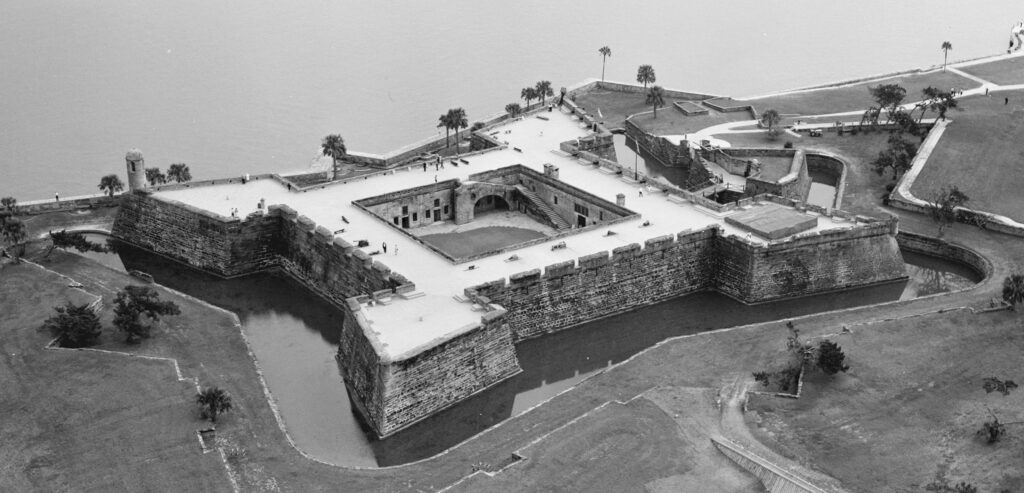
The labor is worth stating plainly. Most of it was done by Native Americans from Spain’s nearby missions, with skilled workers brought in from Havana, and the fort was built in part by African slaves owned by the Spanish. That last detail acquires a strange symmetry later: the Castillo became one of the first entry points for enslaved people fleeing British North America into Spanish Florida, where colonial authorities freed them. Escapees began arriving in 1687, Governor Diego de Quiroga refused an English major’s demand to hand them back in 1688, and Charles II of Spain made the practice official policy in 1693. The result was Fort Mose, just north of St. Augustine, the first free Black settlement in what would become the United States.
The finished fort is a star, with four bastions named San Pedro, San Agustin, San Carlos, and San Pablo, a ravelin covering the sally port, a glacis on the landward sides to force attackers uphill into the cannon, and a moat usually kept dry but floodable with about a foot of seawater. Between 1738 and completion, under engineer Pedro Ruiz de Olano, the interior was rebuilt with vaulted ceilings and the outer walls raised from 26 to 33 feet.
Twenty-Seven Days Under Oglethorpe’s Guns
The Castillo was attacked repeatedly and besieged twice. In November 1702, during Queen Anne’s War, Carolina Governor James Moore laid siege for two months while roughly 1,500 townspeople and soldiers crammed inside the walls. The English cannon accomplished almost nothing, because coquina absorbs impact: cannonballs sank into the stone rather than shattering it. When the Spanish fleet from Havana arrived and trapped English vessels in the bay, the attackers burned their own ships and walked home to Carolina.
In June 1740, General James Oglethorpe of Georgia tried again with seven ships, during the War of Jenkins’ Ear. Three hundred soldiers and 1,300 residents sheltered in the Castillo through 27 days of bombardment. Oglethorpe eventually gave up on the walls and attempted to starve the town, blockading the Matanzas River and the roads, but supplies slipped through and he withdrew. Spain answered by building Fort Matanzas to guard the back door.
Possession of the fort changed five times among four governments, and every one of those transfers was peaceful. On July 21, 1763, following the Treaty of Paris, the Spanish governor handed it to the British, who renamed it Fort St. Mark and used it mainly as a prison. Christopher Gadsden, lieutenant governor of South Carolina, was held here for eleven months, and three signers of the Declaration of Independence, Thomas Heyward Jr., Arthur Middleton, and Edward Rutledge, were also imprisoned in the fort. Spanish troops returned on July 12, 1784. In 1819 Spain signed the Adams-Onis Treaty, Florida passed to the United States in 1821, and the Americans renamed the place Fort Marion after the Revolutionary War raider Francis Marion, “The Swamp Fox.”
Fort Marion as a Prison, and the Question of Osceola
Under American control the storerooms, with their heavy doors and barred windows, were converted into cells, and the fort spent the rest of its working life as a military prison. This is the layer of history that most of the ghost stories draw on, and it is grim enough without embellishment.
In October 1837, during the Second Seminole War, the Seminole chief Osceola was seized while attending a peace conference near Fort Peyton under a flag of truce. He was imprisoned at Fort Marion with his followers, among them Uchee Billy, King Philip, and King Philip’s son Coacoochee, known as Wild Cat. Here the popular version of the haunting needs a correction: Osceola did not die inside these walls. He was transported to Fort Moultrie on Sullivan’s Island in Charleston harbor, and died there. After his death the physician Frederick Weedon decapitated him and kept the head in preservative. Weedon also kept the skull of Uchee Billy, who was captured on September 10, 1837 and did die at the fort, on November 29 of that year.
On November 19, 1837, Coacoochee and nineteen other Seminole prisoners, including two women, escaped. Coacoochee, who enjoyed a good story, later claimed that only he and a friend got out, by squeezing through an eight-inch embrasure high in their cell and sliding down a makeshift rope into the dry moat. The cell he supposedly used became part of the fort’s official lore long before the ghost tours arrived. The escapees reached their band’s camp on the Tomoka River and, citing their treatment, vowed to keep fighting. The war ran four more years.
From 1875, Native prisoners from the western Indian Wars were shipped here, including Chief White Horse of the Kiowa and Chief Grey Beard of the southern Cheyenne. Many died at the fort. Their supervisor, Richard Henry Pratt, struck off the shackles, let the men out of the casemates, and organized schooling, and the drawings the prisoners made became the origin of the art form now called Ledger Art, some of it held by the Smithsonian. Pratt used the experience to found the Carlisle Indian Industrial School in 1879, the model for the federal Indian boarding school system. From 1886 to 1887 roughly 491 Apache were held here, mostly Chiricahua and Warm Springs bands, 82 men and the rest women and children, including the wife of Geronimo. Many had to camp in tents for want of space. At least 24 Apache died as prisoners and were buried at North Beach. In 1898 over 200 deserters from the Spanish-American War were locked up here, one of the fort’s last operational uses, and in 1900 it came off the active duty rolls after 205 years of service under five flags.
The Love Triangle Whispered About in the Towers
The best known of the Castillo’s ghost stories belongs entirely to folklore, and it should be labeled that way. It concerns a love triangle involving Captain Manuel Abela, his wife Dolores, and Captain Diego de Herrera. Visitors to the fort have long reported whispers with no source and figures glimpsed in the towers, and guides connect those experiences to the tale. There is no documentary record in the fort’s history establishing the affair, the identities, or any resulting deaths on the property. It is a story St. Augustine has told about itself for a very long time, which is a different thing from an event.
The other recurring figure is Captain Garcia Marti, a Spanish officer whose apparition is said to patrol the grounds, most often reported after dark. Again, the sighting reports are the evidence, and the evidence is anecdotal.
What People Say Happens on the Gun Deck and in the Casemates
Reported phenomena at the Castillo are consistent from account to account, and none of it is verified:
- The figure of a Spanish soldier, usually identified by witnesses as Garcia Marti, walking the grounds and the ramparts
- Disembodied whispers inside the vaulted rooms, sometimes described as a woman’s voice
- Shadowy figures seen in the towers and along the walls
- A presence associated with the fort’s Native American prisoners, most often reported in the cells and casemates
Worth keeping in mind: a coquina building with vaulted ceilings, deep casemates and open embrasures moves sound in unusual ways, and sea wind through a stone star fort produces plenty of noise that has no ghost attached to it. The fort’s paranormal reputation has also been amplified by television, including appearances on Monumental Mysteries and Ghost Adventures, which tends to standardize which stories get repeated.
Visiting the Castillo de San Marcos
The Castillo is a National Monument and a working public park, not a haunted attraction. It was designated a National Monument in 1924, transferred from the War Department to the National Park Service in 1933, and given back its Spanish name by an Act of Congress in 1942. It was listed on the National Register of Historic Places on October 15, 1966, and named a Historic Civil Engineering Landmark by the American Society of Civil Engineers in 1975. The Park Service runs it alongside Fort Matanzas National Monument.
Plan for daylight hours and normal park operating rules. The gun deck, the bastions, the sally port, the reconstructed moat area and the prison cells are all accessible, and rangers interpret the fort’s military and prison history rather than its ghost stories, so the folklore is better sought on the commercial evening tours that operate in the surrounding historic district. One more piece of the site’s history is easy to miss on the walk in: the fort green held the “Freedom Tree,” which in 1964 became a gathering place for civil rights demonstrators who were not welcome on the state and private property across the street. The St. Augustine campaign led by Robert Hayling, Hosea Williams, and Martin Luther King helped bring about the Civil Rights Act of 1964. Whatever you make of the whispers in the towers, the documented history standing here is the stronger reason to come.
Sources
- American Architecture: 1607 to 1860
- The Building Of CASTILLO DE SAN MARCOS (National Park Service)
- Forget what you know about 1619, historians say. Slavery began a half-century before Jamestown
- Old Saint Augustine: A Story of Three Centuries
- St. Augustine during the Civil War
- Wikipedia: Castillo de San Marcos
Frequently Asked Questions
Where is Castillo De San Marcos located?
Castillo De San Marcos is located at 11 S Castillo Dr, St. Augustine, FL 32084.
Can you visit Castillo De San Marcos?
Castillo De San Marcos is open to the public. Always follow posted rules and respect private property.
Reader sightings
Nobody has reported anything here yet. If you have been, you would be the first.
Report your own visit to Castillo de San Marcos Ghosts: St. Augustine’s Coquina Fort
How haunted is this place?
Be the first to rate
Ghost Tours Nearby
 Haunted Trolley Tour of St Augustinefrom $37
 Riding with the Ghosts a Golf Cart Ghost Tour in St Augustinefrom $39
 St. Augustine Haunted Pub Crawlfrom $35
Affiliate links: BeyondHaunted may earn a commission, at no extra cost to you.
Leave a Reply