
Reviewed by Josh N · Updated March 26, 2026 · How we verify
Reported Phenomena
- Spectral figures
- Shadow figures
- Phantom footsteps
- Sense of being watched
- Screams & cries
Reported by visitors & local legend. Stories, not verified claims.
Address: 1400 Fort Pickens Rd, Pensacola Beach, FL 32561
Official site: National Park Service, Gulf Islands National Seashore
Phone: 850-934-2600
Hours: Fort Pickens gate is open 8 a.m. to sunset year-round. The area entrance station runs 5 a.m. to 8 p.m. from March 1 through October 31, and 5 a.m. to 6 p.m. from November 1 through February 28. The park notes that facilities are closed on New Year’s Day, Thanksgiving, and Christmas Day.
Fort Pickens is one of Florida’s most atmospheric haunted locations
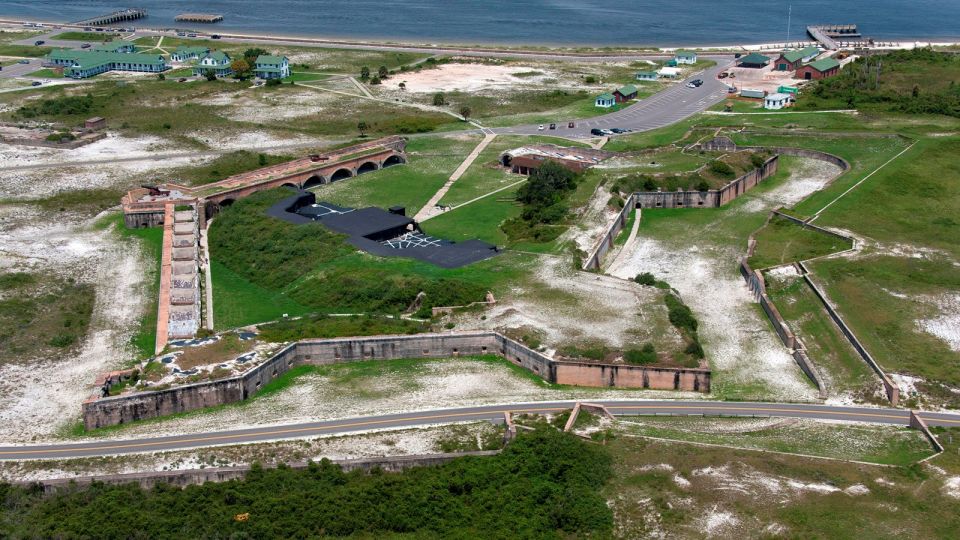
Fort Pickens sits at the western end of Santa Rosa Island inside Gulf Islands National Seashore, and even before you get into the ghost stories, it already feels like the kind of place where legends would thrive. The massive brick fort was built to defend Pensacola Bay and the Pensacola Navy Yard, and the National Park Service describes it as one of the major coastal defenses created after the United States acquired Florida. Its scale, isolated Gulf setting, dark casemates, and long military history all contribute to the eerie reputation it has today.
What makes Fort Pickens especially compelling is that its haunted reputation is layered on top of real hardship. The site’s history includes enslaved labor used in construction, Civil War tensions, wartime hospitals, imprisonment, and the confinement of Chiricahua Apache prisoners, including Geronimo. That does not prove anything supernatural, but it does explain why the fort has become one of the best-known allegedly haunted places in Florida.
The history of Fort Pickens
The roots of Fort Pickens go back to the early nineteenth century. After Spain ceded Florida to the United States under the Adams-Onís Treaty, Pensacola Bay became strategically important to the U.S. military. A new navy yard was established, and Fort Pickens was conceived as part of the effort to protect the bay from foreign attack. Construction began in 1829, and the fort was completed in 1834 as part of the Third System of American coastal fortifications.
The fort’s design was meant to dominate the entrance to Pensacola Bay. NPS records describe a five-bastioned work with walls rising above a defensive ditch, able to mount a large number of cannon and support a much larger wartime garrison than its peacetime staffing. In plain terms, Fort Pickens was built to look intimidating and to be extremely difficult to take.
Its most famous military chapter came at the start of the Civil War. Although Florida seceded in January 1861, Fort Pickens stayed in Union hands. National Park Service material notes that secessionist forces in Pensacola tried to capture the fort before the war formally erupted at Fort Sumter, which means Fort Pickens was tied to one of the earliest serious confrontations of the conflict. The Union presence there remained a major federal foothold on the Gulf Coast.
Later, the Army continued adapting the site for changing military technology. The fort supported harbor defenses in the late nineteenth and early twentieth centuries, including an underwater minefield system and newer gun batteries. The Army used Fort Pickens through World War II before the property eventually became part of Gulf Islands National Seashore in 1971.
The darker chapters behind the haunting stories
A lot of haunted lore around Fort Pickens comes from the fact that the site saw real suffering.
One of the most important facts, and one that is often overlooked in lighter ghost-story writeups, is that the Army forced enslaved Black men to build and later repair the fort. The National Park Service also notes that during and after the Civil War, freedom-seeking African Americans came to Fort Pickens to emancipate themselves. That history gives the site a weight that goes far beyond spooky tourism.
The fort also contained hospital space during the Civil War. On the NPS self-guided tour, one stop explains that surgeons and assistants treated the sick, wounded, and dying there, and that those who died in defense of the United States were buried in a temporary cemetery outside the fort. When people describe the interior rooms as oppressive or uneasy, it is worth remembering that those feelings are attached to places where real trauma occurred.
Another major piece of the story involves the Chiricahua Apache prisoners brought to Florida after the Apache Wars. NPS states that in 1886 the U.S. Army exiled more than 400 Apaches from the Southwest, and that Geronimo and 15 other Apache men were imprisoned at Fort Pickens, separated from their families at first and put to work clearing weeds, planting grass, and stacking cannonballs. Families were later reunited at Fort Pickens in 1887.
That imprisonment has become central to many of the fort’s ghost stories, though it is important to keep the distinction clear. The imprisonment is historical fact. Claims that spirits of Apache prisoners remain at the site are folklore and anecdotal testimony, not verified history.
Reported hauntings at Fort Pickens
Fort Pickens has long been described as haunted in local and paranormal circles. Reports usually center on apparitions, shadow figures, phantom footsteps, screams, strange voices, and an overall sense of being watched in the fort’s darker interior spaces. A Pensacola roundup from Seville Quarter mentions Fort Pickens among the city’s haunted places and says the site has numerous reports of apparitions. Visitor-submitted accounts collected by Haunted Places describe screams, shadow figures, and a man-like figure seen inside one of the older fort structures.
Another recurring part of the lore is the belief that Native American spirits are seen or heard around the fort. That claim appears in haunted-location listings tied specifically to Geronimo and the Apache prisoners. Again, this belongs in the category of reported paranormal legend rather than documented fact, but it is one of the most persistent themes in the Fort Pickens haunting story.
There is also a simpler explanation for why so many people leave Fort Pickens convinced they experienced something strange. The place is physically unsettling in all the right ways. It is a huge brick military complex, surrounded by open coastal landscape, with dim chambers, thick walls, long echoes, and a history full of war, confinement, and death. Even visitors who do not believe in ghosts often describe it as eerie. That atmosphere is real, whether the hauntings are or not.
Is Fort Pickens really haunted?
That depends on what standard you use.
If you mean whether Fort Pickens has a documented history of suffering, conflict, imprisonment, and death, the answer is absolutely yes. The official historical record is more than enough to explain why the site has developed a strong paranormal reputation.
If you mean whether there is official proof that ghosts are present, no. The National Park Service presents Fort Pickens as a nationally significant historic military site and memorial to past injustices, not as a confirmed paranormal location. The ghost side of the story comes from local legend, tourism culture, and visitor testimony.
Visiting Fort Pickens today
Today, Fort Pickens is a public historic site where visitors can tour the fort, explore other defensive structures in the area, camp nearby, and use the NPS app for self-guided interpretation. The National Park Service says the Fort Pickens area includes historic structures such as Fort Pickens, Battery Cooper, and Battery Worth, along with campground and beach access.
For paranormal-minded visitors, the best approach is the same one that works for any historic haunted site. Go in with respect for the history first. Fort Pickens is not interesting just because people say it is haunted. It is interesting because the real events that happened there were intense enough to leave a lasting mark on local memory. The ghost stories came later, but they grew out of something very real.
Never trespass on property that is not yours without permission, and remember that ghost hunting can be dangerous, so always use caution.
Sources
- National Park Service, Fort Pickens Area
- Seville Quarter, Pensacola haunted places roundup
- Florida Haunted Houses, Fort Pickens listing
Frequently Asked Questions
Where is Fort Pickens located?
Fort Pickens is located at 1400 Fort Pickens Rd, Pensacola Beach, FL 32561.
Reader sightings
Nobody has reported anything here yet. If you have been, you would be the first.
Report your own visit to Fort Pickens Haunted History: Ghost Stories, Geronimo, and the Dark Past of Florida’s Coastal Fortress
How haunted is this place?
Be the first to rate
Ghost Tours Nearby
 Pensacola Ghost Tours: Perdition, Pirates, & Purgatoryfrom $26
 Pensacola Walking Ghost Tour With Ghost Hunting Equipmentfrom $30
 Pensacola Haunted Tour Murder with Pirates and Red Light Districtfrom $32
Affiliate links: BeyondHaunted may earn a commission, at no extra cost to you.
Leave a Reply