

Reviewed by Josh N · Updated September 19, 2026 · How we verify
Reported Phenomena
- Disembodied footsteps
- Shadow figures
- Unexplained voices
- Reported apparitions
Reported by visitors & local legend. Stories, not verified claims.
The Belchertown State School sits on 876 acres in the hills of western Massachusetts, and almost everything unsettling about it is a matter of public record rather than rumor. It opened in 1922 as the Belchertown State School for the Feeble-Minded, the state’s term at the time for an institution housing people with intellectual and developmental disabilities. It became known for inhumane conditions and poor treatment of its patients, drew a series of lawsuits that changed disability law in the Commonwealth, and closed in 1992. Ghost stories attached themselves to the ruins afterward, as they do. They are worth separating carefully from the documented history, which is harder to read than any of them.
The Campus at 30 State Street
- Where: 30 State Street, Belchertown, Hampshire County, Massachusetts
- Ground broken: March 1919; construction completed in 1922, with additions afterward
- Size: an 876-acre campus with ten major buildings in a Colonial Revival style, designed by Kendall, Taylor, and Co.
- Closed: 1992
- Listed: added to the National Register of Historic Places in 1994
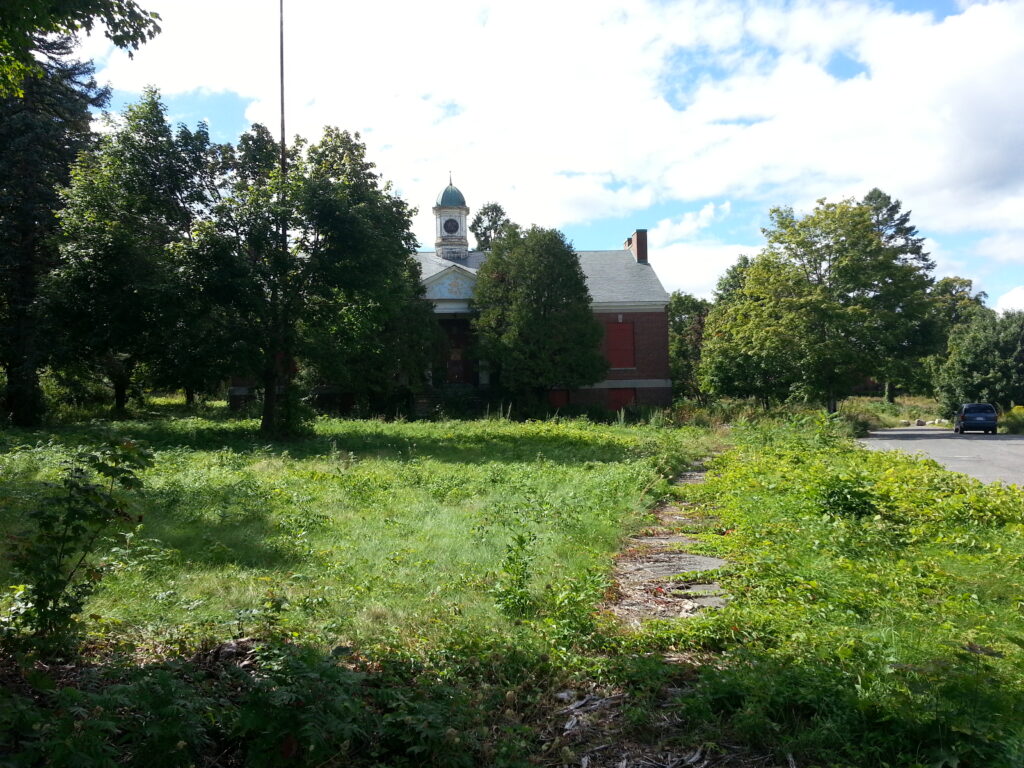
- Condition today: heavily demolished, with the hospital, auditorium, vocational and industrial blocks and most cottages gone
- Access: remaining buildings are boarded up behind road blocks, and trespassers have been arrested
Forty Years Without Scrutiny
Throughout its first forty years, Belchertown operated mostly without outside oversight. Benjamin Ricci, whose son Robert lived at the school and who later led the class-action lawsuit against it, described the conditions there as “horrific,” “medieval,” and “barbaric.”
The specifics recorded from that era explain why. Attendants worked wards holding dozens of patients at a time, with so little time for toilet care that residents were left, in the language of the accounts, half-naked and rolling in their own excrement. Residents with severe physical disabilities were left in bed all day with nothing to occupy them. Those who could not feed themselves were force-fed. Patients were moved roughly enough to cause injuries. Doctors routinely mistook an inability to speak for an inability to understand: one former resident recorded that a physician looked him over during a physical exam and, because he could not talk or apparently respond, concluded he was an imbecile.
The buildings themselves tell part of the story. The kitchen block, where residents received their meals, had drains that spewed sewage onto the kitchen and dining hall floors. Laundry went through the drying ground and came back scrambled, so residents often never wore the same clothes twice. The cottages, nine white houses for the more capable residents, were so pressed for space that caretakers were asked to vacate them in 1972 to make room for the overflow.
“The Tragedy of Belchertown” and the Lawsuit That Followed
The conditions became public in 1970, when reporter Jeremy Shanks published a newspaper article titled “The Tragedy of Belchertown.” Two years later, in 1972, Ben Ricci filed a class-action suit on behalf of his son and the other residents. The judge assigned to the case turned up at the institution unannounced and found clogged plumbing, unattended residents drinking out of commodes, an overwhelming stench of urine and feces, and constant screaming.
Ricci v. Greenblatt was the first lawsuit brought against a state school, and more followed in Massachusetts over the next few years. It was settled by the judge requiring the Commonwealth to provide services and supports to the plaintiff class for the rest of their lives.
Other cases piled up around it. In 1973 the state investigated the deaths of four patients and issued a report finding neglect and insufficient safety protocols. One of the four was Linda Buchanan, who died of exposure after a night outside; the search for her was called off at 10 p.m. and her body was found the next morning, a response investigators deemed insufficient. In 1975, residents Virginia Boyd and Ida Montufesco sued the Belchertown registry of voters after a clerk refused to register them on the grounds that they were under guardianship, which neither of them was. Boyd v. Board of Registrars of Voters of Belchertown established that people living at the institution could vote so long as they were not under guardianship. In 1977 another case tested whether a court-appointed guardian ad litem could refuse treatment on behalf of a 67-year-old man with leukemia who could not care for himself.
In the early 1980s, self-advocates marched from the institution to the town common, where a meeting on the school’s future was being held. Many of the marchers were former residents. It was one of the earliest demonstrations of the self-advocacy movement.
The Residents Who Wrote It Down
Belchertown is unusual among abandoned institutions in that several of the people held there lived to describe it in their own words.
Ruth Sienkiewicz-Mercer, a disability rights advocate with cerebral palsy who was a resident in the 1960s and 1970s, told her story in I Raise My Eyes to Say Yes, written with Steven Kaplan. Donald Vitkus spent his childhood at the school and wrote about it in You’ll Like It Here with Ed Orzechowski. Vitkus once refused to take Thorazine, a psychiatric drug used as a chemical restraint; when a staff member tried to force it down his throat, he bit off the man’s finger, and spent 34 days in solitary confinement for it. He spent the rest of his life advocating for disability rights and earned a degree in human services at Holyoke Community College. He died in 2018 and, at his own request, was buried in the graveyard for Belchertown residents. His grandson said at the funeral that he was no different from the people buried there, that they were his family, and that the burial was a last act of advocacy.
Russell W. Daniels spent thirteen years at Belchertown before being released to a transitional program in Springfield in 1971. On August 22, 1972, a woman was found murdered in his apartment complex. Daniels, then 26 and Black, was brought in for questioning and signed a confession the same day that he could not read and likely did not understand. It was the only evidence against him, and he was convicted and sentenced to life. Ben Ricci brought the details to light, and in June 1974 Governor Francis W. Sargent ordered him transferred out of prison and back to Belchertown on the grounds that the confession had been illegally obtained. The conviction was overturned in 1975 because the jury had never been told of his disability. Despite his innocence, Daniels remained at the institution until it closed in 1992. He later joined the board of the self-advocacy group Open Door Club and worked in dining services at the University of Massachusetts.
Robert Ricci, lead plaintiff in the case against the school, moved into his own apartment in 1980 after 27 years inside. He attended Amherst Railway Society meetings and worked at Amherst Town Hall, where he particularly enjoyed delivering mail to the fire department. He died on December 3, 2025, at 78. His father Benjamin, who wrote Crimes Against Humanity about his fight with the institution, died at Cooley Dickinson Hospital in Northampton, Massachusetts, on January 21, 2006, at 82.
What Is Left of the Ten Buildings
The school limped along for years after the lawsuits and finally closed in 1992. Two years later the complex was listed on the National Register of Historic Places, which did not save much of it. In 2001 a town meeting designated the property an Economic Opportunity Area for twenty years, offering tax incentives to businesses that set up on the site. As of November 14, 2012, the town had settled on a $1.25 million deal transferring the land to a new owner who intended to demolish the asbestos-laden buildings and put up 170 units of assisted living. The project was supposed to be finished by the winter of 2014. The developer backed out, the buildings were boarded up and road blocks went in, and nothing happened. Demolition plans restarted in November 2014 with the same assisted-living concept.
By July 2016 the two most recognizable structures were gone: the hospital, demolished in 2015, and the auditorium and gymnasium building, torn down the same year over PCB concerns. The vocational and industrial blocks came down in 2015. The infirmary followed in 2016. The cottages were all gone by 2017, as was G Ward, the newest building on campus, built in 1964 and considered inadequate for its residents almost immediately because of its large windows and its location. The A and K wards, custodial buildings for male and female patients, had already been demolished in 1977 and 1979 as symbolic acts of progress. Fallout shelters remain scattered in the woods around the campus.
From 2015 onward, vandals made multiple arson attempts on what was left. The public outcry brought a much heavier police presence and arrests.
What People Say They Encounter in the Ruins
No part of the Belchertown State School site is officially recognized as haunted, and none of the following appears in any record connected with the institution. The stories come from trespassers, urban explorers, and local retelling, and they are reported experiences rather than documented events.
- Disembodied footsteps in the corridors of the buildings that were still standing.
- Shadow figures moving across walls and through doorways.
- Unexplained voices and noises in empty wards.
- Apparitions attributed to former residents, an identification that rests on the history rather than on anything anyone has been able to verify.
It is worth saying plainly that the ghost lore is the least interesting thing here, and the most likely to be invented. What is verifiable, the screaming the judge heard, the numbered graves, the 34 days in solitary, is grim enough without embellishment, and most of what people describe in a decaying, half-demolished institution can sit comfortably inside ordinary explanations.
Visiting the Belchertown Site Responsibly
There is no tour and no museum. The surviving buildings are boarded up behind road blocks, the site has seen repeated arson, and the police response to that has produced arrests. Treat the ruins as off limits.
What can be visited is the part of the property the town has reclaimed. Foley Field was made over into a baseball diamond for the local Little League. The institution’s overgrown cemetery has been restored, cleaned up, and re-marked so that the people buried there are memorialized by name rather than only by the numbers on their grave markers. Donald Vitkus chose to be buried there in 2018. If you go to Belchertown for this history, the cemetery is the place that will actually tell you something.
See Belchertown State School for Yourself
Sources
- National Register of Historic Places – Massachusetts (MA), Hampshire County
- Belchertown State School, a Horrific Home for the "Feeble-Minded"
- Editorial: A story of one man's triumph over horrors at Belchertown State School
- Museum: History Timeline (Massachusetts Sec (official))
- Report of investigation of deaths at Belchertown State School
- Wikipedia: Belchertown State School
Frequently Asked Questions
Where is Belchertown State School located?
Belchertown State School is located at 30 State Street, Belchertown, Massachusetts, United States.
Can you visit Belchertown State School?
Belchertown State School is on private property and best viewed from a distance. Always follow posted rules and respect private property.
Reader sightings
Nobody has reported anything here yet. If you have been, you would be the first.
Report your own visit to Numbered Graves: The Ruins of Belchertown State School
How haunted is this place?
Be the first to rate
Nearby Haunted Locations
- 1Spider Gates CemeteryMassachusetts26mi
- 2Elisha, Jemima and the Benton Homestead Ghosts of TollandConnecticut28mi
- 3Ragged Hills (Bara-Hack)Connecticut32mi
- 4Building 16 and the Ruins of Mansfield Training SchoolConnecticut36mi
- 5The Perron House in BurrillvilleRhode Island40mi
- 6The Conjuring House heads to foreclosure auction on HalloweenRhode Island40mi
Leave a Reply