

Reviewed by Josh N · Updated October 9, 2026 · How we verify
Reported Phenomena
- Apparitions in corridors
- Oppressive basement atmosphere
- Reported disappearances
- Sense of presence
Reported by visitors & local legend. Stories, not verified claims.
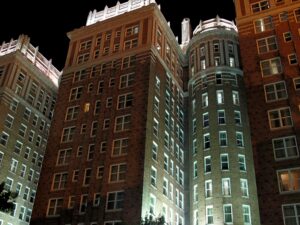
Few buildings in Rhode Island have been resurrected as many times as the Providence Biltmore, the 1922 tower on the southern corner of Kennedy Plaza that has been a luxury hotel, a failed motor inn, a boarded-up liability, a Hilton property and, since 2019, a campus-town boutique hotel under a different name. The ghost stories attached to it are mostly modern, mostly unsourced, and mostly concern a basement, a dining room and a rooftop. The documented history is far stranger than people expect, and it is all on paper.
The Biltmore at a Glance
- Where: 11 Dorrance Street, Kennedy Plaza, downtown Providence, Rhode Island
- Opened: June 6, 1922, as the Providence Biltmore Hotel
- Architects: Warren and Wetmore, the firm behind Grand Central Terminal
- Rooms: originally 600, now 292 after walls came down to create suites
- Listed: National Register of Historic Places, 1977; member of Historic Hotels of America
- Now operating as: Graduate by Hilton Providence, with the old neon Biltmore sign still on the roof
- Reputation: apparitions, occult legends, stories of guests who did not leave
Eighteen Hundred Citizens Paid for It
The hotel was not the vanity project of a single tycoon. It was conceived by the Providence Chamber of Commerce and funded through a public campaign in which 1,800 citizens contributed toward the construction costs, which is an unusual origin story for a building now sold on its sinister atmosphere. The management contract went to the Bowman-Biltmore Hotels chain, founded by John McEntee Bowman and Louis Wallick, and the design went to Warren and Wetmore, working in a neo-Federal Beaux-Arts idiom.
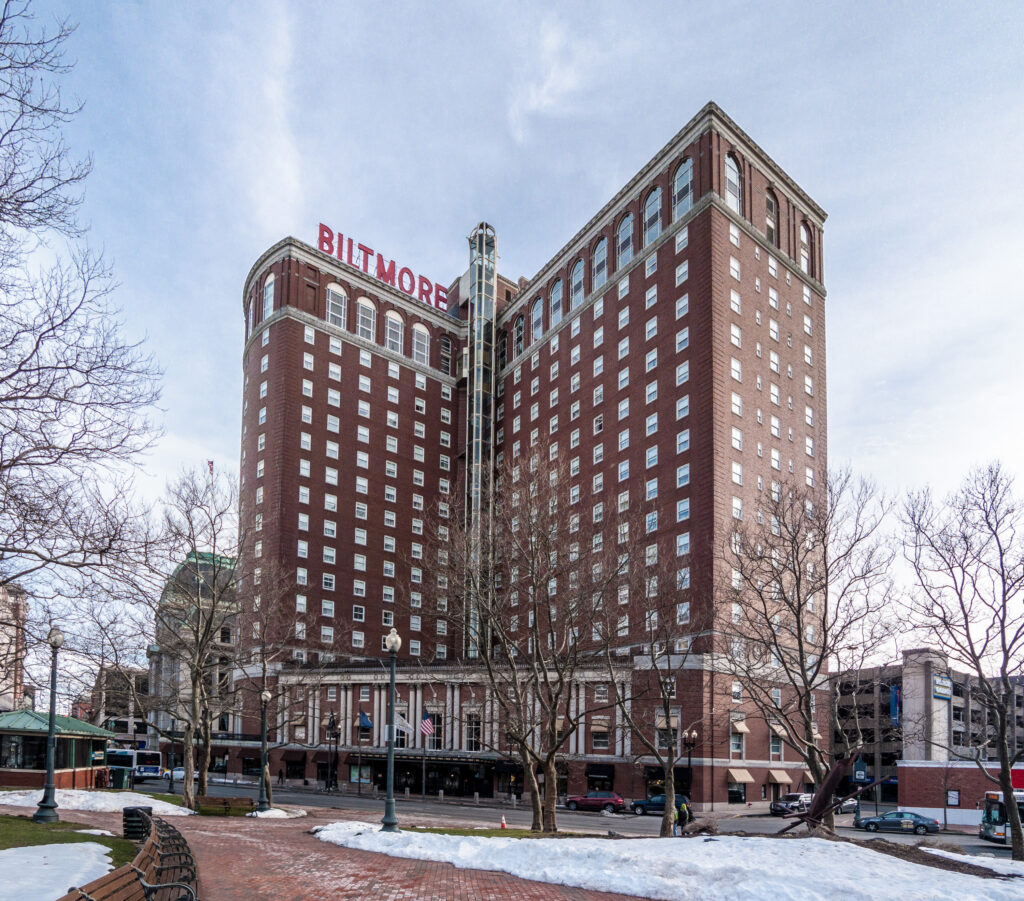
It opened to considerable fanfare on June 6, 1922, and was immediately the second-tallest building in the city after the Rhode Island State House, a distinction it held for six years until the Industrial Trust Tower went up. Today it ranks ninth. It remained the tallest and largest hotel in Providence for seventy-one years, until The Westin Providence was completed in 1993.
Mobsters, Scandals, and a Green Book Listing
For most of the twentieth century the Biltmore was the only luxury hotel in Providence, which meant everyone passed through it. Mobsters, bootleggers, celebrities and politicians frequented its restaurants and bars, and the building served as the backdrop for a long run of Rhode Island political and social scandals. Many of those are documented in Meet Me at the Biltmore, the 2022 book by Amanda Quay Blount chronicling the hotel alongside the city’s own highs and lows.
One fact deserves more attention than the ghost stories usually allow it. The Biltmore welcomed both Black and white guests at a time when racial discrimination in public accommodations was routine, and beginning in 1941 it paid for a listing in The Negro Motorist Green Book, the travel guide published for Black travelers. That is a verifiable piece of the hotel’s record and it sits oddly alongside the lurid folklore.
The earlier article’s Prohibition-era color, including the Bacchante Dining Room and its reputed speakeasy, belongs to local lore rather than to the hotel’s documented history. Providence was a wet city in a dry decade and the Biltmore was where the money drank, so the stories are plausible. Plausible is not the same as proven.
Hurricane Carol and the Eight-Foot Mark on the Lobby Columns
Sheraton Hotels bought the Biltmore in 1947 and renamed it the Sheraton-Biltmore. Seven years later, Hurricane Carol flooded Providence in 1954 and put much of the hotel’s lobby underwater. A plaque in the lobby still marks the high water line, eight feet up the columns. It is the single most visitable piece of history in the building: free, permanent, and genuinely startling once you look up and register how far above your head it sits.
Four Years Dark: The Closure of 1975
The decline was slow and then sudden. Sheraton offloaded the hotel in 1968, along with seventeen other aging properties, to Gotham Hotels, and it became the Biltmore Hotel and Motor Inn. In 1975, amid a flurry of lawsuits over tens of thousands of dollars in unpaid utility bills and back taxes, Gotham was forced to close it. The building then stood vacant for four years in the center of downtown Providence.
This is the period that matters most for anyone interested in why the Biltmore accumulated a reputation. An empty eighteen-story hotel facing demolition is exactly the kind of place a city tells stories about.
Mayor Buddy Cianci backed efforts to designate the building a landmark. A group of local businessmen bought it, among them Bruce Sundlun of the Outlet Company, Michael Metcalf of The Providence Journal, G. William Miller of Textron, and Jim Winoker and Dominic Zinni of B.B. Greenberg Company. Using federal tax credits, they restored the hotel and reopened it in February 1979 as The Biltmore Plaza. The external glass elevator, now the building’s most photographed feature, dates from that renovation and once served all eighteen floors. It no longer runs.
The names kept changing: Biltmore Plaza, A Dunfey Hotel in 1983, then the Omni Biltmore, then fully owned by The Providence Journal, then sold to Grand Heritage Hotels in July 1995 for $7 million and renamed the Providence Biltmore. It went out of receivership on May 31, 2012, to Finard Coventry Hotel Management for $16 million, took a further $10 million in renovations, and joined Curio, A Collection by Hilton, on December 16, 2014. In October 2017 it sold again, to AJ Capital Partners, for $43.6 million, and reopened as Graduate Providence on April 2, 2019. Hilton Worldwide acquired the Graduate brand in May 2024. The neon Biltmore sign survived every one of those transactions.
The Weisskopf Legend and the Rooftop Chicken Coops
The occult material is the reason most people search for this hotel, and it should be handled carefully, because none of it appears in the building’s documented history, its National Register listing, or its published ownership record.
The legend, as it circulates, credits a figure named Johan Leisse Weisskopf with bankrolling a speakeasy at the hotel and with designing the Biltmore as a point of entry for satanic practice into Puritan New England. The story adds hot springs in the basement used for purification rites, waitresses styled as Bacchante Girls, and chicken coops on the roof kept for sacrificial ceremonies. A later change of management is said to have stripped out these features, including the coops and the velvet of the Bacchante Dining Room, and some tellings claim that the renovation agitated whatever was left behind.
Two things are worth stating plainly. First, the hotel was conceived by a chamber of commerce and paid for by public subscription, which is an awkward fit for a building secretly designed as an occult gateway. Second, the frequently repeated claim that the Biltmore inspired the Bates Motel and the Overlook Hotel is not supported by anything in the hotel’s record. Treat the whole Weisskopf cycle as folklore: entertaining, widely repeated, and undocumented.
What People Report Inside the Building
Accounts from guests and staff are the usual grammar of a large old hotel: figures glimpsed in corridors, a sense of presence in the lower floors, and stories of people who are said to have vanished from the building. Reported experiences include:
- Apparitions seen by both guests and staff
- A heavy atmosphere in the basement levels, the focus of the purification-rite legend
- Stories of disappearances linked to the hotel’s mob-era reputation
- A general belief that the 1970s closure and subsequent renovations disturbed something
No named witness, no dated incident and no verified death on the premises underpins any of this. What exists is a reputation, carried forward by ghost tours, television segments and guests who booked a room because they had already read the stories. A building that sat empty for four years and has been gutted and rebuilt repeatedly will produce noises, drafts and sightlines that unsettle people. That does not settle the question. It does mean the paperwork and the folklore should be read separately.
The Biltmore on Screen and on the Page
The hotel has an unusually long screen resume for a regional property. It features prominently in the 2004 Jeff Nathanson film The Last Shot and the 2007 Anne Fletcher film 27 Dresses, and episodes of Showtime’s Brotherhood were shot there between 2004 and 2007. It appears in NOS4A2 on AMC, in the episode “The Hourglass,” which aired on July 26, 2020. In print, it hosts a Brown University reunion in Lauren Weisberger’s The Devil Wears Prada and is mentioned repeatedly in Jeffrey Eugenides’ The Marriage Plot, set at Brown in 1982.
Visiting the Graduate by Hilton Providence
You can book a room. The building operates as an upscale hotel with 292 guest rooms, so the ordinary way to spend a night with the legend is simply to reserve one. It is a member of Historic Hotels of America, the official program of the National Trust for Historic Preservation, and it has been on the National Register of Historic Places since 1977.
If you are not staying, the public areas reward a short visit on their own. Find the plaque marking the 1954 flood line eight feet up the lobby columns. Look at the exterior glass elevator, a 1979 addition that no longer operates. Note the neon Biltmore sign on the roof, kept by owners who otherwise renamed the place. The rooftop Grand Ballroom holds up to 750 guests and offers expansive views over Kennedy Plaza, but it is event space, so access depends entirely on whether something is booked. From 2003 to 2019 the building also housed the largest Starbucks in New England, a fact that gets left out of the ghost tours.
Standard courtesy applies in a working hotel. Guest floors are for guests, staff are not tour guides, and the basement is not open to the curious.
See The Providence Biltmore Hotel for Yourself
Sources
- The Green Book Guides African-Americans to Safety in New England (and Elsewhere)
- Providence Biltmore Hotel History, The Biltmore
- Omni Hotels History | Lane Memorial Library
- Sundlun signs bill to finance convention center
- Registration Statement (Sec (official))
- Wikipedia: Providence Biltmore
Frequently Asked Questions
Where is The Providence Biltmore Hotel located?
The Providence Biltmore Hotel is located at 11 Dorrance Street.
Can you visit The Providence Biltmore Hotel?
The Providence Biltmore Hotel is a place where you can stay overnight. Always follow posted rules and respect private property.
Reader sightings
Nobody has reported anything here yet. If you have been, you would be the first.
Report your own visit to Eight Feet of Floodwater: The Providence Biltmore
How haunted is this place?
Be the first to rate
Leave a Reply