

Reviewed by Josh N · Updated October 5, 2026 · How we verify
Reported Phenomena
- Unexplained noises
- Phantom footsteps
- Disembodied voices
- Shadow figures on tiers
Reported by visitors & local legend. Stories, not verified claims.
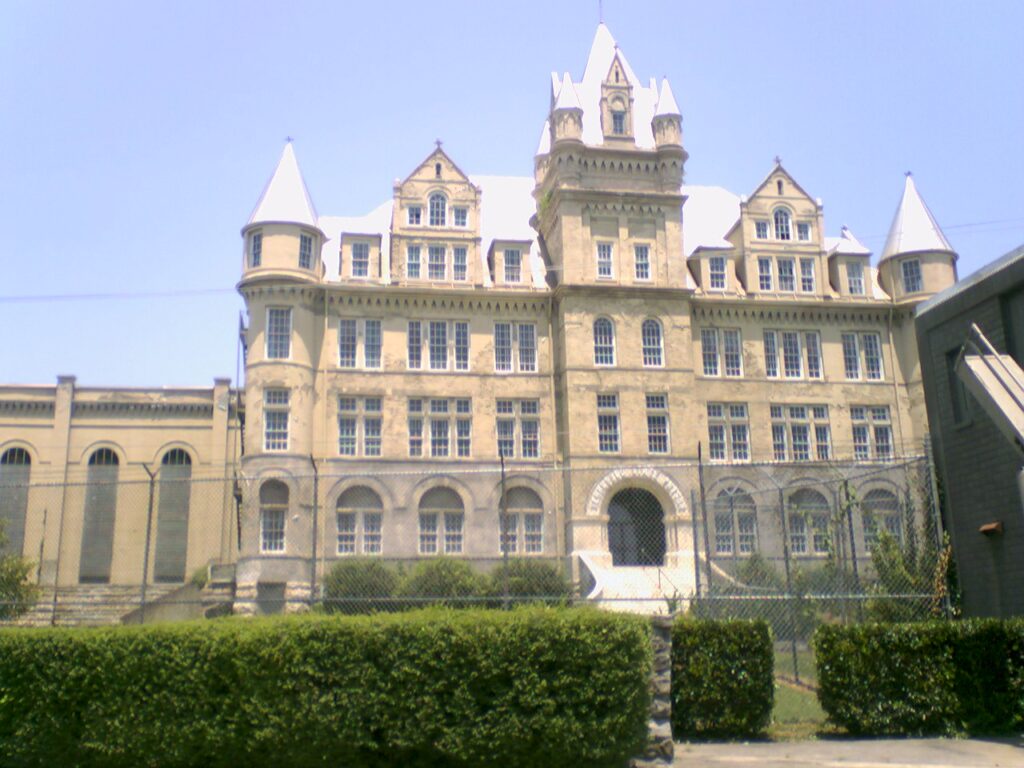
Six miles west of downtown Nashville, on Centennial Boulevard, a Gothic stone fortress sits empty behind a twenty-foot wall. The Tennessee State Prison took its first inmates in 1898 and held them until 1992, and in that span it absorbed riots, mass escapes, fires, and a century of overcrowding that began on the very first day it opened. Nothing about the place is subtle, which is part of why Tennessee has few buildings more thoroughly attached to ghost stories, and few where the documented history is grimmer than the folklore.
Before Centennial Boulevard: The 1831 Penitentiary
The prison on Centennial Boulevard was Tennessee’s second attempt at a state penitentiary. The first stood on what is now 15th Avenue between Church Street and Charlotte Avenue, and it became operational on January 1, 1831, with 200 cells, a warden’s residence, and a hospital. It was the first institution of its kind in Tennessee and in the South, modeled on New York’s Auburn Penitentiary in both discipline and design.
The Auburn system meant silence. Prisoners worked together in workshops during the day with downcast eyes and no permission to speak, then slept alone in separate cells at night. Letters and visits from family were allowed only when necessity demanded. Men and women were both held there, the first male inmate registered in 1831 and the first female inmate in 1840.
In 1863 the Union Army took the penitentiary over as a military prison. The population tripled under occupation and conditions got worse, with convicts leased out to the federal government by the Occupation Government of Tennessee to help repay mounting debts. One of the men held during that period was Mark R. Cockrill, a Confederate sympathizer whose West Nashville property would later be bought as the site for the new prison. After the Civil War the racial composition of Tennessee’s prison population changed sharply: Black inmates went from roughly five percent of the prison’s population before the war to about sixty-two percent by 1869, and in 1868 every female prisoner in the state was an African American woman.
Convict Leasing and the Labor That Paid for the Walls
Every convict was expected to work off part of the cost of his own incarceration. Inmates put in up to sixteen hours a day for meager rations and slept in unheated, unventilated quarters. In the 1840s that labor built part of the state capitol in Nashville. It proved so profitable that the penitentiary turned into a revenue-generating system competing directly against free laborers, and the state leased factory space inside the walls to private companies.
In 1870 the penitentiary struck a deal with the Tennessee Coal, Iron, and Railroad Company that established the first convict-leasing program in the country. Free laborers struck against the company in 1871. The strike failed, but it was the first of many revolts against convict leasing. A women’s wing opened in 1892, and overcrowding soon pushed men and women back in together.
Opening Day, February 12, 1898: 1,403 Men for 800 Cells
The replacement prison was designed as a Gothic, fortress-like structure with 800 small cells, each intended for a single inmate, plus an administration building, offices, warehouses, and factories, all enclosed by rock walls twenty feet high and three feet thick. The plan included a working farm outside the walls, a separate system to keep younger offenders away from hardened ones, and a women’s wing at the northwest corner of the grounds for female inmates who worked the farm.
It was built by Enoch Guy Elliott, husband of Lady Ida Beasley Elliott, a missionary to Burma. Governor Peter Turney had made Elliott chief warden of the old prison, and Elliott used mostly prison labor to raise the new one. Construction ran past 500,000 dollars, not counting the land.
The 800 cells opened to prisoners on February 12, 1898. That same day the institution admitted 1,403 men, nearly double its design capacity, and the overcrowding never really left. The old Church Street penitentiary was torn down the same year, with salvageable material reused in outbuildings at the new site, so pieces of the 1831 building ended up inside the 1898 one.
Escapes, Riots, and Fires Behind the Rock Walls
On August 4, 1902, sixteen prisoners blew out the end of one wing and escaped. Guards shot and killed one of them. Two were never recaptured. A later uprising saw inmates seize the segregated white wing and hold it for eighteen hours before surrendering. In 1907 several convicts commandeered a switch engine and drove it straight through a prison gate. Inmates staged a mass escape in 1938. Several serious fires broke out over the years, one of which destroyed the main dining room. Riots followed in 1975 and again in 1985.
The Tennessee Department of Correction opened the Riverbend Maximum Security Institution in Nashville in 1989, and the old prison closed in June 1992 over overcrowding concerns. As part of the settlement in the class action suit Grubbs v. Bradley, filed in 1982, a federal court issued a permanent injunction in 1993 barring the department from ever housing inmates at the Tennessee State Prison again. That injunction is why the building has stayed empty rather than being reopened in some reduced form.
What People Say Happens Inside
The ghost lore attached to the prison is folklore rather than documented record, and it is worth saying so plainly. Visitors, film crews, and paranormal investigators have reported unexplained noises in the cell blocks, footsteps in empty corridors, voices with no source, and figures glimpsed along the tiers. Popular accounts single out death row, the execution area, and the yard as the places where people claim the most activity, and they describe the apparitions as former inmates and guards. No verified account identifies any of these figures by name, and the institutional history summarized above does not document the executions the stories lean on. What the building does have is a long record of violent death, fires, and misery, which is usually enough to generate stories on its own.
The prison has also been filmed heavily, which spread its reputation well past Nashville. Johnny Cash recorded the live album A Concert Behind Prison Walls there in 1974, with Linda Ronstadt, Roy Clark, and Foster Brooks as guests. Music videos by Eric Church, Cage the Elephant, and Pillar were shot on site. Celebrity Paranormal Project filmed two episodes there, “The Warden” and “Dead Man Walking,” calling the location “The Walls Maximum Security Prison” in both.
Can You Visit the Tennessee State Prison?
Not legally, and not safely. The interior was declared off-limits in 2011 because of asbestos, and the structure was severely damaged by an EF3 tornado during the outbreak of March 2 and 3, 2020. Proposals to turn the site into a museum or tourist attraction have been floated repeatedly over the years and none have come to anything. The property remains state-controlled and closed, so the realistic option is a look at the facade from the public road outside. Trespassing here means a condemned building full of asbestos, tornado damage, and law enforcement that takes the fence seriously.
See Tennessee State Prison for Yourself
Sources
- Tennessee State Penitentiary (Tennessee (official))
- Historic Tennessee State Prison damaged in Nashville tornadoes
- Women and imprisonment in the U.S.: History and Current Reality
- Tennessee State Prison Records 1831-1992
- Photographs, descriptions and rewards of prisoners who escaped from the Tennessee State Prison August 4, 1902 by dynamiting the prison walls
- Wikipedia: Tennessee State Prison
Frequently Asked Questions
Can you visit Tennessee State Prison?
Tennessee State Prison is on private property and best viewed from a distance. Always follow posted rules and respect private property.
Reader sightings
Nobody has reported anything here yet. If you have been, you would be the first.
Report your own visit to 1,403 Men in 800 Cells: Nashville’s Tennessee State Prison
How haunted is this place?
Be the first to rate
Ghost Tours Nearby
 Nashville's Ghost Bus: A True Crime Ride Along Haunted Tourfrom $55
 Haunted Nashville: Ghosts, Legends & Hidden Histories Tourfrom $25
 Haunted Spirits: Nashville's True Crime Ghostly Pub Crawlfrom $38
Affiliate links: BeyondHaunted may earn a commission, at no extra cost to you.
Leave a Reply