

Reviewed by Josh N · Updated September 22, 2026 · How we verify
Reported Phenomena
- Woman in black dress
- Apparition at dusk
- Figure watching reflecting pool
- Fleeting shadows
Reported by visitors & local legend. Stories, not verified claims.
Cincinnati’s oldest surviving park structure is also the backdrop to one of the city’s most notorious killings. The Spring House Gazebo in Eden Park, Ohio, is a brightly painted Moorish bandstand that has stood beside Mirror Lake since 1904, and for most of its life it has been exactly what it looks like: a pleasant place to sit on a hilltop above the Ohio River valley. Then, on a fall morning in 1927, a bootlegger named George Remus chased his wife’s taxi through the park and shot her in front of it. The ghost story people tell here begins with that one verifiable event, which is more than most haunted sites can claim.
Quick Facts on the Spring House Gazebo
- Location: Eden Park, Cincinnati, Ohio, near the center of the park beside Mirror Lake
- Designed by architect Cornelius M. Foster and completed in 1904
- The oldest enduring park structure in the Cincinnati municipal park system
- Built in the Moorish style, with brightly painted arches and ball finials
- Appears in the logo of the Cincinnati Park Board as an icon of the whole park system
- Site of the fatal shooting of Imogene Remus on October 6, 1927
- Free, open, and accessible in daylight hours as part of a public city park
Cornelius Foster’s Moorish Bandstand
Foster’s design has outlasted every other structure in the Cincinnati park system, which is part of why the gazebo ended up on the Park Board’s own logo. The Moorish styling is not subtle: horseshoe arches, strong paint, ball finials on top. It reads as a piece of turn of the century civic showmanship rather than a quiet garden folly, and it was built to be looked at from across the water.
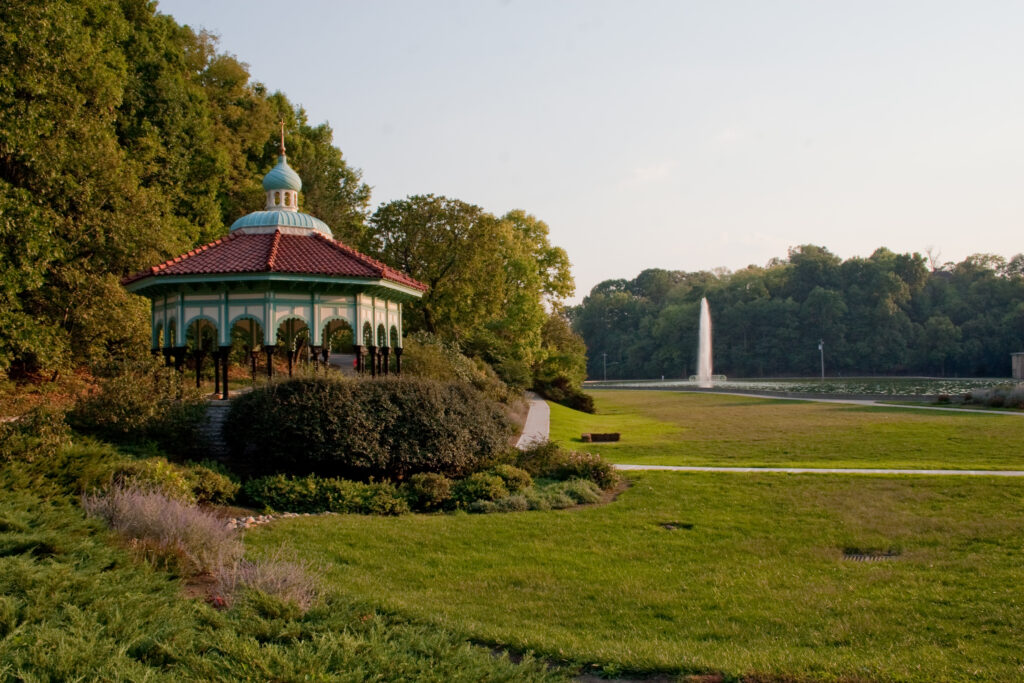
That water is Mirror Lake, a large reflecting pool that began life as a city reservoir and now has a walkway running the whole way around it. The seasonal fountain in the lake throws water 60 feet into the air and can be seen from miles away, because Eden Park sits high on a hilltop. The geometry matters to the ghost story, since the apparition people describe is almost always reported looking out over that pool rather than standing inside the structure.
The Spring That Gave the Gazebo Its Name
The name is a leftover. An older spring house stood on the spot, and the spring beneath it had a local reputation for therapeutic qualities. Cincinnatians carried the water away by the bucketful until testing found the spring contaminated. The well was sealed off in 1912, eight years after the gazebo that replaced the spring house went up. Whatever the water was doing for anybody, it stopped doing it well over a century ago, and the gazebo kept the title.
George Remus, Prohibition’s Cincinnati King
Remus was a popular Cincinnati attorney who became a bootlegger on an industrial scale. In 1925 he was indicted for thousands of violations of the Volstead Act. The jury took under two hours to convict him, and he was given a two year federal sentence, which he served at the Atlanta Federal Penitentiary.
Prison is where the story turns. Remus befriended a fellow inmate and confided that his wife Imogene, whom he adored, controlled his money. The inmate was Franklin Dodge, an undercover prohibition agent. Dodge resigned his job and began an affair with Imogene. Together the pair liquidated Remus’s assets and hid as much of the money as they could, tried to have him deported, and, according to the record of the case, hired a hit man to kill him for $15,000. Imogene sold Remus’s enormous Fleischmann distillery and sent her imprisoned husband $100 out of the multimillion dollar empire he had built.
In late 1927 Imogene filed for divorce.
October 6, 1927: The Killing in Front of the Gazebo
On the morning of October 6, 1927, Imogene was on her way to court for the finalization of the divorce, riding in a cab with her daughter. Remus had his driver chase the cab through Eden Park and force it off the road. He got out, and in front of the Spring House Gazebo he shot Imogene fatally in the abdomen.
Remus then acted as his own lawyer. He argued that he was a man driven mad by his wife’s adultery, thievery, and betrayal, and he was acquitted. It stands as one of the first successful uses of the insanity defense in an American courtroom. The man who committed a killing witnessed in a public park walked out of the trial a free man, which is a large part of why the case has never stopped being retold in Cincinnati.
The Woman in the Black Dress at Mirror Lake
What follows is legend and reported experience, not documented fact. No investigation has established anything unusual at the gazebo, and the accounts circulate as folklore attached to a famous crime.
The story is that the ghost of Imogene Remus haunts the gazebo. Since the shooting there have been reports of a figure in a black dress in and around the structure, gazing out at the reflecting pool nearby. Alleged sightings cluster at a particular time: dusk, in the autumn season, roughly the time of year and time of day that the killing itself belongs to. Visitors also describe fleeting shadows and an atmosphere of unease near the structure, though those reports are vaguer and harder to pin to any source.
Two things are worth holding in mind. The specificity of the sightings, black dress, dusk, autumn, looking at the water, tracks the details of the 1927 story closely enough that expectation is doing some of the work. And a lakeside gazebo on a hilltop at dusk in October, with a fountain running and low light coming off a reflecting pool, is an efficient machine for producing half-seen figures. Neither point disproves what people say they have seen. Both are part of the honest picture.
Visiting the Spring House Gazebo in Eden Park
This is a free, open, public city park, which makes it one of the easier haunted sites in Ohio to see for yourself. The gazebo stands near the center of Eden Park next to Mirror Lake, and the perimeter walkway around the pool gives you the view of the structure that appears on the Park Board’s logo and in nearly every photograph of it. The fountain runs seasonally, so a winter visit gets you the architecture without the 60 foot plume.
If the folklore is your reason for going, the reported sightings point at autumn dusk. Go with the understanding that you are visiting the scene of a real homicide with a real victim, that the gazebo itself predates the crime by more than two decades, and that the building’s main claim to significance is architectural: it is the oldest thing standing in the Cincinnati park system.
Sources
- Find A Gem
- Logo on the Homepage of the Cincinnati Park Board
- George Remus 1876-1937
- Wikipedia: Spring House Gazebo
Frequently Asked Questions
Can you visit Eden Park Gazebo?
Eden Park Gazebo is open to the public. Always follow posted rules and respect private property.
Reader sightings
Nobody has reported anything here yet. If you have been, you would be the first.
Report your own visit to Imogene Remus and Eden Park’s Spring House Gazebo
How haunted is this place?
Be the first to rate



Leave a Reply