

Reviewed by Josh N · Updated September 13, 2026 · How we verify
Reported Phenomena
- Pool apparitions
- Phantom splashing
- Door 13 figure
- Child's laughter
- Woman in white
- Crying infant sounds
- Cold spots
- Flickering lights
Reported by visitors & local legend. Stories, not verified claims.
Tied up at Pier H in Long Beach, California, the RMS Queen Mary has now spent far more of her life as a hotel than she ever did crossing the Atlantic. Stories about Queen Mary ghosts fill her tour schedule and most national lists of haunted places, and in 2008 Time magazine included the ship in its “Top 10 Haunted Places”. The documented history behind those stories is a good deal stranger, and a good deal better evidenced, than the legends that grew up around the ship after she was moored.
Quick Facts on the Long Beach Queen Mary
- Built by John Brown & Company at Clydebank, Scotland, beginning in December 1930 as Hull Number 534
- Launched September 26, 1934; maiden voyage from Southampton on May 27, 1936
- Wartime troopship known as the “Grey Ghost”; carried over 800,000 troops
- Retired by Cunard in 1967 and permanently moored at Long Beach on December 9, 1967
- Listed on the National Register of Historic Places in 1993
- Operating today as a hotel, museum and event venue; formally reopened to the public on April 1, 2023
Hull Number 534 and the Loan That Finished Her
She began as a number. Work on Hull 534 started on the River Clyde in December 1930, stopped in December 1931 when the Great Depression drained Cunard’s finances, and resumed only after the British government granted a loan. The loan came with a condition: Cunard had to merge operations with its struggling rival the White Star Line, and on May 10, 1934 the two companies created the Cunard-White Star Line to run their combined fleet.
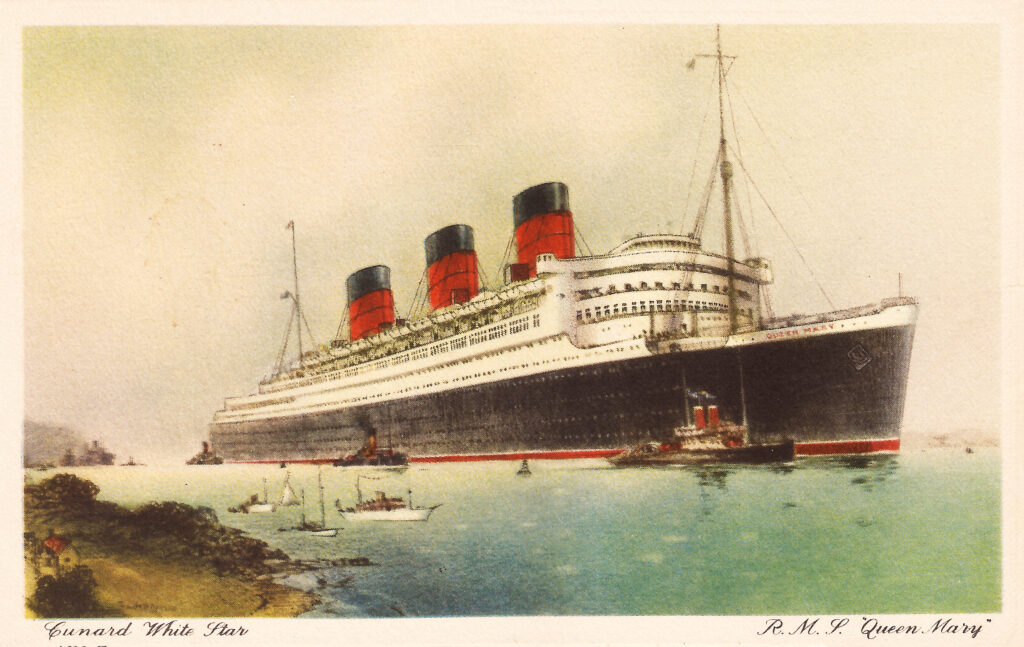
The name stayed secret until the last moment. Cunard traditionally ended its ship names in “ia” and intended to call her Victoria, but when the company’s representatives asked King George V for permission to name the liner after Britain’s greatest queen, he replied that his wife Mary would be delighted. Queen Mary launched Hull 534 herself on September 26, 1934, with eighteen drag chains checking the hull’s run down the slipway into a river that had been deepened and widened specifically to take her.
Fitted out with twenty-four Yarrow boilers and four Parsons turbines, she managed 32.84 knots on trials and sailed from Southampton on her maiden voyage on May 27, 1936 under Sir Edgar Britten, reaching New York on June 1. Critics called her design conservative next to the streamlined French liner Normandie, but she carried more passengers, and in August 1936 she took the Blue Riband. She lost it in 1937, took it back in 1938, and held it until the SS United States claimed it in 1952.
Inside, she carried two indoor swimming pools, libraries and nurseries for all three classes, a lecture hall, paddle tennis courts and dog kennels. She was the first ocean liner fitted with her own Jewish prayer room, part of a deliberate policy of distancing British shipping from the antisemitism of Nazi Germany. Those interiors matter to the ghost stories, because most of them are now gone.
The Grey Ghost: Troopship Years
Converted at Sydney in 1940, the liner had her hull, superstructure and funnels painted navy gray, which gave her the nickname that stuck. A degaussing coil went around the hull against magnetic mines, the carpets and silver went into warehouses, and triple-tiered wooden bunks replaced the staterooms. She ran fast, alone and on zigzag courses, which made her almost impossible for U-boats to catch. Adolf Hitler reportedly offered a bounty of one million Reichsmarks and the Oak Leaves to the Knight’s Cross to any submarine captain who sank her or her sister.
Two wartime incidents stand out. On October 2, 1942, off the Irish coast, she sliced through her escort, the light cruiser HMS Curacoa, with the loss of 338 lives. Under orders never to stop, she steamed on with a fractured stem. Then on December 11, 1942, roughly 700 miles from Scotland, a rogue wave broadsided her in a gale. She rolled 52 degrees and was later calculated to have been three degrees from capsizing with more than 11,000 men aboard.
From July 25 to 30, 1943 she carried 15,740 soldiers and 943 crew, a total of 16,683 people, a record for the most ever carried on one vessel that still stands. Winston Churchill crossed on her three times, listed on the manifest as “Colonel Warden”, and on one 1943 crossing he and his staff worked on the Normandy invasion and he signed the D-Day Declaration aboard. By the end of the war she had carried over 800,000 troops and traveled more than 600,000 miles. Afterward she delivered war brides to Canada before a refit from September 1946 to July 1947 returned her to passenger service.
The 1,001st Crossing and a $3.45 Million Bid
Commercial jets began flying the Atlantic in 1958, cutting London to New York to seven or eight hours, and the liner trade never recovered. By 1965 the entire Cunard fleet was losing money. When both Queens were put up for sale, Long Beach’s bid of $3.45 million beat out Japanese scrap merchants.
On September 27, 1967 she completed her 1,001st and final North Atlantic crossing, having carried 2,112,000 passengers over 3,295,355 nautical miles. She left Southampton for the last time on October 31, 1967 with 1,093 passengers and 806 crew aboard, rounded Cape Horn, and arrived at Long Beach on December 9.
What the Conversion Tore Out
Anyone hunting ghosts aboard should understand how little of the original ship survives below the waterline. The conversion plan cleared almost everything below R deck to make room for Jacques Cousteau’s Living Sea Museum. Out came all the boiler rooms, the forward engine room, both turbo generator rooms, the stabilizers and the water softening plant. Only the aft engine room and shaft alley were spared. The empty fuel tanks were packed with local mud to hold the center of gravity and draft. The funnels were lifted off to extract the scrap, found to be badly degraded, and replaced with replicas. With most of her propellers gone and her machinery gutted, the United States Coast Guard settled a labor dispute by ruling that the Queen Mary was a building.
The second class pool was removed entirely and the space turned over to offices. The first class pool survived but could not be used for swimming after the conversion because of modern safety codes and the compromised structure directly beneath it. It held water until the late 1980s and today can be seen only on guided tours and from the first class entrance on R deck. No second class, third class or crew cabins remain intact anywhere aboard.
The Pool, Door 13 and the Locked Stateroom
The hauntings are a Long Beach phenomenon, not a shipboard one. Claims that the vessel was haunted began in earnest in the 1980s, and one plausible account is that employees originated or encouraged them to spook guests and draw business. They have multiplied ever since.
The best known legends include a stateroom said to be haunted by someone murdered there, a young girl associated with the ship’s former second class pool, and a father who is supposed to have killed his two daughters aboard. Tour guides and guests add to these: apparitions in period swimwear around the pool areas, splashing from empty tiled rooms, a bearded figure near the engine room’s Door 13, a woman in a white evening gown, a child’s laughter in the corridors, the sound of a crying baby, cold spots, and lights that flicker without explanation. None of this is verified. All of it is reported, repeatedly, by people who were there.
No Murder in the Ledger
The central claims can be checked, and they do not hold. There is no historical record that any person was murdered aboard the Queen Mary. Most deaths that occurred on the ship were from natural causes. The stateroom murder, the drowned girl and the father who killed his daughters have no documentary support behind them.
Joe Nickell, a fellow of the Center for Inquiry, attributes the ship’s haunting reputation to pareidolia, to illusory mental images triggered by subjective feeling, and to the daydreaming that comes naturally to workers performing repetitive tasks in a vast, echoing, half empty hull. That explanation does not dispose of every account, and it is not meant to. It does mean that a visitor should treat the tour narration as folklore with a commercial history rather than as a body of evidence. The documented tragedy aboard this ship is the Curacoa, and 338 men, and no ghost tour is required to make that unsettling.
Visiting the Queen Mary at Long Beach
The ship closed in May 2020 during the COVID-19 pandemic, and the city of Long Beach took back control of the property in June 2021 after the leaseholder’s bankruptcy. Engineers had already warned that the hull was vulnerable to flooding, and the deteriorated lifeboats were urgently removed because their weight was cracking the support system along the side shell. Of the 22 boats then aboard, 11 originals were saved for restoration. Limited tours resumed on December 15, 2022, and the ship formally reopened to the public on April 1, 2023.
You can book a room. The hotel occupies converted first and second class cabins on A and B decks, and in 2024 the Queen Mary was inducted into Historic Hotels of America, the official program of the National Trust for Historic Preservation. Guided tours are the only way to see the first class swimming pool. Worth finding while you are aboard is the amateur radio station W6RO in the Nate Brightman Radio Room, staffed by volunteers from a local club during most public hours and named in 2007 for the Long Beach radio amateur who proposed it.
Restoration is ongoing and visible. In February 2025 the city approved an agreement with the Queen Mary Heritage Foundation to fundraise and carry out work on artwork, furnishings and historic fixtures, while structural repairs stay under city oversight. On February 2, 2026, Queen Mary 2 returned to Long Beach for a whistle salute marking the 90th anniversary of the original’s maiden voyage, the first reunion of the two ships in twenty years.
See Queen Mary for Yourself
Sources
- NPS Focus
- National Register of Historic Places Registration Form (Archives (official))
- Historic Hotels of America
- 1938 newsreel of shipyard construction
- Remarkable things you didn't know about the Queen Mary ocean liner
- Wikipedia: RMS Queen Mary
Frequently Asked Questions
Where is Queen Mary located?
Queen Mary is located at 1126 Queens Hwy, Long Beach, CA 90802.
Can you visit Queen Mary?
Queen Mary is a place where you can stay overnight. Always follow posted rules and respect private property.
Reader sightings
Nobody has reported anything here yet. If you have been, you would be the first.
Report your own visit to Door 13 and the Drained Pool: Queen Mary Ghosts, Long Beach
How haunted is this place?
Be the first to rate
Nearby Haunted Locations
- 1Notoriety on Main StreetCalifornia18mi
- 2Pio Pico’s Grand HotelCalifornia21mi
- 3Bloody Christmas 1951 and the Empty Lincoln Heights JailCalifornia22mi
- 4Katie Wheeler Library in Irvine, California History and Haunted ClaimsCalifornia23mi
- 5Haunted History of Yorba Cemetery in CaliforniaCalifornia25mi
- 6Jingling Keys in the LobbyCalifornia25mi

Leave a Reply