Reviewed by Josh N · Updated November 25, 2026 · How we verify
Reported Phenomena
- Spectral figures
Reported by visitors & local legend. Stories, not verified claims.
Walk the shoreline at Riverside in East Providence, Rhode Island, and the Crescent Park Looff Carousel is the one thing that gives the ground away. Everything else is housing, parking and water. For ninety-three years this was an amusement park big enough to be nicknamed the “Coney Island of the East,” and the carousel is the last working piece of it. Visitors sometimes arrive expecting a ghost story to go with a vanished resort of that size. The documented record does not supply one, and this guide will not manufacture one. What the record does supply is a hurricane, a fatal cable, two suspicious fires and a court fight that saved a building.
Quick Facts on the Riverside Amusement Park
Crescent Park operated in Riverside, East Providence, from 1886 to 1979. It covered nearly 50 acres, with Narragansett Bay to the west and Bullock Cove to the southeast. It closed to the public after the 1977 season, undone by financial problems, structural neglect and pollution in the bay. Most of the land is now a housing complex. The Looff carousel survives on site and still runs.
George B. Boyd and the Crescent Shaped Beach
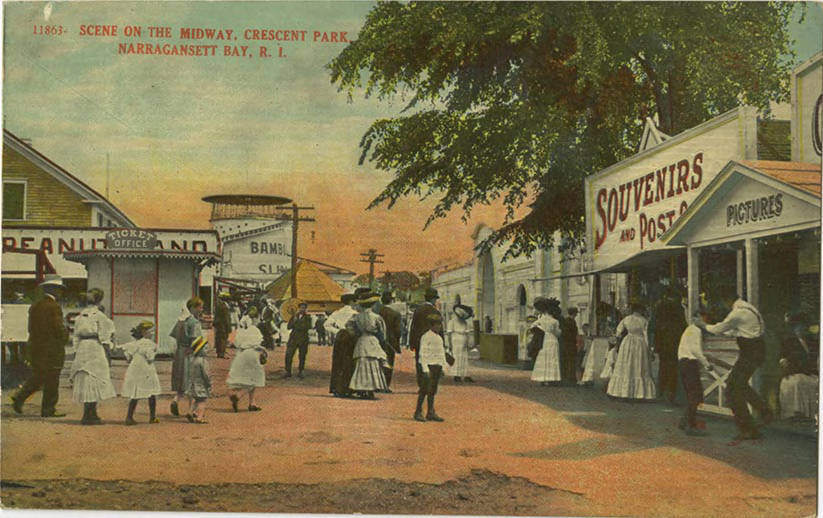
In 1886, George B. Boyd signed a five-year lease on a lot of Narragansett Bay frontage just east of the Bullock’s Point Hotel and built an amusement park there, naming it for the crescent shape of the beach. He later bought the hotel itself, renamed it the Crescent Park Hotel, and turned the whole sprawl into a resort.
Charles I. D. Looff installed the park’s first carousel in 1892, built on pylons over the beach beside a 400 foot pier. It measured 50 feet across, carried three rows of horses and could seat 70 riders. Rail transport began running between Providence and the park around the same time, and steamboats were unloading passengers at the pier. By August 1892 those boats left Providence once an hour on weekdays and every thirty minutes at weekends, and at the park’s height, boats were reportedly landing every 20 minutes.
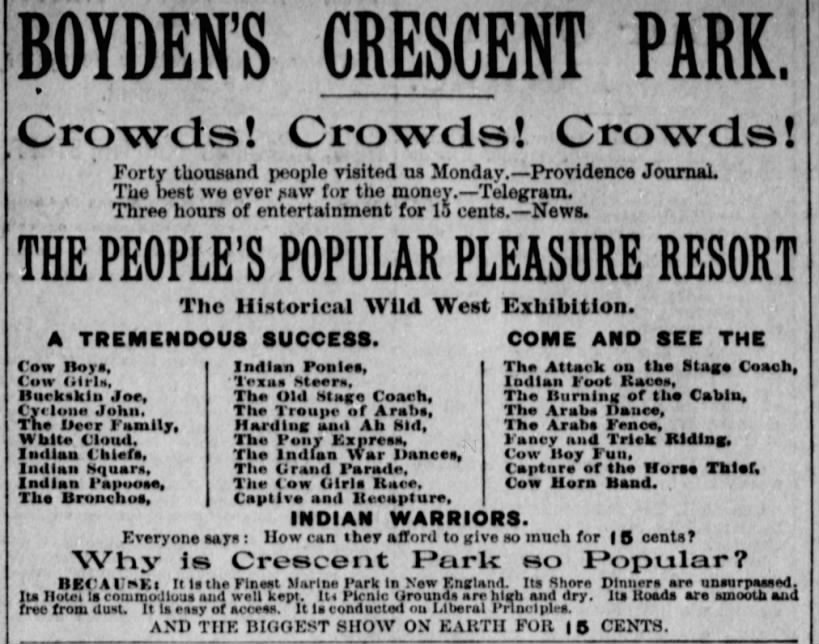
The crowds were enormous. By 1893 Crescent Park was the second most popular amusement park in the state after Rocky Point across the bay in Warwick. In mid-July 1894 the Providence News reported 20,000 visitors on a single Sunday, and estimates over the following years ran between 50,000 and 75,000 across a summer weekend. The 1894 bill of attractions included chariot and hurdle competitions, aerial gymnasts and a Japanese circus troupe from Tokyo, alongside the clambakes, bandstands, roller skating hall, boat rides and midway.
Looff’s Masterpiece and the Factory Beside It
The carousel that still stands is the second one Looff built here, dating to 1895. It carries 61 hand-carved horses, one camel and four chariots, with a German band organ built by A. Ruth & Sohn. It ran on steam before it was converted to an electric motor. Looff also built the park’s first roller coaster, the Flying Toboggan, and in 1900 LaMarcus Thompson put up a scenic railway next to the carousel.
In 1905 Looff moved his carousel factory from Brooklyn to Crescent Park and attached a workshop to the north side of the carousel building. He converted the standing horses to jumpers and used the machine as a showroom for buyers from around the country. He left for Long Beach, California in 1910, handing operations to his son Charles Jr. and daughter Helen. Charles Jr. oversaw the new Shore Dinner Hall in 1914, raising capacity to 2,000, added a wax museum, a roller skating rink and the Rivers of Venice dark ride, and turned the Dance and Music Hall into the Alhambra Ballroom. From 1922 he also ran a radio station, WKAD, from the park grounds. He died in 1925.
The park changed owners repeatedly. It was sold in 1898 to the liquor dealers Jeremiah Sullivan and Robert Tobin of East Providence, passed in 1901 to the Hope Land Company owned by Fred and William Dexter, and later to Beacon Manufacturing, which mortgaged the park to Charles Looff Jr. after manager Randall A. Harrington died in 1918. By the end of the 19th century the Providence Journal of Commerce had called it the largest shore resort under the proprietorship of a single person anywhere in the world.
The Hurricane, the Snapped Cable and the Long Decline
The forty-room Crescent Park Hotel came down in 1935 to make room for more parking. Three years later a hurricane destroyed the pier, several buildings and the southern half of the Comet roller coaster. The Comet was rebuilt the following year, then closed during World War II after a cable snapped and killed a U.S. Navy sailor. That is the only death the record attaches to the park, and the sources give no name and no date beyond the war years.
Arthur R. Simmons, a grandson of Charles Looff Sr., bought the park with Frederick McCusker in 1951 for somewhere between $300,000 and $325,000. They added rides, converted the Alhambra Ballroom into the Sugarberry Lounge and expanded Kiddieland, but attendance kept falling. Polio epidemics kept families away, and the opening of Disneyland made traditional seaside parks look dated. Hurricane Carol destroyed the pier again in 1954 and it was never rebuilt. Developer Melvin T. Berry bought the park in 1966 meaning to modernize it; the Alhambra Ballroom burned down in September 1969, and Berry sold out that same year for $350,000 to Bayside Recreation, a subsidiary of Fairbanks Industries, which immediately announced plans to rezone 15 acres for housing.
Fairbanks filed for Chapter 11 bankruptcy in 1975. HNC Real Estate Investors ran the 1976 season, the property was auctioned that year for $490,000, and Crescent Park was officially shuttered in 1977. The rides were auctioned in 1979 and the City of East Providence paid $500,000 for the land. Part of the midway burned in 1980 in what was suspected to be arson. The Shore Dining Hall burned in 1984. The rest was torn down.
The Crescent Park Five and the Court Fight for the Carousel
When the park closed, the carousel looked likely to go with it. Two groups formed to stop that: Save Our Carousel and the Carousel Park Commission. Five local residents, Gail Durfee, Jobel Aguiar, Richard Lund, Linda McEntee and Robin Peacock, became known as the Crescent Park Five and led the legal challenge to the housing development, represented by attorney Arlene Violet. The courts settled it: the city kept 7 acres of beachfront and 4 acres for the carousel, and Kelly & Picerne took the remaining 39 acres for the low-income housing complex now called Crescent Park Manor.
A $1 million grant from Representative Patrick Kennedy in 1984 paid for a new foundation, a sprinkler system and rewiring, and the carousel reopened in July 1984. The Rhode Island General Assembly named it the “State Jewel of American Folk Art” in 1985, the National Park Service designated it a National Historic Landmark in 1987, and it took the National Carousel Association’s Historical Carousel Award in 1994.
Why Crescent Park Has No Documented Hauntings
Sites like this attract ghost stories by default: a huge vanished pleasure ground, a fatal accident, fires, a ride dismantled, a landscape built over. Local lore of that kind may well circulate in East Providence. It does not appear in the documented history of the park, and nothing in the available record describes an apparition, a sound or an unexplained incident at Crescent Park or inside the carousel building. Anyone who tells you the horses turn by themselves is going beyond the evidence. The honest version is that the place is haunted in the ordinary sense: 93 seasons of noise and crowds on a shoreline that now holds apartments.
Riding the Carousel at Riverside Today
The carousel operates where it always has, on the old park ground overlooking the bay. It has needed steady work to keep going. The National Trust for Historic Preservation gave $150,000 in 2000 for further updates, the ring gear was replaced in 2010, and in 2019 the East Providence City Council allocated $100,000 for repairs after the structure was found to be sinking into the sand and swaying. That work was delayed by the COVID-19 pandemic and the carousel did not reopen until 2022. Given that history, check operating season and hours before traveling. The surrounding housing is private residential property; the beachfront acreage retained by the city is the part open to the public.
Address: Riverside, East Providence, Rhode Island
See Crescent Park for Yourself
Sources
- Rhode Island Industries and Industrial Opportunities. Part 3 of the Annual Report for 1906.
- The Coney Island of the East Coast
- Outings yesterday
- History of Crescent Park
- The Outdoor Amusement Industry – From Earliest Times to The Present
- Wikipedia: Crescent Park (defunct amusement park)
Frequently Asked Questions
Where is Crescent Park Looff Carousel located?
Crescent Park Looff Carousel is located at Riverside, East Providence, Rhode Island.
Can you visit Crescent Park Looff Carousel?
Crescent Park Looff Carousel is open to the public. Always follow posted rules and respect private property.
Reader sightings
Nobody has reported anything here yet. If you have been, you would be the first.
Report your own visit to Crescent Park Looff Carousel: All That Survived in Riverside
How haunted is this place?
Be the first to rate
Ghost Tours Nearby
 Haunted History Walking Tour of Providencefrom $30
 Providence Ghost Tours: Phantoms, Poltergeists, & Pestilencefrom $26
 Real Ghosts of Providence: True Crime Ghost Tourfrom $30
Affiliate links: BeyondHaunted may earn a commission, at no extra cost to you.
Leave a Reply