
Reviewed by Josh N · Updated September 13, 2026 · How we verify
Reported Phenomena
- Spectral figures
Reported by visitors & local legend. Stories, not verified claims.
Nothing about the haunted Big Thicket announces itself from a roadside pullout. There is no cliff, no waterfall, no overlook. One description quoted in the literature of the region puts it bluntly: “It has no commanding peak or awesome gorge, no topographical feature of distinction. Its appeal is more subtle.” What Southeast Texas has here instead is density, water, heat, and a very long habit of hiding people. That combination, rather than any single documented tragedy, is what has given the Big Thicket its reputation as a place where things go missing and stories accumulate.
The orientation is simple enough. The region is an imprecise block of mixed pine and hardwood forest, part of the Piney Woods, conservatively covering all of Hardin County, most of Polk and Tyler counties, and parts of Jasper, Liberty and San Jacinto counties. The National Park Service established the Big Thicket National Preserve within it in 1974, and UNESCO recognizes it as a biosphere reserve. It has historically been the densest forest region in the state.
Eight Ecosystems, or Eleven, Depending on Who Is Counting
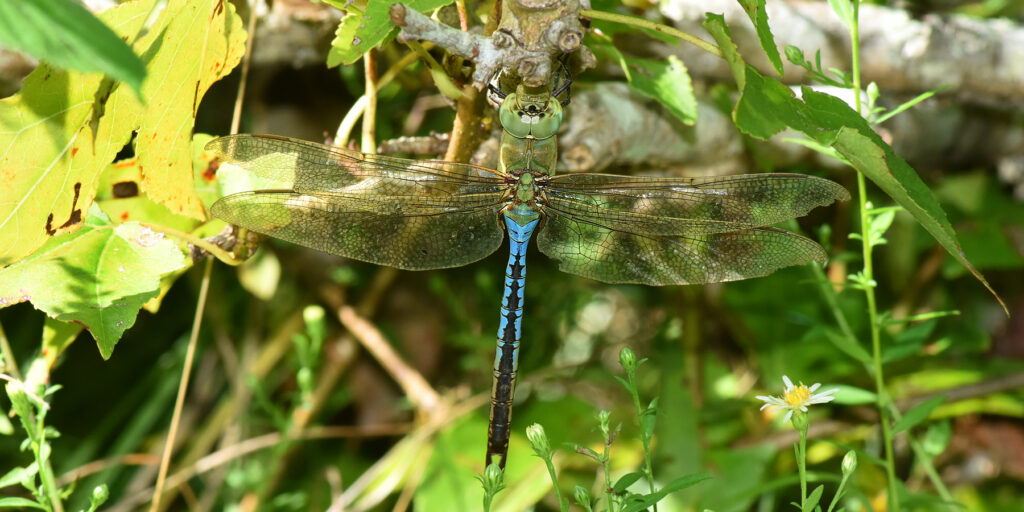
The Big Thicket’s real distinction is biological rather than scenic. Biologists have identified at least eight, and as many as eleven, ecosystems within the area, packed into a relatively small footprint because the soils change so quickly underfoot. More than 160 species of trees and shrubs, 800 herbs and vines, and 340 types of grasses are documented here, along with orchids, ferns and four kinds of carnivorous plants. Well over 500 species of vertebrates occur in the region.
Defining the thing has always been a problem. A biological survey in 1936 drew a boundary around over 3,350,000 acres covering 14 counties. A later botanical study in 1972 settled on a region of over 2,000,000 acres. Two serious attempts, two very different maps. That vagueness is part of why the Thicket has always felt like somewhere you enter rather than somewhere you arrive.
Baygalls: The Black Water That People Mean by “Thicket”
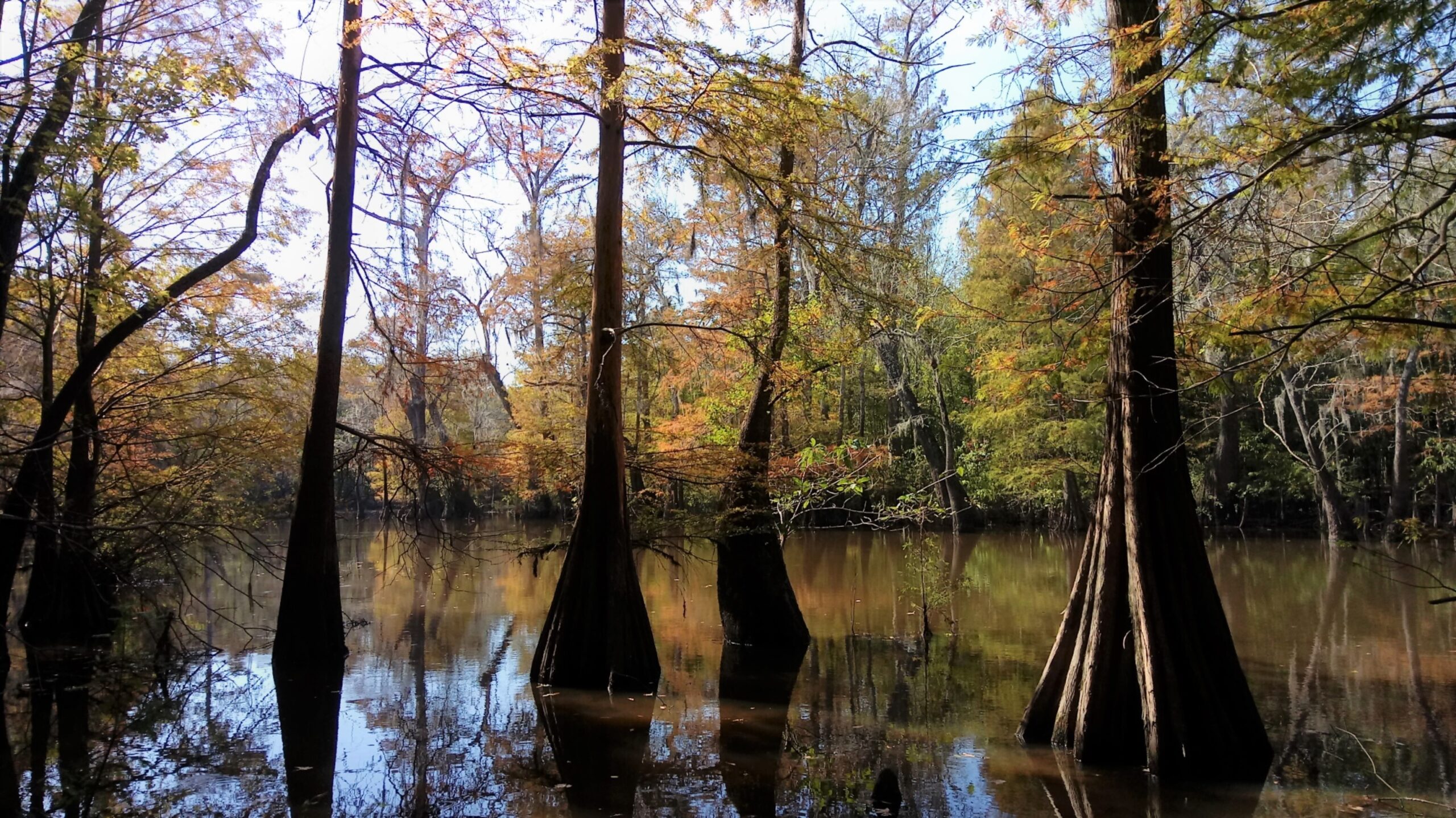
If any one landscape here supplies the atmosphere the ghost stories borrow, it is the baygall. The source description is hard to improve on: “With dense undergrowth and twisted vines growing in stagnant, blackwater, acid bogs, under a shadowy canopy of swamp tupelo and cypress, baygalls are often said to exemplify and epitomize the Big Thicket.” The water is acidic enough that pH levels of 4.5 are common. Some baygalls are no larger than a pool. One author states that the Jack Gore Baygall Unit of the preserve, at 12 square miles, is the largest baygall in the world.
Elsewhere the ground is palmetto flats, where dwarf palmettos grow in dense stands and Spanish moss and resurrection fern hang from the canopy. The best preserved examples lie around Pine Island Bayou and Little Pine Island Bayou, an area known locally as the “Traditional Thicket” or “Hunter’s Thicket.” Cypress sloughs hold standing water year round. Bald cypress typically live for 600 years or more and some are known to have reached 1,200, though nineteenth century logging for a rot-resistant hardwood prized in shipbuilding stripped most of the old giants out.
Hideout Country: Conscription Dodgers, Jayhawkers and Free-Range Hogs
The human record is what gives the folklore its spine. The Atakapa-Ishak occupied the area nomadically, leaving hunting camps rather than permanent towns, and were largely decimated by European diseases in the late eighteenth century. The Alabama-Coushatta, migrating west ahead of European encroachment, settled the northern sections of the Big Thicket by 1780, decades before their reservation was acquired in 1854.
By the mid-nineteenth century the Thicket was sparsely settled by people living off subsistence farming, hunting, and free-ranging hogs and cattle, and it had acquired a reputation as a refuge “for those avoiding conscription in the Confederate Army, Jayhawkers, outlaws, and such.” After the Thirteenth Amendment was ratified in late 1865, emancipated people settled in the Big Thicket and survived off the land, homesteading, hunting and foraging. Some squatted, some bought small parcels, and those plots occasionally grew into communities such as Fresenius in Hardin County. African American residents had specialized in nocturnal, silent, no-gun hunting methods, a skill set that reads like folklore but was practical woodcraft.
182 Bears in a Single Year Around Tarkington Prairie
The Thicket’s most concrete loss is documented rather than rumored. Vernon Bailey, chief naturalist for the U.S. Biological Survey, interviewed a hog farmer and bear hunter named Ab Carter in 1904. Carter described setting out in 1883 with a neighbor to exterminate the bears preying on their free-ranging hogs. That same year, 182 bears were killed within a 10-mile radius of Tarkington Prairie in Liberty County, and the annual hunting continued until 1900, when the last two bears in that area were killed. Field naturalists in 1902 recorded the tail end of it, noting at Sour Lake that bears were “Still common in the swamps near here; a few killed every year.”
Other animals vanished with them. Hog-nosed skunks, red wolves, ocelots and jaguars were all extirpated from their historical ranges here. In 1902 the ornithologist Harry Church Oberholser reported what he considered reliable accounts of jaguars in east Texas, including one killed south of Jasper a few years earlier. The extinct ivory-billed woodpecker once occurred in the Big Thicket. Extremely rare modern bear sightings are believed to be wandering individuals from reintroduction efforts in adjacent areas of Louisiana, which means that a black shape crossing a Hardin County road at dusk now genuinely qualifies as an improbable sighting.
What the Record Supports, and What It Does Not
This is where honesty matters. The material that documents the Big Thicket in detail is geological, botanical, zoological and historical. It records soils, storms, sawmills, censuses and bear counts. It does not record apparitions, ghost lights, hauntings or named spirits. Anyone repeating a Big Thicket ghost story should be clear that it is oral tradition, not documented incident, and that no verified paranormal event in the region is established by the historical record cited here.
What the record does support is a landscape that reliably disorients people. Humidity stays well above 60 percent most of the time and exceeds 90 percent often. Summer highs average 89 to 94 degrees. Floodplains and bottomlands in the south can retain surface water for days and weeks after rain. Five species of venomous snake occur in the area, with the copperhead and the cottonmouth among the most common snakes of any kind. American alligators occur throughout wherever there is sufficient water. Feral pigs, an introduced species, are described as constituting one of the most serious conservation threats in Texas. Under a closed canopy, in black water, in that heat, with those neighbors, a forest does not need a ghost to unnerve a visitor.
Visiting the Big Thicket National Preserve
The preserve is federal land, open to the public, and scattered across multiple units rather than sitting as one continuous block, which is why visitors should plan around a specific unit rather than a single entrance. The Jack Gore Baygall Unit offers the baygall environment at its largest scale. The palmetto flats around Pine Island Bayou are the classic “Hunter’s Thicket” scenery. Roadsides, oddly enough, are recognized by some as a distinct plant assemblage and are a convenient, accessible place to see wildflowers without leaving pavement.
The Park Service actively manages the land rather than simply fencing it. Longleaf pine once dominated the region, and the preserve runs one of the most active prescribed burn programs in the country to bring it back. Around the agency’s 2016 centennial, efforts were made to plant between 100,000 and 300,000 longleaf pines. Conservation here is not new: the push to save the Thicket from the oil and lumber industries began as early as the 1920s with the founding of the East Texas Big Thicket Association by Richard Elmer Jackson.
Go slowly, and go prepared for heat, water and insects. A line quoted in accounts of the region advises that the Thicket “communicates best with solitary wanderers” and that the important trick on the trail is to shift focus from the big scene to the miniscule. Whatever you believe about what else may be out there, that is sound advice for a forest with no view.
Address: Big Thicket National Preserve, Hardin County, Southeast Texas
See Big Thicket for Yourself
Sources
- Sam Houston State University Archives Collection – The Big Thicket
- Nature Lover's Guide to the Big Thicket
- Big Thicket National Preserve (National Park Service)
- Texas Clovis Fluted Point Survey, 4th Update: Further Insights into the Early Paleoindian Occupation of Texas
- The Big Thicket: Pristine Wilderness or Archeologically Understudied?
- Wikipedia: Big Thicket
Frequently Asked Questions
Where is Big Thicket National Preserve Texas located?
Big Thicket National Preserve Texas is located at Big Thicket National Preserve, Hardin County, Southeast Texas.
Can you visit Big Thicket National Preserve Texas?
Big Thicket National Preserve Texas is open to the public. Always follow posted rules and respect private property.
Reader sightings
Nobody has reported anything here yet. If you have been, you would be the first.
Report your own visit to Bears, Outlaws and the Haunted Big Thicket of Southeast Texas
How haunted is this place?
Be the first to rate
Ghost Tours Nearby
 The Dead by Moonlight Ghost Tourfrom $35
 The Ghosts of Houston Tourfrom $30
 Psychos, Killers, and Victims Tourfrom $150
Affiliate links: BeyondHaunted may earn a commission, at no extra cost to you.
Leave a Reply