
Reviewed by Josh N · Updated August 26, 2026 · How we verify
Reported Phenomena
- Spectral figures
- Phantom footsteps
Reported by visitors & local legend. Stories, not verified claims.
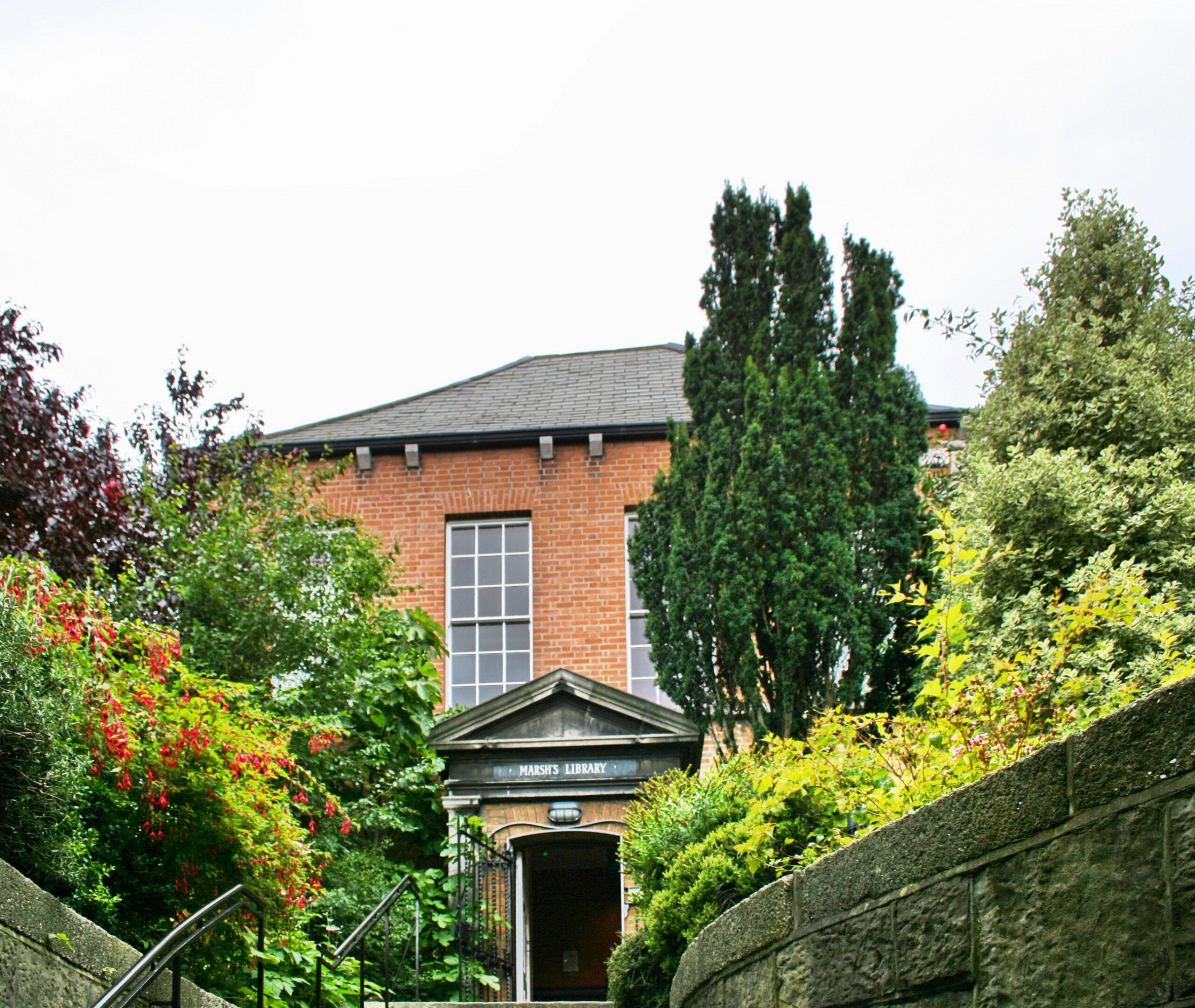
Ask around Dublin’s ghost tours and Marsh’s Library gets named sooner or later: a dim upper gallery, chained readers’ cages, bullet holes in the oak. Anyone hunting the story of haunted Marsh’s Library should know at the outset that the documented history of the place, rich as it is, records no apparition, no death in the reading room and no named revenant. What it does record is stranger and more concrete than most invented hauntings, and it sits in St Patrick’s Close, next door to St Patrick’s Cathedral, in the heart of the city.
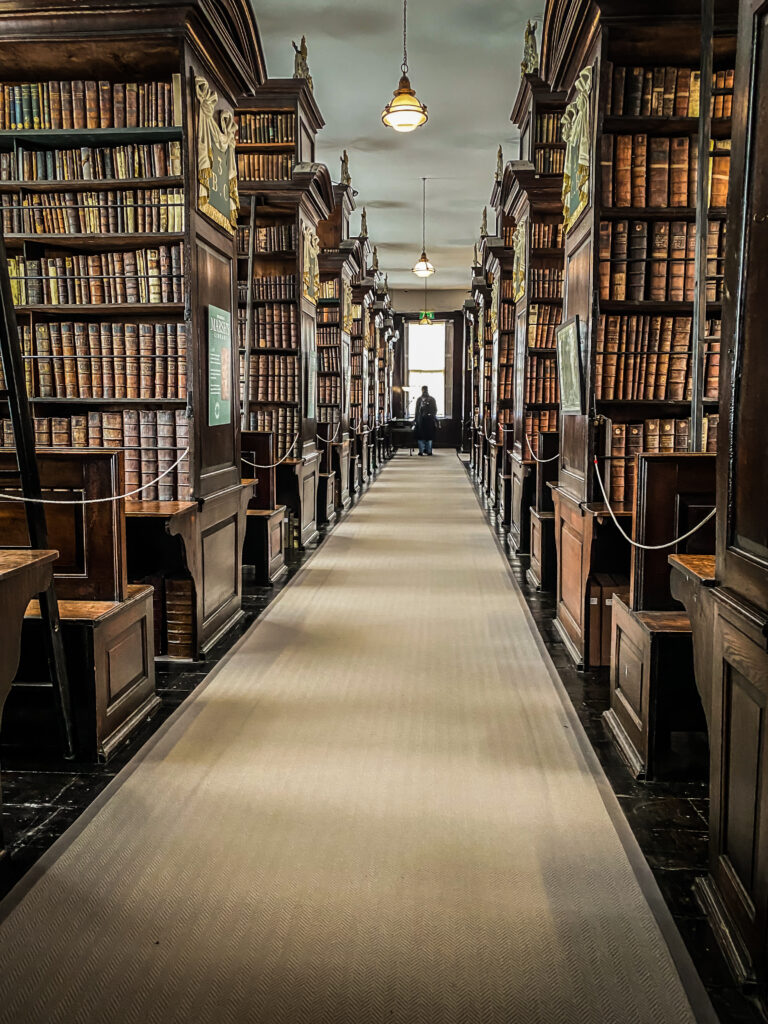
The library is one of the last 18th-century buildings in Ireland still used for the purpose it was built for. Over 25,000 books from the 16th, 17th and 18th centuries stand on the shelves they were placed on, in bookcases of quarter-plained Baltic oak with carved and lettered gables. Roughly 300 manuscripts and around 80 incunabula, books printed before 1501, are held alongside them.
Narcissus Marsh, St Sepulchre’s Palace and the Building of 1703
The library was built for the Most Rev. Narcissus Marsh, Church of Ireland Archbishop of Dublin and formerly Provost of Trinity College, Dublin. A plot belonging to St Sepulchre’s Palace, beside the cathedral, was allocated for it in 1701, and construction began in 1703. The First Gallery and the Old Reading Room appear to have been finished by 1705. The Second Gallery followed in 1708 or 1709.
The design came from Sir William Robinson, then Surveyor General of Ireland. Robinson did not see the job through: after his disgrace for unrelated financial impropriety he returned to England, and Thomas Burgh designed the extension to the library wing and the entrance porch in 1710.
Marsh gave his own books, including the former library of Bishop Edward Stillingfleet, over 10,000 volumes regarded as one of the finest collections in England, which he had bought for 2,500 pounds. When it opened to the public in 1707 it was the first public library in Ireland. The Marsh’s Library Act 1707 vested the house and books in a body known as the Governors and Guardians of the Library, made up of religious and state dignitaries; their successors still oversee the place. Marsh died in 1713 and is buried just beyond the library walls, in the grounds of the cathedral.
Elias Bouhereau, the Huguenot Who Kept the Keys
The first librarian, or Keeper, was Dr Elias Bouhereau, a Huguenot refugee from La Rochelle who fled France after the Revocation of the Edict of Nantes. He donated his personal library too, and it reflects exactly what you would expect of a man who left in a hurry: French religious controversy, medicine, and histories covering the Massacre of St Bartholomew’s Day and the Siege of La Rochelle. If any human presence saturates this building, it is his, and the biographical facts do the work that a ghost story usually has to.
The collection kept growing. Irish manuscripts were bought from Dudley Loftus in 1695, among them an Irish-Latin dictionary of 1662 and royal grants in Ireland from 1604 to 1631. In 1745, John Stearne, Bishop of Clogher, left half his books to the library, the other half going to Trinity. There is a volume of the Lives of the Irish Saints in Latin from around 1400, and 16th-century madrigals.
The Cages, and the Marks of Easter 1916
Two physical details account for most of the library’s uncanny reputation. The first is the three wire alcoves known as the cages, which came into use in the 1770s in response to thefts. Readers with a valuable book were shut in with it. The arrangement looks, to modern eyes, like something out of a gaol rather than a scholarly institution, and it photographs accordingly.
The second is the damage. Some of the bookcases carry bullet holes from the Easter Rising, when Jacob’s Biscuit factory next door was occupied. That is not folklore; it is in the timber. A building that took gunfire during the Rising and kept its original fittings will attract stories whether or not anyone ever saw anything in it.
Separating the Record From the Tour Patter
Nothing in the documented history of Marsh’s Library establishes paranormal activity. No verified account of footsteps, figures or voices appears in the record used for this entry. Visitors who arrive expecting a named ghost are likely to leave with something else instead: a room where the light, the shelving and the smell have not been meaningfully altered in three centuries. Treat anything more specific that you hear at the door as local storytelling until someone produces a source for it.
Visiting Marsh’s Library on St Patrick’s Close
The library is open to visitors for a fee of 7 euro, or 4 euro for students and senior citizens, with free entry for under 18s. Check the official site at marshlibrary.ie/visit for current opening hours, as they change.
Scholars and students can read the books and manuscripts by appointment. Researchers are admitted free of charge but must apply in advance to reserve a place in the Reading Room. The catalogue is online. Exhibitions and occasional conferences run through the year, and the library posts at least one image from the collections daily on Instagram, Facebook and Twitter, which is the cheapest way to gauge whether it is your sort of place before you pay in.
It is not a secret. Tourist numbers reached 16,000 in 2013, 17,000 in 2014 and 23,000 in 2015. Muriel McCarthy became the first female Keeper in 1989 and held the post until her retirement in 2011; the current Keeper, now titled Director, is Dr Jason McElligott. Charitable donations are still recorded in a special ledger that dates back to 1707.
Address: St Patrick's Close, Dublin, Ireland
See Marsh's Library for Yourself
Sources
- Marsh's Library
- Marshe's Library, Dublin (Sir William Robinson), [Archeire, Irish Architecture Online]
- History
- Search what is available in Ireland
- Narcissus Marsh & His Library.
- Wikipedia: Marsh's Library
Frequently Asked Questions
Can you visit Marshs Library Wire Cages?
Marshs Library Wire Cages is open to the public. Always follow posted rules and respect private property.
Reader sightings
Nobody has reported anything here yet. If you have been, you would be the first.
Report your own visit to Bullet Holes and Wire Cages: Haunted Marsh’s Library, Dublin
How haunted is this place?
Be the first to rate
Ghost Tours Nearby
 Haunted Dublin Walking Tourfrom $27
 Dark Dublin Walking Tour: Torture, Murder and Mysteryfrom $27
 Gravedigger 2-Hour Ghost Bus Tour From Dublinfrom $40
Affiliate links: BeyondHaunted may earn a commission, at no extra cost to you.
Leave a Reply