

Reviewed by Josh N · Updated September 21, 2026 · How we verify
Reported Phenomena
- Unexplained footsteps
- Doors opening unaided
- Objects moving
- EVP recordings
- Disembodied whispers
Reported by visitors & local legend. Stories, not verified claims.
Turn a crank in Council Bluffs and a three story drum of cells rotates past a single fixed doorway. That mechanism gave the Pottawattamie County Jail its nickname, the Squirrel Cage Jail, and it is the reason this red brick block in western Iowa draws architecture historians and ghost hunters in roughly equal numbers. Built in 1885 and used continuously until 1969, it is now a museum, and it is one of only three rotary jails left standing anywhere in the country.
Some orientation before the stories. The jail was designed by William H. Brown and Benjamin F. Haugh of Indianapolis, Indiana, at a cost of $30,000, and it went up at the same time as the county’s new courthouse, which was finished in 1888. It was listed on the National Register of Historic Places in 1972 and designated a National Historic Landmark in 2023. Eighteen jails of this type were built in the United States. This is the only one that was three stories tall.
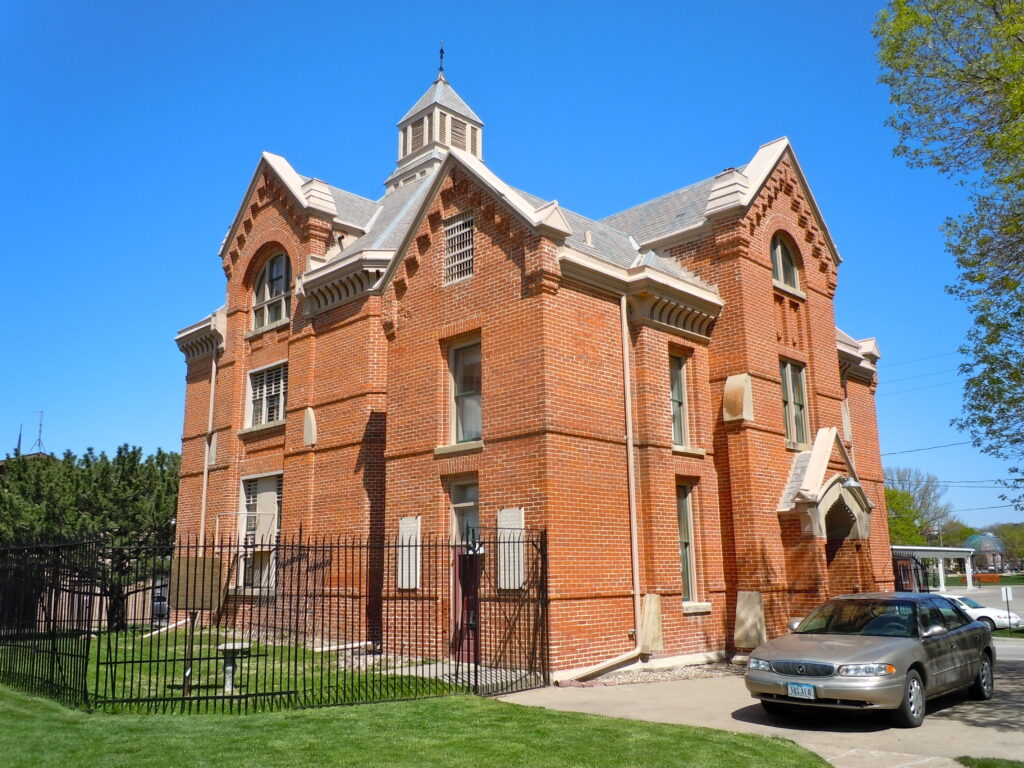
Brown and Haugh’s Revolving Cellblock
The design solved a problem that nineteenth century jailers took seriously: how to hold prisoners securely while keeping contact between prisoner and keeper as close to zero as possible. The answer here was a cage containing a stack of pie-shaped cells mounted on a turntable. Only one opening existed in the outer cage on each level. To reach a particular inmate, a jailer rotated the whole drum until that cell lined up with the gap. Nobody unlocked anything. Nobody walked a corridor past a row of doors.
The front portion of the building was conventional and domestic by comparison, housing offices for the jailer, a kitchen, trustee cells, and separate quarters for women. The rest of the structure is the machine itself.
Efficiency came at a price. A revolving cellblock has a pinch point wherever the turning cage passes a fixed edge, and accounts of the jail’s working years describe limbs caught in the moving bars and injuries that would have been impossible in an ordinary cellhouse. Rotary jails fell out of favor across the country for exactly this reason, along with the obvious difficulty of getting everyone out quickly in a fire.
Four Deaths on the Record, and One Claim That Is Not
The jail is often described as a place of mass suffering. The recorded death count is smaller and more specific than the reputation suggests: four deaths over the building’s years of operation, understood locally as one heart attack, one suicide, and two accidents. That is a grim tally for a county lockup, but it is not a massacre, and it is worth holding onto the actual number when you hear larger ones repeated on a tour or in a video.
One other frequently repeated detail deserves a flag. It is commonly said that the jail was built on the site of a former morgue. That claim circulates widely in local retellings and has become part of the standard patter, but it is not something the building’s landmark documentation establishes. Treat it as lore rather than record.
From County Lockup to County Museum
The building served as the working county jail until its closure in 1969, an extraordinarily long run for a mechanism that most jurisdictions abandoned decades earlier. In 1971 the Council Bluffs Park Board acquired it. In 1977 the county historical society took ownership, and the society has maintained it as a museum ever since. That continuity matters: the cage was never gutted for redevelopment, which is why the rotating drum survives at all.
What People Report Inside the Cage
None of what follows is verified. It is what visitors and investigators say they have experienced, and it is consistent enough to be worth describing plainly.
- Footsteps on the upper floors and in corridors where nobody is standing.
- Cell doors and other doors reported opening or closing without a hand on them.
- Small objects said to shift position between passes through a room.
- Whispers and indistinct voices, frequently recorded and put forward as electronic voice phenomena by groups working with audio equipment.
A few things about the building itself should temper any reading of that list. This is a heavy iron and masonry structure with a rotating mechanism, metal stairs, and a great deal of hard surface. Sound carries and echoes oddly in it, and a partly balanced cage can move. That does not explain everything anyone has reported, but it explains a lot of it, and any honest visit should start from there.
The Jail on Air: Gang Busters and Ghost Adventures
The jail’s strangeness reached a national audience long before ghost television existed. The old time radio program Gang Busters featured it in an episode about escape artist John K. Giles that originally aired on September 29, 1945, in which the fictionalized “Pottawattamie Prison” has impregnable bars and microphones in the walls, and Giles files a key from a sharpened utensil to get out. More recently, in 2019, the Travel Channel series Ghost Adventures devoted a special episode to the building, titled “Serial Killer Spirits: Axe-Killer Jail.”
Visiting the Squirrel Cage Jail in Council Bluffs
This is a genuine museum rather than a ruin or a seasonal attraction, operated by the Historical Society of Pottawattamie County, so daytime visitors can see the rotary mechanism, the pie-shaped cells, and the jailer’s quarters in ordinary light. Hours vary by season, and the society also runs after-hours paranormal events, so check current schedules before you drive in rather than assuming the doors are open.
Go for the machine first. There are only three rotary jails left in the United States and only ever one built three stories high, and standing at the base of that cage explains more about nineteenth century thinking on punishment than any placard will. Whatever else you think you hear on the upper floors is yours to interpret.
See Squirrel Cage Jail for Yourself
Sources
- Historic Pottawattamie County Squirrel Cage Jail
- Serial Killer Spirits: Axe Killer Jail
- NPGallery Asset Detail (National Park Service)
- Wikipedia: Pottawattamie County Jail
Frequently Asked Questions
Where is Squirrel Cage Jail located?
Squirrel Cage Jail is located at 226 Pearl Street.
Can you visit Squirrel Cage Jail?
Squirrel Cage Jail is open to the public. Always follow posted rules and respect private property.
Reader sightings
Nobody has reported anything here yet. If you have been, you would be the first.
Report your own visit to Three Stories of Rotating Cells: Council Bluffs’ Squirrel Cage Jail
How haunted is this place?
Be the first to rate
Leave a Reply