Reviewed by Josh N · Updated February 9, 2026 · How we verify
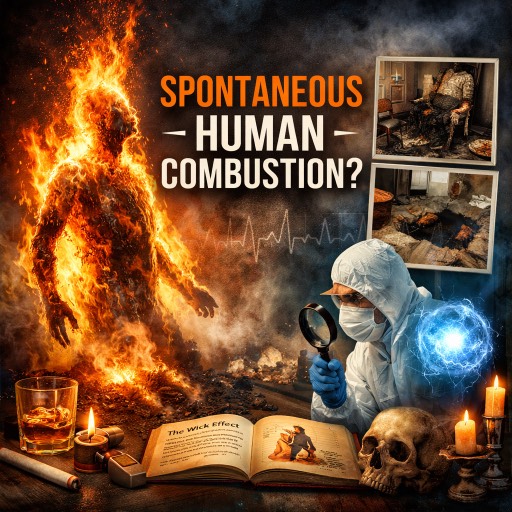
Spontaneous human combustion (SHC) is a controversial phenomenon in which a human body is reported to catch fire and burn without an obvious external ignition source. Accounts typically describe severe burning localized to the body, while surrounding objects such as furniture, walls, or nearby items remain largely undamaged. These cases have been reported for centuries and continue to spark debate among scientists, forensic investigators, and paranormal researchers.
While often associated with folklore and the paranormal, spontaneous human combustion has also been examined through modern forensic science, which offers grounded explanations for many incidents once thought to be mysterious.
Historical Background of Spontaneous Human Combustion
Reports of spontaneous human combustion date back to at least the 17th century. Early European medical journals and newspapers documented cases where victims were allegedly reduced to ashes without nearby fire damage. Before advances in forensic science, these incidents were frequently attributed to divine punishment, internal chemical reactions, or supernatural forces.
The topic gained widespread attention in the 19th century, appearing in medical debates and even literature. Charles Dickens referenced spontaneous human combustion in Bleak House, reflecting how seriously the idea was considered at the time.
Documented Real-Life Cases
The Case of Mary Reeser (1951)
Mary Reeser, a 67-year-old woman from Miami, Florida, is one of the most frequently cited spontaneous human combustion cases. In July 1951, Reeser was found almost completely incinerated in her apartment. Her remains were largely reduced to ash, yet nearby objects—including newspapers and furniture—were only lightly scorched.
Investigators initially struggled to explain how such extensive burning occurred without the apartment itself catching fire. Later forensic reviews suggested that Reeser may have fallen asleep while smoking, igniting her clothing and initiating a slow-burning process.
The Case of John Bentley (1966)
John Bentley, a retired physician in Pennsylvania, was found dead in his bathroom under unusual circumstances. His body was almost entirely burned, except for a lower leg, while the bathroom itself showed limited fire damage. The floor beneath him had burned through, but nearby items remained intact.
Subsequent analysis suggested that Bentley may have accidentally ignited himself using a pipe lighter, with the fire sustained by his clothing and body fat.
Other Reported Incidents
Numerous similar cases have been reported in the UK, Ireland, and the United States, particularly involving elderly individuals living alone. Common factors often include reduced mobility, smoking, alcohol consumption, and synthetic clothing materials.
Scientific Explanations for Spontaneous Human Combustion
The Wick Effect (Most Accepted Theory)
The wick effect is the leading scientific explanation for spontaneous human combustion. According to this theory:
- Clothing acts as a wick, similar to a candle
- Body fat serves as fuel
- An external ignition source (such as a cigarette or spark) starts the fire
- The fire burns slowly at relatively low temperatures over several hours
This process can severely damage the body while producing minimal damage to the surrounding environment. Experimental recreations using animal tissue and cloth have demonstrated that the wick effect is plausible under specific conditions.
Alcohol and Metabolic Factors
Historically, alcohol consumption was blamed for spontaneous human combustion, with claims that intoxicated individuals were more flammable. Modern science has disproven the idea that alcohol-saturated bodies can ignite internally. However, intoxication may increase risk indirectly by impairing awareness, mobility, or the ability to extinguish flames.
Ball Lightning and External Energy Sources
Some speculative theories suggest that rare natural phenomena such as ball lightning could ignite a person. While ball lightning is a documented atmospheric event, there is no credible evidence directly linking it to spontaneous human combustion cases.
Professional and Forensic Opinions
Modern forensic pathologists overwhelmingly agree that no verified case of spontaneous human combustion has occurred without an external ignition source.
- Dr. John DeHaan, a leading fire investigator, has stated that all investigated SHC cases can be explained through conventional fire behavior.
- The FBI and other forensic agencies classify spontaneous human combustion as a misinterpretation of accidental deaths involving fire.
Autopsy results in alleged SHC cases typically show burn patterns consistent with slow, sustained fires rather than explosive or internal combustion.
Paranormal Perspectives and Cultural Beliefs
Despite scientific explanations, spontaneous human combustion remains a fixture in paranormal research and popular culture. Paranormal theorists argue that:
- Some cases lack clear ignition sources
- Fire patterns appear selective or defy conventional spread
- Witness accounts occasionally report strange odors, blue flames, or sudden ignition
These interpretations often intersect with beliefs about psychic energy, poltergeist activity, or unexplained human bioenergy. However, such claims have not been substantiated through controlled scientific study.
Why Spontaneous Human Combustion Persists as a Mystery
The enduring fascination with spontaneous human combustion stems from several factors:
- Visually disturbing and emotionally shocking scenes
- Incomplete or outdated investigations in older cases
- Media sensationalism
- Human discomfort with unexplained death
When modern forensic standards are applied retroactively, the majority of historical SHC cases align with accidental fires involving the wick effect.
Conclusion: Is Spontaneous Human Combustion Real?
Based on current scientific evidence, spontaneous human combustion is not recognized as a genuine phenomenonoccurring without an external ignition source. What appears spontaneous is typically the result of:
- Accidental ignition
- Sustained low-temperature burning
- Misinterpretation of fire damage
While the concept remains compelling within paranormal circles, modern forensic science provides grounded explanations for even the most puzzling cases.
Frequently Asked Questions
Has spontaneous human combustion ever been proven?
No. There is no verified case where a human body ignited without an external source.
Why are surroundings often untouched?
Slow-burning fires fueled by the wick effect can concentrate damage on the body while sparing nearby objects.
Is spontaneous human combustion considered paranormal?
Scientifically, no. Culturally and historically, it is often discussed in paranormal contexts.
Reader sightings
Nobody has reported anything here yet. If you have been, you would be the first.
Leave a Reply