
Reviewed by Josh N · Updated March 30, 2026 · How we verify
The universe feels like it should be crowded. Modern astronomy has confirmed thousands of exoplanets, and NASA says the Milky Way likely holds at least 100 billion planets. At the same time, NASA also notes that we still have no evidence of life beyond Earth. That tension between apparent probability and total silence is the heart of the Fermi paradox, and it is exactly the tension that gives the Dark Forest Hypothesis its grip on the imagination.
Among the many proposed answers to the Fermi paradox, few are as unsettling as the Dark Forest Hypothesis. In simple terms, it suggests that intelligent civilizations stay quiet because broadcasting their existence is dangerous. In this view, the cosmos is not empty because nobody is out there. It is quiet because the civilizations that survive learn to hide. The idea is widely associated with Cixin Liu’s The Dark Forest, the second novel in his Three-Body Problem series, and it has since become one of the most recognizable pop-cultural frameworks for thinking about extraterrestrial silence.
For a paranormal, mystery, or speculative audience, the Dark Forest Hypothesis is compelling because it flips a familiar question. Instead of asking, “Why haven’t aliens contacted us yet?” it asks, “What if silence is the smartest thing any civilization can do?” That shift turns the night sky from a place of wonder into a place of strategic fear. It transforms cosmic loneliness into cosmic caution. And even though the hypothesis is not established science, it remains one of the most powerful thought experiments attached to the search for extraterrestrial intelligence.
What Is the Dark Forest Hypothesis?
The Dark Forest Hypothesis is a proposed solution to the Fermi paradox. The Fermi paradox describes the contradiction between the seemingly high likelihood that intelligent life should exist elsewhere and the lack of evidence that it does. Britannica summarizes the paradox as the gap between the probable emergence of extraterrestrial intelligence and the absence of evidence for it, while NASA frames it around Fermi’s famous question: if the galaxy is old and full of planets, why is the universe still so quiet?
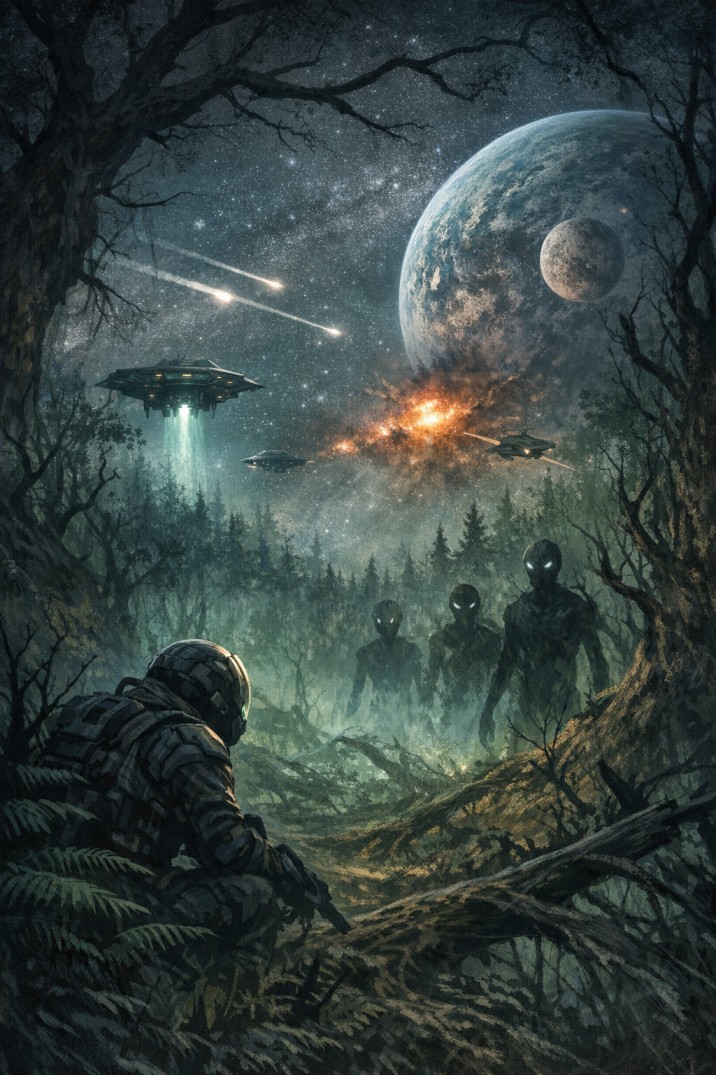
The Dark Forest answer is stark: every civilization is like a hunter moving silently through a dark forest. Nobody knows who or what is out there. Nobody can be sure of another civilization’s intentions. Because the stakes are existential, the safest strategy is silence. The Planetary Society describes the idea as a universe in which civilizations act like silent hunters, and where revealing your location risks destruction.
That does not make the hypothesis a formal, experimentally confirmed law of astrophysics. It is better understood as a philosophical and strategic model layered onto the Fermi paradox: a way of imagining how rational, survival-driven civilizations might behave under deep uncertainty. Its power comes less from observational proof and more from how brutally plausible its underlying logic can seem.
Where the Idea Came From
The phrase most people know today comes from science fiction, not from a mainstream astrophysics paper. Macmillan’s author and book pages identify The Dark Forest as the second novel in Cixin Liu’s Three-Body Problem series. The concept became globally familiar through that trilogy, especially after the series reached a broad English-language audience in translation.
That origin matters because it helps keep the concept in perspective. The Dark Forest Hypothesis is often discussed as though it were a fully developed scientific doctrine, but its modern popularity came through fiction. That does not make it useless. Science fiction often gives people memorable frameworks for thinking about real scientific questions. It does mean, however, that readers should separate “hauntingly persuasive idea” from “demonstrated explanation.”
Why the Dark Forest Hypothesis Feels So Convincing
One reason the idea sticks is that it begins with a real scientific puzzle. NASA’s exoplanet program notes that we have confirmed more than 6,000 exoplanets and that billions likely exist in the Milky Way. NASA’s “Are We Alone?” overview adds that despite this abundance, we still have no evidence of life beyond Earth. The Dark Forest Hypothesis offers an emotionally satisfying answer to that silence: life may be out there, but hidden.
Another reason it feels persuasive is that it relies on uncertainty, not malice. The hypothesis does not require every alien civilization to be aggressive. It only requires that no civilization can safely assume another civilization is peaceful, stable, or permanently weak. In a galaxy where mistakes could mean annihilation, extreme caution can look rational. That logic mirrors deterrence theory on Earth: when the consequences are irreversible, actors may choose secrecy and preemption over trust. This is an inference from the strategic structure of the hypothesis rather than a direct observational result.
It also helps that the idea fits human intuitions about history. On Earth, first contact between unequal societies has often been disastrous for the weaker side. People naturally project that history outward. If technologically superior civilizations exist, many readers assume contact might not look like benevolent diplomacy. The Dark Forest Hypothesis takes that fear and makes it cosmic. This is again a reasoned analogy, not a proven description of extraterrestrial behavior.
The Core Logic Behind the Theory
At its core, the Dark Forest Hypothesis depends on a few simple assumptions.
First, civilizations want to survive. That is the baseline assumption behind nearly every SETI scenario, whether optimistic or pessimistic. A civilization that does not protect its long-term survival is unlikely to remain detectable for very long. This survival framing also appears in debates over active SETI and METI, where researchers weigh the possible benefits and harms of sending messages into space.
Second, civilizations may have limited information about one another. Even if you detect a signal, you may not know the sender’s true capabilities, motives, political stability, or future behavior. The SETI post-detection protocols themselves reflect the seriousness of uncertainty: they emphasize verification, coordinated analysis, and international consultation rather than impulsive response.
Third, if hostile action is possible and defense is uncertain, early detection may matter more than good intentions. In that framework, any newly discovered civilization could be seen as a future threat, even if it appears harmless now. That is one reason Dark Forest thinking tends to produce a grim conclusion: staying hidden may be safer than announcing yourself. The Planetary Society’s summary of the theory captures exactly that fear.
Once those assumptions are combined, silence becomes strategically sensible. If everyone is afraid, nobody speaks. If someone does speak, others may interpret that signal as a risk. The result is not a friendly galactic commons. It is a cosmos shaped by caution, concealment, and the possibility of preemptive violence. As a conceptual model, that is what makes the Dark Forest Hypothesis so memorable.
How It Connects to SETI and METI
The Dark Forest Hypothesis often appears in debates about SETI and METI. SETI refers to the search for extraterrestrial intelligence, traditionally through listening for signals. METI refers to messaging extraterrestrial intelligence, meaning deliberate attempts to transmit messages outward. Those are related but not identical activities.
That distinction matters because Dark Forest logic is much more threatening for METI than for passive listening. If the universe really does punish visibility, then sending strong intentional messages could be riskier than simply observing. SETI’s own public-facing protocol materials reflect caution: confirmed detections should be verified openly, and no reply should be sent until broad international consultation has taken place.
At the same time, the policy literature is more nuanced than the bleakest version of the hypothesis. A 2012 overview in Acta Astronautica concluded that active SETI is very unlikely to be dangerous, though the possibility could not be completely excluded. A 2013 paper on transmissions from Earth argued that deliberate METI broadcasts to date have generally been less detectable than some existing terrestrial emissions, especially powerful radar systems, while also noting the uncertainty around the outcome of any real contact. In other words, the academic discussion is not simply “broadcast and hope” versus “stay silent or die.” It is a debate about uncertain risk.
That nuance is important. Dark Forest thinking can make any transmission sound reckless, but the real-world discussion is not settled. Some researchers argue that Earth has already been leaking radio and radar signatures for decades, which means total invisibility may be unrealistic. Others argue that targeted, intentional beacons are a different matter and deserve international debate before they are sent.
The Biggest Strength of the Dark Forest Hypothesis
Its greatest strength is psychological and strategic coherence. The hypothesis offers a clean explanation for why a galaxy full of potential civilizations might still look silent from Earth. It does not require life to be rare, technology to be impossible, or interstellar travel to be unworkable. It only requires fear, uncertainty, and survival incentives.
That simplicity is powerful. Many Fermi paradox solutions depend on unknown biology, unknown sociology, unknown engineering limits, or unknown timelines. The Dark Forest Hypothesis, by contrast, depends on incentives that humans already understand well. Its assumptions may be pessimistic, but they are not hard to grasp. That makes the theory sticky in the public imagination and especially attractive to readers drawn to existential mystery. This is interpretive analysis based on the sources above.
The Biggest Problems With the Theory
The first problem is evidence. There is currently no direct evidence that extraterrestrial civilizations exist, much less that they are deliberately hiding or eliminating rivals. NASA explicitly notes that we have no evidence of life beyond Earth. That means the Dark Forest Hypothesis is trying to explain an absence with another absence. It may be logically possible, but it is not empirically confirmed.
The second problem is overgeneralization. The hypothesis often assumes that many or most civilizations would reach the same grim conclusion. But real intelligence may vary enormously. Different species, different technologies, and different social systems might produce very different behavior. A single universal rule for all civilizations could be too neat. This is a reasoned critique rather than a direct statement from one source, but it follows from the uncertainty emphasized in both NASA’s overview and SETI policy materials.
The third problem is testability. If a civilization stays silent, we may never know whether it is hiding, extinct, non-technological, uninterested, or simply too distant to detect. That makes the Dark Forest Hypothesis hard to falsify. A theory that can explain almost any silence risks becoming more of a worldview than a testable scientific explanation. This is an inference from the structure of the hypothesis and the observational limits described by NASA and SETI sources.
The fourth problem is that not all communication is equal. The literature on METI points out that Earth already produces detectable electromagnetic leakage, and that past deliberate METI attempts may be less detectable than stronger existing radar emissions. If that is correct, then the line between “hidden” and “visible” is blurrier than Dark Forest rhetoric sometimes suggests.
Does the Dark Forest Hypothesis Mean We Should Stay Quiet?
There is no scientific consensus that humanity should adopt total silence because of the Dark Forest Hypothesis. The official post-detection and response materials from SETI and the International Academy of Astronautics point toward caution, verification, openness in confirmed findings, and broad consultation before any reply is sent. They do not endorse panic, nor do they assume that all extraterrestrial contact would be hostile.
A careful takeaway is this: the Dark Forest Hypothesis is useful as a warning model, not as settled policy. It reminds us that contact questions are not only scientific. They are also ethical, political, and civilizational. Even if the hypothesis is wrong, it forces a serious question: who gets to speak for Earth, and under what level of risk? That question is very real, even if the cosmic hunters remain hypothetical.
Why the Idea Endures
The Dark Forest Hypothesis endures because it is emotionally sharp, intellectually simple, and cosmically terrifying. It takes the Fermi paradox and gives it narrative teeth. A silent universe can feel abstract. A universe full of watchers who survive by staying hidden feels personal. It recasts empty skies as an active warning.
It also lives in the space between science and myth, which is often where the most durable modern ideas take root. The same culture that loves ghost stories, unsolved disappearances, and forbidden places is primed to respond to a cosmic version of the same emotional pattern: the sense that silence may not mean emptiness, but danger. That is interpretation, not a sourced scientific claim, but it helps explain why the concept travels so well beyond astronomy circles.
Final Thoughts
So, what is the Dark Forest Hypothesis really? It is not proof that alien civilizations are hunting one another across the stars. It is not a confirmed rule of astrobiology. It is a disturbing, influential, and strategically coherent answer to one of humanity’s biggest unanswered questions: if life should be common, why does the universe seem so quiet?
Its real value may be less in being correct and more in being clarifying. The hypothesis forces us to confront how little we know about intelligence, survival, trust, and communication at cosmic scale. It warns against naïveté without proving despair. And that is why it remains so powerful: not because it has solved the mystery of the stars, but because it makes the mystery feel darker, sharper, and harder to ignore.
Sources
- NASA Science, Exoplanets
- NASA Science, Are We Alone?
- Encyclopaedia Britannica, Fermi paradox
- The Planetary Society, The Fermi Paradox: Where are all the aliens?
- Macmillan / Tor, The Dark Forest by Cixin Liu
- SETI Institute, Protocols for an ETI Signal Detection
- International Academy of Astronautics, Declaration of Principles Concerning Activities Following the Detection of Extraterrestrial Intelligence
- P. Musso, The problem of active SETI: An overview (Acta Astronautica, 2012)
Reader sightings
Nobody has reported anything here yet. If you have been, you would be the first.
Leave a Reply